44. Tricky Balance:Food Idolatry vs Quick, We Need to Eat!

Actually, food preparation is an important concept to think about. We are currently experiencing a rash of new writings about food- what constitutes real food, why fast food threatens our health and way of life, why we should consider eating only locally grown foods, and why the planet cannot sustain food production for the anticipated population of nearly nine billion people worldwide by 2050. The latter chapters of this book attempt to address our individual connection and ease of access to food in the United States with issues of food and water scarcity in much of the rest of the world. For now, suffice it to say that our present national attention to food is, perhaps, overindulgent, and a fascinating study in human nature. On the one hand, we idolize food and nearly make food practice a religion. Food critics, cable cooking shows, and internet bloggers remind us that the world of food has its own language and rules, where food takes on godlike characteristics. On the other hand, such obsession-compulsion and misplaced fidelity is contradicted by a post-modern and relatively mainstream insistence that food be characterized, above all else, by convenience. We don’t have time to fuss over food, and we just want something to mollify our hunger. Somewhere in this dilemma, most of us find ourselves having to work very hard to find middle ground. We want to provide healthy food for ourselves and our families, and wish we could enjoy it together more often.

Unless you have hired help, procuring, storing, and preparing food is a necessity that someone in the home must meet on a consistent basis. Because nutritional needs across the age span can only be met by regular consumption of a variety of healthy foods, we need to understand the importance of the roles of planning menus, buying food, keeping ingredients on hand, and making time and space for preparing food in ways that are appetizing, wholesome, and, yes, even convenient. What’s more, most of us need to do this on a tight budget.

More often than not, this obligation falls to the adult women of a household, but more and more, men are taking an active role in a family’s food needs. One of my colleagues is a single father with two elementary school-aged daughters. The three of them have a routine for the four nightly meals they share each week. On Mondays after school, they go together to the grocery store. Each girl plans the menu for one meal and dad plans two. They walk and talk themselves through the store, picking out the ingredients they need for their planned meals. Once home, they work together in the kitchen to put foods away and begin the evening meal prep. It is not unusual for some of the girls’ friends to stay for a meal with this little family. Each meal begins with prayer, and dad intentionally guides the conversation around biblical stories and themes while having the girls replay the day’s events. My colleague says that this activity of planning, shopping for, making and sharing meals has bonded the three of them together like nothing else they do. In the process, the girls are learning to shop and compare prices, consider substitutes, store and prepare food, and entertain friends in their home over a shared meal.

No matter who sees to the food provision in your home, that person must be well-versed in the age-appropriate nutritional needs, within budgetary limits, of all of the family members being fed. And, if time is tight, it is a job that requires planning, discipline and creative thinking. In Post #45 we will begin to address where to start.

~Julie A.P. Walton, Ph.D.

Photo credit:  K. Luymes

40. Family Supper-Are You Kidding Me???

With schools starting, this is a great time for us to start Chapter 6:Table Time at Home for Families in this blog book called Come Back to the Table: A Countercultural Call to the Christian Practice of Shared Meals.  Hopefully, the preceding chapters have convinced you that sharing meals, as a distinct Christian practice, should be an important part and pattern of your daily family life.  But, as any parent will tell you, mustering the family around a nightly meal can be a harrowing, energy-sucking experience. This may be particularly true for one-parent families, those in which both parents work full time outside the home or in homes with children with special needs. When I began working full time at our local hospital after years of being home all day while going to school at night, I was not prepared for the panicky rush that the dinner hour became. One of us had to eat and run back out for a meeting or school event. A child forgot to tell you on the way home that she needs a large neon-green poster board (no, the white one in the closet simply won’t do) for an ecology assignment that’s due tomorrow. Your spouse ate a big lunch out today with co-workers and isn’t hungry. Dirty breakfast dishes in the sink need clearing out before dinner preparations can begin. Lunchboxes need cleaning out. You forgot that the frozen ground beef you were counting on for tacos tonight got used up in last week’s meatloaf.  The dog is starving and needs to go out, and the laundry should be started before supper to ensure that the volleyball uniform is ready for tomorrow’s big game.

Is it any wonder that the shared meal becomes sacrificed to the tyranny of more pressing issues? Yet, for me and my family, dinner together around the family dining table remained a critically important activity, and we were determined to make it all work even after I began putting in 45-hour weeks at the hospital around the same time our daughter started middle school sports. This is because the table is where we build family. It is the one time each day we can each sit in a place we call “ours” and, for even twenty blessed minutes, know we are in this life together, and that God is at its center. Miriam Weinstein believes a family evening meal “sort of forces an environment when everyone has to stop and sit down. It creates a boundary when you’re sitting around a table. It’s a designated time. It focuses attention on what is going on here and now between the people around the table. It gives us a specific time to review our day”[1] together.

In our next post we will start to “dig in” to what this kind of family life can look like.

[1] Miriam Weinstein, The Surprising Power of Family Meals: How Eating Together Makes us Smarter, Stronger, Healthier, and Happier (Hanover, NH: Steerforth Press, 2005), p.74. Weinstein’s treatment of the challenges facing the regular family meal is excellent.

13. Cooking: a Lost Practice

I am old enough to have had a middle school home economics course in which we (girls only that is) learned some cooking basics, long before the arrival of “baby” carrots.I remember learning how to make cooked carrots. Within two years, girls were taking shop class and boys were learning to cook, and I was being encouraged in the high school arena to set my sights high, because women were now truly free of the “bondage” of homemaking to be and do anything they wanted.  Today, life skills classes are rare.   Children are more apt to take technology classes than they are home economics.  Ironically, it’s  much easier today to find a recipe on the Internet than it is to follow its directions.

Despite my schooling, however, I was still in for some truly big surprises when I married because I had learned little at home about food preparation.  With almost no money my husband and I had much to learn about how to plan menus and meals on a budget, how to shop specials and maximize coupon values, how to read labels and stretch meals by making soups or casseroles that also served as work lunches later in the week.  Neither of us knew how to use a slow cooker, or make a healthy sack lunch, or can or freeze foods, or how to make traditional foods in healthier ways.  We didn’t even know how much milk to buy for two people, or what kind of milk to get, and had to phone home for directions when making our first pot roast (we promptly received a Better Homes and Gardens Cookbook the next Christmas which is still in use to this day).  We only knew how to make macaroni and cheese from a box, and had no clue how to grow our own garden or process its abundance for year-round consumption.

However, just out of graduate school, starting my first job, and embracing all it meant for a woman to be highly educated and employed, my biggest adjustment came with the realization that I had no sense of what it meant to serve with any shred of self-sacrifice.  After six years of university food service, I had never once considered that getting food on the table for my own family might take time, planning, sacrifice, and a less me-centered attitude. It took me by surprise (shock might be a better term) to discover that having a somewhat food-averse spouse meant that, unless I was willing to live on Cocoa Puffs and frozen pepperoni pizza, the responsibility for getting food from store to pantry, and from pantry to table was going to lie squarely and solely on my shoulders for the next fifty years or more.[1]  I was overwhelmed and far, far under-prepared for this role.  What’s more, income from our entry-level jobs in Washington, D.C. did not bring in enough money for entertaining others at our table once our tithe and living expenses were covered.[2]  Not that it mattered; I did not know how to cook for a crowd anyway.

Not long after, as a new mother, I had no idea what to feed this little girl after she was weaned, nor how much.  Is it true she shouldn’t have cow’s milk until after her first birthday?  What should we do when she refuses a food?  Is there a way to prevent her father’s food aversions from rubbing off on her? How should we teach her acceptable behavior at the dinner table?  What foods are dangerous for toddlers? How in heaven’s name is this supposed to work?  There we were with a baby, living far from our own families.  I thank God for my dietitian friend Eileen at church, whom I kept on speed dial.  She helped set me on a path of understanding about food, foodways, service to my family, and the importance of the shared meal.[3]

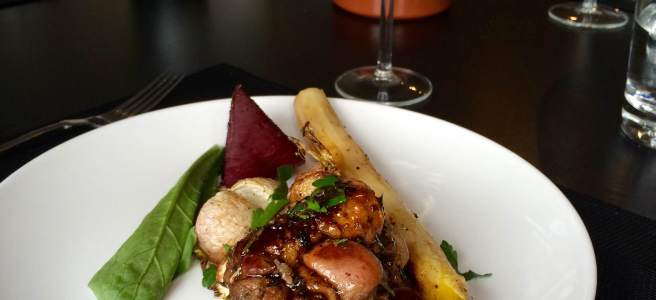
Today, our daughter lives in Paris. As a matter of fact, I am writing this piece from Paris. Just last weekend, the two of us took a Market Cooking class from Chef Lise at La Cuisine Paris.   lacuisine-paris    We toured the local market, selecting duck legs, 3 fine cheeses, beet root, white asparagus, blood oranges, strawberries, turnip, and several fresh herbs to take back to the kitchen-classroom and learn how to make a French feast, including duck a l’orange (see the featured image). It was a wonderful day of sharing the kitchen and table with each other and 6 strangers.

I encourage you to start cooking more often.  Be on the lookout for easy and affordable recipes that you can use when you invite someone to a simple meal.  If you have children at home, involve them in the planning, shopping, and preparation of the meal- it is an important way of teaching them about hospitality and sharing.

In the next post, we will consider how the shared meal (especially the evening meal) as a practice, in particular a Christian practice, has the potential for both common and sacred relationships in the daily lives of believers.

Until then, bon appetit!

~Julie A.P. Walton, Ph.D.

[1] Lest you think poorly of my husband, let me defend him here.  Although he cannot cook and his tastes and texture issues create significant limits, he is the world’s best dishwasher.  We have always shared kitchen responsibilities with unspoken devotion; we share shopping, I prep and cook, he cleans.  It is a beautiful arrangement.  Chapter six will explore these duties in the context of family and food.

[2] I should note here that our apartment in Silver Spring, Maryland was directly across the street from my husband’s office.  As I was not yet working full time, my husband would frequently call around 11:45 a.m. to say he was bringing a coworker home for lunch.  I quickly learned to put out a simple meal that didn’t break the bank, and have always been grateful to him for helping me learn (to unbend really) to trust God to make the “bread and fish” multiply so that there was always more than enough to go around.

[3] As an example, Eileen invited me to drive out to a farm to pick broccoli one day.  I had never known that the “U-Pick” concept extended beyond apples, strawberries, and Christmas trees.  When I got home with about eight pounds of broccoli I had to undertake a crash course in prepping it all for the freezer.  We were graced with months of fresh farm-to-table and highly nutritious broccoli that winter.  It is still a family favorite to this day.