33. Glad Hearts Eat Together!

In the first chapters of the book of Acts, Luke picks up exactly where he left off in his gospel, reviewing Jesus’ last moments on earth eating with and teaching the disciples before ascending to heaven. The disciples, now referred to as apostles by Luke, return to Jerusalem after Jesus’ ascension to wait for the promised baptism by the Spirit. They spend the next fifty days praying with believers (in Acts 1:15 Luke says there were about one hundred and twenty gathered), until the day of Pentecost. From this point onward, the fellowship of baptized believers grows under the preaching of Peter and the apostles.

“They devoted themselves to the apostles’ teaching and to the fellowship, to the breaking of bread and to prayer. Everyone was filled with awe, and many wonders and miraculous signs were done by the apostles. All the believers were together and had everything in common. Selling their possessions and goods, they gave to anyone as he had need. Every day they continued to meet together in the temple courts. They broke bread in their homes and ate together with glad and sincere hearts, praising God and enjoying the favor of all people. And the Lord added to their number daily those who were being saved” (Acts 2:42-47).

This passage in Acts 2 contains several important clues about how “church” may have operated in those earliest days. Obviously, there were no church buildings or church staff, no pews, fellowship hall, or Sunday school rooms for the first Christians, and no trained clergy, except possibly for converted Pharisees and scribes with a schooled understanding of the law. There was no set liturgy, no New Testament gospels or letters yet written, nor any prayer books or hymnals to use. In other words, the early church had no formal infrastructure, and no real recognizable identity through a set, much less standardized set of Christian practices across the Roman Empire.

From a sociologic and historic perspective, nascent social undertakings often rely heavily on the infrastructure already present in society at large. For example, when we plant a new church today, it is common to meet in an existing school or office building otherwise empty on Sundays. Likewise, when a new belief system is born, it will often be imbued with elements of the culture out of which it emerges, and Christianity, born in Jerusalem during Roman occupation in the Hellenistic era is no different.

We know from Scripture that these earliest Christians met together on a consistent basis. In Jesus’ day there were two main ways people regularly met together, at the temples (Jewish or pagan), and at meals. In other words, worshipping together and sharing meals were common social practices of that era. Peter and the apostles prayed at the temple and taught in the temple courts where Jewish religious teaching in Jerusalem had always been done, until this became increasingly difficult because of the opposition of Jewish leaders. This leaves the shared meal as the one standing social practice by which early Christians could meet together in small groups.

We should ask ourselves why we don’t do the same.

~Julie A.P. Walton, Ph.D.

32. Jesus Lives-to Eat Again!

Post #31 finished up this book’s chapter about the meals of Jesus during his earthly life.  In this next chapter, we shift our focus to the meals  (and food fights!) of the first Christians.

Luke ends his gospel with two fascinating scenes. First, two of Jesus’ followers, having walked with a unrecognizable Jesus along the road to Emmaus, invite him to stop and share a meal. Again, Jesus steps in to act as host by taking the bread, blessing it, breaking it, and giving it to the other two, who immediately recognize this “stranger” as the risen Jesus. This act, of taking, thanking, breaking and giving bread is the same thing Jesus did when he fed the 5,000, and again at his Last Supper. It’s a repeated practice at meals designed to sear into our minds that Jesus is always with us as host, provider, and savior. In other words, regularly breaking and eating bread together is a practice meant to make us think of Jesus, to recognize his presence at our meal fellowship, and to remember his incomprehensibly great love for us.

The Emmaus scene ends with the two followers running back to Jerusalem to report to the eleven disciples that Jesus lives, and that they didn’t recognize him until he broke the bread. And, as the thirteen of them excitedly replay the story amongst themselves, Jesus suddenly appears right in their midst. The disciples, already on an emotional roller coaster are terrified (after all, it is still Sunday, less than twenty four hours since the empty tomb was discovered). So Jesus shows them his pierced hands and feet to try and calm their fears, and then asks, “Do you have anything here to eat?” (Luke 24:36-41).

Here stands the risen Christ alive, in the flesh, asking for something to eat, because the first thing he wants is to celebrate with them in table fellowship! This is Jesus’ way of convincing them he’s not a ghost, and this turns their fear into joy. In accepting and eating a piece of broiled fish, Jesus, who until now had always assumed the role of host at meals, accepts the hospitality of the disciples. First bread at Emmaus, then fish in Jerusalem- this is an echo of Jesus’ shared meal on a remote hillside when he commanded the disciples, “You give them something to eat.” (Luke 9:13)

Jesus leaves us with a model for our own meal ministry; Jesus will always be present at our meals, asking if we have anything to eat, and expecting us to be host to the itinerant, hungry, fearful, and doubting people in our world. By sharing a simple meal at our table, we break bread with others so that they too might recognize Jesus.

Next time, in Post 33, we will begin to scour Acts for clues about the meals of the early Church.

~Julie A.P. Walton, Ph.D.

(Featured image: emmaus-art-3.jpg from http://heartofgaemmaus.org)

29. Meals for Prodigals

Luke records several parables in chapter 15 about the lost condition of sinners and the redemption available following repentance. These culminate in the parable of the prodigal son, where Jesus describes a famously wayward son who returns home hungry after squandering his inheritance. By rights, his father need not take him back. But, this father has been watching for his son’s return, and sets in motion a grand feast to celebrate the son’s reinstatement in the family.

Here is a feast to note. When a lost loved one returns home with a changed heart, when s/he seeks forgiveness, our natural response should be one of joyful celebration through feasting. It’s a recurring theme throughout the meal stories in the Gospel of Luke; repentance, reconciliation, and redemption are available to all. Our place at God’s table is waiting for our change of heart, which is the catalyst leading to a reformed and responsive life, reenergized by eating the spiritual food Jesus provides.

Not long after preaching the “lost” parables, and getting closer to his last days in Jerusalem, Jesus finds himself in Jericho, peering up into a sycamore tree at Zacchaeus, the town’s chief tax collector. Looking him in the eyes, Jesus doesn’t bother asking Zacchaeus what he wants. Instead, Jesus tells Zacchaeus that he plans on staying at his house. One minute Zacchaeus is “lost” among the tree’s leaves, and the next he is jumping down with rejoicing. Immediately, another meal with “sinners” is in the works. It must have been a very happy meal indeed, marked by a festive welcome unlike any Jesus had experienced in the homes of the Pharisees.

Just imagine:  Jesus coming up to you and asking you to set a place at your dining room table for him!  What’s the menu?  Who else would you invite?  What would the table conversation be like?  Believe it or not, the day is coming when you WILL be seated at the wedding feast table with Jesus the bridegroom. Jesus the lamb of God.  The bread of life.  The Lord of your life.  Wow!  Jesus welcomes you, the prodigal, you, the sinner, with open arms, and the first order of business is a shared meal!

18. The Day Jesus Needed Tampons

Allow me to share a true story, one that dramatically changed how I think about the shared meal. I was at a conference in Seattle in June, about a year after starting to research the Christian practice of the shared meal. On this particular night a colleague and I headed down to the wharf to get some fish and fries. While getting on line at the outdoor fish stand, we were approached by a homeless woman for money for feminine products. A colleague replied,

“No.”

But, I was intrigued by the woman’s request because it had never once occurred to me how a homeless woman would manage such a monthly (and expensive) need. This woman was relatively young, maybe in her early thirties. One of her front teeth was chipped, and her skin showed obvious signs of vitamin deficiency, likely related to alcohol abuse. Not wanting to give her money for alcohol, I instead said,

“Well, let’s go to the drugstore and I will buy you what you need.”

The woman immediately argued that it was thirteen blocks to the nearest drugstore, and she’d just take the money. So I looked her right in the eyes and said,

“No, I am sorry. I can’t give you any money.”

She swore at me and walked away, and I found myself asking to her back,

“Wait a minute! Are you hungry?”

The woman stopped in her tracks, turned back toward me with a question on her face (my colleague did too), and I said,

“I am getting some fish and fries for supper. Do you want some supper?”

She eyed me with a suspicious hope and I managed to hold her gaze. Wrinkling up her forehead she said,

“Well, can I have a Coke too?”

I replied, “Sure. You can have fish and fries and a Coke, same as I am having.”

She came toward me then, and touched my arm with her filthy, scaly hands, and I all but recoiled from this physical contact that violated my “personal space”.[1] She quizzed me again,

“Can I have the biggest Coke they got?”

“Sure, the biggest Coke you can get”, I said.

By now we were next in line. I told her to go ahead and order, while informing the vendor that her order was on me. With great flourish and glee the woman ordered fish and fries and “the biggest Coke you got,” while ferociously tearing at the napkin dispenser to stuff napkins in her pocket. As I stepped up to make my order and pay, she turned to me, put her reeking arm around my shoulder and said,

“Lady, you made my day. You made my whole month. Thank you.”

And she skipped down the line to fill her Coke cup. Her order came up, and she snatched at the sack of food wondering aloud if she could get some ketchup. I motioned to the tables overlooking the harbor where ketchup bottles stood ready for the diners, but she said,

“No, no, no. I need them little packets of ketchup. Lots of ‘em.”

So the vendor gave her a fistful of ketchup packs while I filled my drink, looking around for my colleague amongst the tables, and, I admit, consciously hoping this woman would be on her way. And that’s what happened- she bounded off with her food and drink and napkins and ketchup. My colleague commented that I was an easy target while I sat down congratulating myself that the situation had turned out so well. I went to bed that night content that God had placed a need in front of me and I had responded with kindness and generosity- I had loved my “neighbor” in an uncomfortable situation.

I was awakened by a voice around 2:00 a.m. I remember sitting up in the bed, frightened that someone had broken into the room. I confirmed that I was awake, not dreaming and then felt a shadow at the end of the bed. There was Someone in my room; Jesus was here, and I had nowhere to hide. But very gently, he repeated the question with which he’d awakened me,

“What was her name?”

“What? Whose name?”

And the Lord distinctly and forthrightly said,

“What was the name of the woman at the fish stand?”

Then he was gone. And my heart welled up with an overwhelming wretchedness. I had bought a hungry woman some food. But, even after more than a year of study on the Christian practice of the shared meal, I had failed to dignify the woman’s existence by asking her name, and inviting her to sit with me for supper. I had not once thought to pray with her or for her, to introduce her to the Jesus I know and love. I had helped a hungry person by sharing some money. But I had not shared a meal or had any serious conversation about God and his love with this distressed woman whose hunger was deep. That night I learned that while hunger comes in all shapes and sizes, and that non-judgmental love for the stranger is itself a hard and strange calling, we are called nonetheless to attend to the needs of those Jesus places in our path, even when it means sharing an evening meal at close quarters around a table with someone who suffers from addiction and needs a bath almost as badly as she needs Christ. I gave her a meal, but I neglected to tell her about the coming Feast.

I tell you this story because we all need to think about why our participation in Christian practices like the shared meal may take much practice. It is precisely through these shared practices Christians can “more fully…understand their shared life of response to God’s active presence in Christ and to embody God’s grace and love to others amid the complexities of contemporary life”[2] and how they can help us think “about how a way of life that is deeply responsive to God’s grace takes actual shape among human beings.”[3] What is even more important, the Seattle story unveils a truth about who is welcome at God’s Table. “Jesus intentionally ate with those at the margins…as an act of compassion but also of empowerment.”[4]

Shared meals afford us all these things: helping us understand our shared lives together, responding to God’s presence, embodying his grace, and recognizing and empowering the marginalized. Thus, the shared meal constitutes a critically important practice we should not ignore, because they provide a regular opportunity for becoming “deeply responsive” to God’s provision, nourishment, and grace. If you have been hungering for a change in the way you live your life, start at the table. Invite. Prepare. Provide. Sit. Eat. Relax. Converse. Listen. Invest in the other lives at the table. Pray together. Read Scripture. Forgive. Reconcile. Be forgiven. Laugh. Cry. Share. Live. And, God himself will be amongst you to confirm its rightness. It is time to clear your table of mail and projects and get started. And, the best place to start is with Jesus himself, and the meals he shared.

[1] I say “personal space” because it is a cultural norm in North America to be physically “distant” from strangers, giving us the “power” to decide who is invited into that space. The Pharisees of Jesus’ day weren’t any different-they kept the “unclean” away and criticized Jesus for doing the opposite. I admit to being a little germ-conscious, so hugs, and touching, and handshaking have always made me uncomfortable. You can ask my friend Joy, the hugger. After five years I can now hug her back with enthusiasm. These things take practice!

[2] Dorothy C. Bass, “Introduction,” in Practicing Theology: Beliefs and Practices in Christian Life, ed. Miroslav Volf and Dorothy C. Bass (Grand Rapids: Wm. B. Eerdmans, 2002), p. 7.

[3] Craig Dykstra and Dorothy C. Bass, “A Theological Understanding of Christian Practices,” in Practicing Theology: Beliefs and Practices in Christian Life, ed. Miroslav Volf and Dorothy C. Bass (Grand Rapids: Wm. B. Eerdmans, 2002), p. 15.

[4]Smith, G.T., A Holy Meal: The Lord’s Supper in the Life of the Church, p. 77.
 

15. Evening: the New Day Starts Now

The truth is, we find getting together at the table (even just getting the food into the house) a practical challenge in a today’s world. In Eden, God invited Adam and Eve to eat all sorts of plant life.  God fed them well.  There was, of course, that one forbidden food.  Now, forbidden foods have a way of not being good for us.  A diabetic must avoid sweets.  Walnuts or shrimp are life threatening for people with a nut or seafood allergy.  But, Adam and Eve, driven by what Griffiths calls the vice of curiosity, made a fatal mistake for all of Creation.[1]  The intimacy we had with God was broken, and not until Jesus came- eating and drinking, suffering, dying, rising, forgiving our sins, and inviting us to the feast of the Lamb-did we have any hope for restored relationship with God.

The table, then, at home and at church (table and Table) is the place of invitation, nourishment, acceptance, forgiveness, gratitude, learning, growing, and going.  It is as much about relationship building and disciple-making as it is about food.  In both instances, we come hungry for food and companionship with one another and with God.  In both instances, we are invited and fed by something or Someone who had to die for us to live.  God’s Word fills us.  In both instances, we leave with a co-mission to go and do likewise for our neighbor.  And, in both instances, we can stand with Jesus and proclaim “that we live by ‘every word that comes from the mouth of God,’ because that word has everything to do good things, with real nourishment for body and soul.  With the eyes of faith, Christ comes to be known as that word, incarnate, embodied, the Word of God, present then and now.  Christ is then the invitation, the way we have of re-creating that living relationship of intimacy with God that the original humans knew in the garden.”[2]

 Rethinking the Practice of a Shared Evening Meal

I believe we need to be at the table each night, fully present and alive to the invitation, provision, and gratitude a meal together involves, with a keen insight that compels us to keep families knit together and to regularly weave strangers into our midst. In our homes and churches, the time spent at the table, especially in the evening, is never wasted.  It slows time down, it reconnects us with those we love as well as with the guest, it provides a shared training ground for life’s challenges, and it generatively introduces the next generation to the saving ways and nourishment of a life in Christ.  Perhaps most importantly, I suggest that it affords us the time for opening a new day together because the rhythms and predictability and rightness of the Christian practices transform the way we view the world and time.

Dorothy Bass considers how attending to the practices shapes a day in her book Receiving the Day: Christian Practices for Opening the Gift of Time.[3]  This book unlocked for me an entirely new perspective on how a regular “day” could flow.  Our modern notion is that each day starts at sunrise and continues until bedtime. However, a careful study of the creation story in Genesis 1 literally flips a day on its head; God created, there was night, then day.  In practice, then, a new day actually begins in the evening.  Can you believe it?

After Adam and Eve sinned, God was strolling in the garden in the cool of the day looking for them.  Evening was a time for walking with God.   Imagine the implications of making it a regular faith practice to restructure your “day” so that a new day begins as you get home from work or school.  Then you can consider the place of the evening meal as a shared practice from the ancient Jewish custom of beginning the new day in the evening.

Gathering family, friends, and strangers around the table for supper might actually be considered a corporate event for greeting the new day.  In other words, the evening meal is a threshold we cross together, a natural transition from the work and school day that is behind us to the new day ahead, filled with all of God’s creative possibilities.  At the evening meal, we gather together to be nourished, but not just with food.  We prepare to spend the evening walking and resting with God as Adam and Eve did, putting aside a day in which we may have done or said something we should not have, or failed to do or say something we should have.   God intends for the day to be done.  And at the table, together, we transition to a new day in Christ that is immediately ahead of us.

I don’t know about you, but this was a revolutionary idea for me, that nighttime be less a time of recovery and more about active preparation.  For me, getting home from work was always about wrapping myself in the comforting insulation of house and family.  It was a way to hibernate and shield myself from the outside world, to recover from this day, and to literally shed this day’s responsibilities.  In doing so, getting a nightly meal on the table always seemed just one more obligation in a long day’s to-do list that included work, laundry, packing lunches, helping with homework, paying bills, and church committee meetings. Next time we will dig into this idea of new day like hungry teens into a pizza!

Julie A.P. Walton, Ph.D.

LET ME KNOW WHAT YOU THINK ABOUT ALL THIS!  IT HELPS AS I W RITE AND REVISE 🙂

Featured Image credit:  K.Richardson, 2016

[1] Paul J. Griffiths, The Vice of Curiosity: An Essay on Intellectual Appetite (Kitchener, Ontario: Pandora Press, 2006). In this short treatise, Griffiths discusses the darker nature of curiosity as a means to owning and controlling knowledge for power, the same kind of appetite Adam and Eve gave into.

[2] Cathy C. Campbell, Stations of the Banquet (Collegeville, Minnesota: Liturgical Press, 2003), p. 13.

[3] Dorothy C. Bass, Receiving the Day: Christian Practices for Opening the Gift of Time (San Francisco: Jossey-Bass, 2000).

14. A Significant Motif

So, we can see that as a custom, the regular, planned, healthy shared meal at home is difficult to accomplish on a consistent basis without someone being intentional about it; the family supper and the church family supper are less common events in these days of compressed and multi-layered schedules.  But, if we consider the shared meal (especially the evening meal) as a practice, in particular a Christian practice, it then has the potential for both common and sacred relationships in the daily lives of believers.  So even though it may often seem like a lost practice, we should at least consider if it is an important practice in need of attention, intention, and restoration; it is time to explore why eating together matters.

People must eat, and every single thing we eat was once a living entity as plant or animal.  So there is always this built-in truth that for us to eat and live, something else must be sacrificed.  It is interesting that Jesus started his ministry not with fortifying food, but a fast.  In Matthew 4 Jesus fasts forty days in the wilderness.  Now, a forty-day fast will leave most humans at death’s door, famished, literally starving.  How fitting that Satan’s first tempting volley is to entice Jesus to eat bread.  While it feels both farcical and predictable that Satan would dare tempt the Bread of Life with earthly bread, we must remember that Satan knew that Jesus was both man and God, and appealed here to Jesus’ human need to eat. But, Jesus responds, “It is written: ‘Man does not live on bread alone, but on every word that comes from the mouth of God.’” (Matthew 4:4)[1]

There is a significant motif here that must not be missed.  Where do Christians come together, on a regular basis to be nourished, satisfied, and sustained?  It is at the Table.[2]  At this Table, we eat the bread that is Christ’s body, and drink the cup that is his blood.  Someone has died so we might live.  It is a central Christian practice for believers to share this meal, as it confirms and affirms our identity as God’s people living out our faith in a family of believers. In the early Church, Paul puts it this way: “The cup of blessing that we bless, is it not a sharing in the blood of Christ? The bread that we break, is it not a sharing in the body of Christ?” (1 Corinthians 10:16 NRSV).  Paul emphasizes the shared nature of Communion.  In a way, it is the family meal for the people of God.

In our sacred meals at church, we live out, again through shared practice, the saving grace of Jesus Christ.  Side by side around this sacred Table we are invited in our hunger to partake, in our wounded-ness to be healed, and in our loneliness to be a welcome part of the Body.  As one Body we look inward to Christ the Word, remember who he is, the sacrifice he became, and the grace with which he’s invited us, and we eat together. As we leave this Table, still side-by-side, we are forgiven, fed, and fortified to look outward beyond the Table, our eyes opened to see Christ in one another, and to take his gospel to a hungry, wounded, and lonely world.  Our shared meal at the Table “is specifically an act by which we are enabled to discern the world, to see and respond in a manner that is consistent with the reign of God.  Our vision for the world is renewed and we are oriented with the will and purposes of God…[it is this] Supper [that should] foster a capacity to see and act with courage, integrity, love, and justice in the world…”[3]

In a curious way, this suggests what should also happen at home. We meet around the common family table to be fed, a shared meal for our physical body, as well as sustenance for our social and familial needs to connect, and also, because for Christian families, to share God’s Word, that is, Christ the Bread of Life, is to grow together as a family in intimacy with God.  This is the true ‘tie that binds’ and strengthens us two and three times a day to do God’s work in a hurting world.  So, in daily meals at home and common meals at church we practice all that it means to consume both our daily bread and God’s Word in one another’s company.  In return, we benefit from all the shared meal has to offer-a safe place to BE- to belong, be heard, be nourished, be affirmed, be forgiven, and be taught.

In short, the table and the Table both share the common elements of a Christian practice: we are invited to partake of what only God can provide.  In gratitude we are nourished and formed into more godly people for work in God’s kingdom.  It is beautifully simple.  At least, it should be.

Let’s Eat!  Together!

~Julie A.P. Walton, Ph.D.

[1] Jesus is quoting Deuteronomy 8:3, where Moses reminds Israel of the manna God provided to quell their hunger in the desert that they might know that life depends on every word, in particular the Ten Commandments, that comes from God’s mouth.

[2] For the purposes of this book, Table refers to the sacred meal of the Lord’s Supper, while table connotes the place where any common meal is shared.

[3] Smith, G.T., A Holy Meal: The Lord’s Supper in the Life of the Church, p. 74.

13. Cooking: a Lost Practice

I am old enough to have had a middle school home economics course in which we (girls only that is) learned some cooking basics, long before the arrival of “baby” carrots.I remember learning how to make cooked carrots. Within two years, girls were taking shop class and boys were learning to cook, and I was being encouraged in the high school arena to set my sights high, because women were now truly free of the “bondage” of homemaking to be and do anything they wanted.  Today, life skills classes are rare.   Children are more apt to take technology classes than they are home economics.  Ironically, it’s  much easier today to find a recipe on the Internet than it is to follow its directions.

Despite my schooling, however, I was still in for some truly big surprises when I married because I had learned little at home about food preparation.  With almost no money my husband and I had much to learn about how to plan menus and meals on a budget, how to shop specials and maximize coupon values, how to read labels and stretch meals by making soups or casseroles that also served as work lunches later in the week.  Neither of us knew how to use a slow cooker, or make a healthy sack lunch, or can or freeze foods, or how to make traditional foods in healthier ways.  We didn’t even know how much milk to buy for two people, or what kind of milk to get, and had to phone home for directions when making our first pot roast (we promptly received a Better Homes and Gardens Cookbook the next Christmas which is still in use to this day).  We only knew how to make macaroni and cheese from a box, and had no clue how to grow our own garden or process its abundance for year-round consumption.

However, just out of graduate school, starting my first job, and embracing all it meant for a woman to be highly educated and employed, my biggest adjustment came with the realization that I had no sense of what it meant to serve with any shred of self-sacrifice.  After six years of university food service, I had never once considered that getting food on the table for my own family might take time, planning, sacrifice, and a less me-centered attitude. It took me by surprise (shock might be a better term) to discover that having a somewhat food-averse spouse meant that, unless I was willing to live on Cocoa Puffs and frozen pepperoni pizza, the responsibility for getting food from store to pantry, and from pantry to table was going to lie squarely and solely on my shoulders for the next fifty years or more.[1]  I was overwhelmed and far, far under-prepared for this role.  What’s more, income from our entry-level jobs in Washington, D.C. did not bring in enough money for entertaining others at our table once our tithe and living expenses were covered.[2]  Not that it mattered; I did not know how to cook for a crowd anyway.

Not long after, as a new mother, I had no idea what to feed this little girl after she was weaned, nor how much.  Is it true she shouldn’t have cow’s milk until after her first birthday?  What should we do when she refuses a food?  Is there a way to prevent her father’s food aversions from rubbing off on her? How should we teach her acceptable behavior at the dinner table?  What foods are dangerous for toddlers? How in heaven’s name is this supposed to work?  There we were with a baby, living far from our own families.  I thank God for my dietitian friend Eileen at church, whom I kept on speed dial.  She helped set me on a path of understanding about food, foodways, service to my family, and the importance of the shared meal.[3]

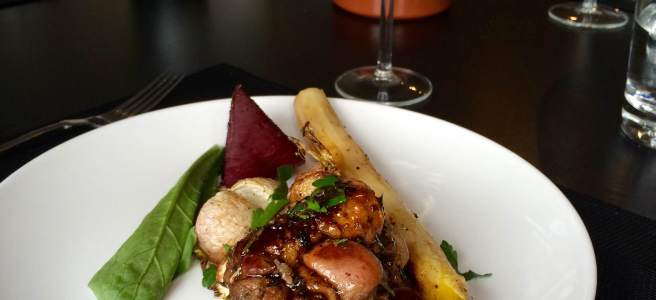
Today, our daughter lives in Paris. As a matter of fact, I am writing this piece from Paris. Just last weekend, the two of us took a Market Cooking class from Chef Lise at La Cuisine Paris.   lacuisine-paris    We toured the local market, selecting duck legs, 3 fine cheeses, beet root, white asparagus, blood oranges, strawberries, turnip, and several fresh herbs to take back to the kitchen-classroom and learn how to make a French feast, including duck a l’orange (see the featured image). It was a wonderful day of sharing the kitchen and table with each other and 6 strangers.

I encourage you to start cooking more often.  Be on the lookout for easy and affordable recipes that you can use when you invite someone to a simple meal.  If you have children at home, involve them in the planning, shopping, and preparation of the meal- it is an important way of teaching them about hospitality and sharing.

In the next post, we will consider how the shared meal (especially the evening meal) as a practice, in particular a Christian practice, has the potential for both common and sacred relationships in the daily lives of believers.

Until then, bon appetit!

~Julie A.P. Walton, Ph.D.

[1] Lest you think poorly of my husband, let me defend him here.  Although he cannot cook and his tastes and texture issues create significant limits, he is the world’s best dishwasher.  We have always shared kitchen responsibilities with unspoken devotion; we share shopping, I prep and cook, he cleans.  It is a beautiful arrangement.  Chapter six will explore these duties in the context of family and food.

[2] I should note here that our apartment in Silver Spring, Maryland was directly across the street from my husband’s office.  As I was not yet working full time, my husband would frequently call around 11:45 a.m. to say he was bringing a coworker home for lunch.  I quickly learned to put out a simple meal that didn’t break the bank, and have always been grateful to him for helping me learn (to unbend really) to trust God to make the “bread and fish” multiply so that there was always more than enough to go around.

[3] As an example, Eileen invited me to drive out to a farm to pick broccoli one day.  I had never known that the “U-Pick” concept extended beyond apples, strawberries, and Christmas trees.  When I got home with about eight pounds of broccoli I had to undertake a crash course in prepping it all for the freezer.  We were graced with months of fresh farm-to-table and highly nutritious broccoli that winter.  It is still a family favorite to this day.


12. Is There Food on Your Table?

In Acts 2:42, we are told about the first believers:  “They devoted themselves to the apostles’ teaching and to the fellowship, to the breaking of bread and to prayer… All the believers were together and had everything in common (v. 44)… They broke bread in their homes and ate together with glad and sincere hearts, praising God and enjoying the favor of all people.” (v. 46-47)

A study of the communal meal practice of the first century church reveals a radically different model from our present-day attitudes toward shared meals.[1]  Why did their shared meal practices disappear over time, and why, today, do our foodways and mealways look so different?  A foodway is an accepted term that describes the habits and practices of food consumption and production in a cultural, social, or economic context, and shows us “how societies construct notions of self and community.” [2],[3]

The North American approach to food has shifted most dramatically in the past forty years, and seems absurdly paradoxical even for Christians because our foodways swing between two poles, one of apathy and ignorance, the other of obsessive and compulsive control. We now have 24-7 cooking shows on television, yet very few of us actually cook anymore.  We say we have no time to eat, but most of us are overweight, a symptom of eating too much too often.  Time is scarce, while cheap (and unhealthy) food is overabundant.  We spend millions of dollars each year on dieting (i.e. we spend more in an attempt to eat less).  Some of us overdo, while others do nothing; some of us are indifferent to our health and healthcare, while others’ anxiety about their health creates fanatical control issues.  Most people shun regular exercise while others spend far too many self-absorbed hours in the gym. We either become overly fastidious about the quality of our food sources, or we consume vast amounts of processed foods we know are not good for us.  (As one example, boxed cereal, a highly processed food, once promoted as just one part of a healthy breakfast, has become the default nighttime ‘meal’ when we are short on time, energy, or creativity.)  Our dining and kitchen tables are repositories for mail and school papers rather than places for a shared meal.

Since the dawn of time, people have been hunters, gatherers, farmers and shepherds.  Today we are much more disconnected from understanding how food reaches our tables.  At home and at church, we take pride in our manicured lawns and landscaping, but rarely consider using the church property to grow food for others with no land.  It seems that we are hungry, but not for food, and that Christians in particular need to think and pray about their own selected foodways and mealways.

Thoughtfulness can go a long way to help us find a healthy middle ground where food and meals are concerned.

“To grow food and eat in a way that is mindful of God is to collaborate with God’s own primordial sharing of life in the sharing of food with each other.  It is to participate in forms of life and frameworks of meaning that have their root and orientation in God’s caring ways with creation… Food is about the relationships that join us to the earth, fellow creatures, loved ones and guests, and ultimately God.  How we eat testifies to whether we value the creatures we live with and depend upon… When our eating is mindful, we celebrate the goodness of  [all creation has to offer], and…acknowledge and honor God as the giver of every good and perfect gift.”[4]   In other words, we must relearn what it means to care about, and care for all creation, including ourselves.

Perhaps even more importantly, our inattention to meals and cooking means we have stopped teaching our children about foodways and meal practices (mealways).[5]  In my experiential nutrition class a few years ago, I handed a bunch of fresh carrots from the farmers’ market to a student to peel.  I can still see him standing at the sink, carrots in hand, exclaiming with confusion that these could not possibly be carrots, because in his world all carrots were the size of one’s pinky finger and had no peel or green leafy tops.

Fortunately, young people are beginning to show a resurgent interest in healthy (and just) ways to grow, prepare, and share food!

[1] A subsequent chapter discusses the meal practices of the early Church in detail.

[2] Angel F. Mendez-Montoya, The Theology of Food: Eating and the Eucharist (Chichester, UK: Wiley-Blackwell, 2012), p.6.

[3] I have coined the term “mealway” to describe the general habits and practices surrounding how a society or culture consumes meals.

[4] Norman Wirzba, Food and Faith: A Theology of Eating (New York, New York: Cambridge University Press, 2011), p. xiii, 4

[5] This is a critically important point, as we will see.  Much is learned in the kitchen and around the table that actually has little to nothing to do with food.

11. What ARE You Sharing with Others?

Instead of moving into the next chapter on the shared meal, I thought it might be a good time for DESSERT: to REVIEW the notion and nature of the Christian practices, and give you some discussion questions to think and pray through.

Christians are in training, actively practicing particular behaviors that lead to a mature faith and Christlike attitude.  Training takes intention-we need to plan it into our hours and days.  It takes submission, obedience, and sacrifice.  More than anything else, our training takes time.  When our life is already too crowded with a full schedule, we must learn to discern where and how our time is being misspent-as individuals and as a family.  We don’t “make time” for the disciplines and practices; only God makes time.  Instead, we shift our attitude and priorities.  We whittle down here, plan better there.  But mostly, we give our time to the Lord and ask him to help us use our waking hours in ways that honor him.

We have seen how our individual attention to the spiritual disciplines and our shared participation in the Christian practices forms us in our faith into the holy living to which we are called.  They strengthen us to live in a world that is not our final home, to share Christ’s gospel with joy, and to serve God and neighbor out of a delighted obedience.  This is a humbling yet energizing way to live one’s life in sacrifice, thanksgiving, and hope.  Not a life that is all about “me” but one that is focused intentionally on the believing community of “we”.

The early Church that formed out of persecution and dispersal in the first century was marked by the things believers had and did in common.  In our hyper-individualized society, it is difficult for us to comprehend the necessity and power of such communal or shared practices.  Those historic Christian practices formed the essence of our shared practices today, particularly those of worship, prayer, and Holy Communion.  Still, other practices, like that of the shared meal among believers, are no longer a regular part of our life in common.

DISCUSSION QUESTIONS

  1. The thesis of this chapter is that growing in your Christian faith requires sustained practice. List here some individual spiritual disciplines you do now to grow in your faith.  What do you like about each one?  What makes it hard to do them consistently?  What discipline do you NOT do now that you would like to incorporate into your daily walk?  Why?
  1. Discuss the nature of the spiritual disciplines and the Christian practices. How are they alike?  How are they different?
  1. Life often goes too fast, and we begin to feel as if we are running aimlessly on a treadmill going nowhere. How can attention to the disciplines and practices give you a new sense of purpose and direction and peace?
  1. If your life is simply too crazy-busy, take some moments to ask why. List here those things that take up most of your day/week.  Is there anything you and/or your family consistently do that could be put aside?  Done differently?  Ask yourself what you do, then ask yourself what you want, and consider how these answers differ.
  1. Have you ever given much thought to the shared Christian practices? Why is it important that you and your children are present in corporate activities like worship, prayer, Holy Communion, testimony, and confession-forgiveness-reconciliation?  What does it mean if you are routinely absent from these practices (either mentally or in your physical presence)?
  1. The next chapter will discuss the notion and nature of the shared meal as a distinctly Christian practice. Jot down your week’s typical meal patterns/schedule and with whom they are shared.

Please share your thoughts-it helps me as I continue to write the back chapters of this book to get a sense of what you think, what you do vs. what you wish for.  Thanks! You can click on SHARE to send to friends, and write in the Leave a Comment box below.  

~Julie A.P. Walton, Ph.D.

(featured image credit:  High Tea in China.  K.Richardson. 2016)

10. The MEAT of a Christian Practice

In the last post, I introduced the idea that our customs are not the same thing as a practice, and promised to sketch out the common elements of a Christian practice.

Let’s start with the idea of customs.  As an example, meal customs are informative.  Why did Jesus recline at meals?  Why did the Jews wash their feet before entering the dining area?  Why did Jesus tell the story of the man who threw a banquet for friends who were no-shows?  As we will see in subsequent posts, the meals that Jesus attended were shaped by the influences of Greece and Rome, as well as Jewish tradition, and, as a result, diners’ behaviors were circumscribed by particular customs.  A fundamental question for us is how did Jesus’ first followers move from those religiously and socially-traditional meals into the practice of the first century church in which shared meals were an integral part of the worship experience?

If a Christian practice is an activity that is regular, shared with other believers, and designed to strengthen our common life together as Christians, then it might be helpful to try and sketch out what I believe are the common elements of a Christian practice on our way to showing how the shared meal qualifies as such a practice.

As noted, there are several distinct Christian practices which we do together in Christian community, including worship, prayer, fasting, Sabbath-keeping, stewardship, the Lord’s Supper, forgiveness, and, as I claim, the shared meal.  The common elements of these Christian practices are invitation, provision, gratitude, nourishment, and formation.

God invites us into a particular practice whether it is worship or prayer or a shared meal.  We are invited to enter the practice by entering into God’s and one another’s presence, entering into rest and restoration, and entering into community and communion with God and one another.  Thus, there is always a kind of prologue to each practice, in which we mindfully enter into the practice by divine invitation to do so.  From the perspective of a shared meal, we accept God’s invitation to take time out to eat and share and rest together at table and in God’s presence.

There is an element of mutually beneficial provision in each of the practices.  We are individually and corporately provided for with charitable care and concern out of God’s grace and abundance, paradoxically finding in each practice an opportunity to serve as a way of providing for others.  We commit to praying for others, we fast together in lament and petition for a particular provision, and, when we worship and share in the sacred meal of Holy Communion, we realize God’ provision for our own life through Jesus’s life, death, resurrection and coming consummation.  Moreover, we learn, with grace and humility, to accept others’ service to us despite our ever-undeserving state.  Most importantly, God provides this time that we may to set it aside for Himself, others, and for our in-common well-being.

Each of the Christian practices contains the attribute of gratitude.  There is nothing we practice together which does not raise up an unquenchable desire to thank God as the source of all things good, and praise him for being our Creator, Savior, Counselor and King.  When we share a meal, we say grace before eating because we are so grateful for God’s ongoing presence in and provision for our lives, and for the food before us that will fuel our service to the kingdom.

The Christian practices nourish us by both feeding and satisfying our physical, emotional, and spiritual hungers to the point that we, in turn, are energized and able to serve God and neighbor.  We often enter into a particular practice with a mindset that there must be “something in it for me.”  The reality, as is often the case in our Christian walk, is that God intends the practice to show his glory, and create in us as the body of Christ the deep love and sacrificial posture we need to love him and serve our neighbor.

Lastly, the Christian practices all share the element of formation.  The profoundly formative nature of the practices is nearly beyond comprehension.  The practices introduce us to the kingdom of God, then reinforce and direct our discipleship.  We begin to grasp that all the Christian practices are inter-related, and that the more we practice them simultaneously in community, the stronger the weave of our life in common together.  To put it another way, the practices of the first Christians give us a firm anchor in how to live out our common lives (Acts 2:44).  Moreover, the practices act as a compass to direct us-in Christian community– along a path of growth and maturity in our faith, what we often call our ongoing development in Christlikeness.  It is the daily practice of our shared prayer, worship, meals, Sabbath-keeping, and forgiveness that leads, over time, to human flourishing- for ourselves and those we serve- to God’s glory.

Finally, then, we can ask if, in the lives of Christians, the shared meal is simply a custom handed down from earlier generations, or if Christians should view it from a faith perspective as a Christian practice.  It has always been a universal custom for people to eat together, no matter what their belief systems entailed.  As far as family and church family are concerned, it seems to me that we treat the shared meal as custom, easily shaped by the culture and the times, when it may actually be meant to be approached as a central communal practice in the Christian home and in the Church.  The shared meal, like other Christian practices, embedded with invitation, provision, gratitude, nourishment, and formation has the deep potential to fortify and direct our individual and common lives in ways that might surprise us.  So, it is to the notion of shared meals as faith practice we wll turn next time.

Thanks for sharing this space!  We are steadily moving into the MEAT of the shared meal as Christian practice!  There is a button below to :LEAVE A COMMENT.  I would appreciate hearing what you think.

~ Julie A.P. Walton, Ph.D.

(Featured image photo credit:  K.Richardson. 2016)