24. You Feed Them

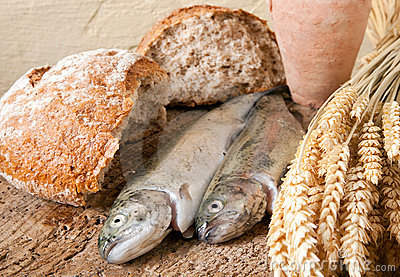
Not long after his delightful meal with Simon, Jesus sends out the Twelve to preach the arrival of God’s kingdom (Luke 9:1-17). He tells them to travel so lightly as to not even carry any money or food, but depend on the hospitality of strangers.[1] When the disciples return bursting with stories of their missionary journey, Jesus takes them away to the town of Bethsaida for respite and fellowship. But crowds follow, intent on seeing and hearing Jesus. By late afternoon, the disciples begin to worry about the size of the crowd and the approaching evening. Jesus has a simple reply when they ask him what all these people are going to do about the evening meal.   He says, “You give them something to eat” (Luke 9:13).

Here, Jesus quickly becomes the host of a very simple (bread and protein), yet very large meal. He breaks the bread and fish, thanking God for providing them. Not only does everyone eat some, they all have their fill. We shouldn’t be surprised that Jesus did this. When Israel wandered in the wilderness, God sent manna and quail for food. Even in the middle of our wilderness experiences, if we trust God to provide there is always enough. The point is, when the Bread of Heaven hosts a meal, no one goes away hungry, and there are always ample leftovers.

In the next post, #25, we will look at the connections between meal and gospel.

~Julie A.P. Walton, Ph.D.

[1] Compare this to today, when, on long trips we either pack a large cooler, or stop at fast food places along the way. Our self-sufficiency keeps us from the need to depend on strangers and assures that we maximize our ability to get things our way.

Featured image credit: http://www.dreamstime.com/royalty-free-stock-photography-miracle-bread-fish-image9906677

23. Simon, a Most Appalling Host

Although they don’t understand, Jesus is speaking to the Pharisees and scribes about the irrelevance of their self-imposed and self-righteous dietary rules and meal traditions in the absence of a repentant heart. The contrast is stark, when, in his Sermon on the Plain (Luke 6), Jesus promises blessing to those who are spiritually hungry (Luke 6:21) and woe to those who are (or think they are) well-fed now (Luke 6:25).

After this, the Jewish leaders invite Jesus to a meal on at least three occasions. At first, the welcome to Jesus is likely the kind that would have been extended to any other itinerant Jewish teacher new on the scene. The Pharisees and scribes would naturally want to hear more of what this man had to say, extending hospitality out of respect to honor the guest through table fellowship. Because of the general Hellenization of the times, it is not out of order to imagine that the meetings the Jewish leadership held were plausibly comprised of a shared meal followed by a symposium-like discussion. This was the common practice among colleagues, religious and civic groups, clubs and societies, clients and patrons, and philosophers.

So, we next see Jesus attend a meal in Luke 7:36-50 at the home of a Pharisee named Simon. Jesus has just scathingly and publicly accused the Pharisees of folly for their complaints that, unlike John who abstained from bread and wine, Jesus came eating and drinking, a glutton and a drunkard, and a friend of sinners (Luke 7:34-35). So it is interesting to contemplate what seems on first blush to be an absurd scene in which a Pharisee (of all people!) has invited this Jesus (of questionable reputation for fraternizing with the unclean) to his home for dinner. In reality the welcome should be considered a natural extension of Jewish hospitality.

Jesus reclines with Simon (and, presumably, others, most likely Pharisees and/or scribes) at the table in Simon’s house. While they are eating, a woman well-known throughout the town as a prostitute stands behind Jesus at his feet, crying. Remember, uninvited guests could enter a dining room and stand behind the reclining diners at their feet. Although relatively unwelcome, out of respect for the ancient rules of hospitality unsolicited company was allowed to stay and observe. But, this woman gets involved. While Jesus is eating, she begins to cry, then for lack of anything better, wipes his tear-wetted feet with her hair. She kisses his washed feet, and pours expensive perfume on them (most likely paid for out of her sin-begotten earnings).

Simon is privately disgusted, saying to himself, “If this man were a prophet, he would know who is touching him and what kind of woman she is- that she is a sinner” (Luke 7:39). But Jesus knows exactly what Simon is thinking, so he raises a discussion point about debts owed a lender, trapping Simon into agreeing that the one forgiven the largest debt will most love the one who forgives. This meal scene plays out as a perfect example of the ways in which Jesus used mealtimes to accept an invitation no matter its motive, then to teach repentance, confront and forgive sin, and accept the love and sacrifice of those whose hearts are changed.

Given the expected etiquette of the day, Simon turns out to be an intentionally appalling host, and given the Pharisaic obsession with insulating oneself from the unclean, it is a wonder that he even deigns to share his table with Jesus. This is because Simon, going against every culturally-mandated rule of hospitality does not offer Jesus any water for washing. Without washing first, Jesus must eat as one unclean. Moreover, Simon does not greet Jesus with a kiss, nor does he provide any oil for anointing (all three of these are actions subsequently offered freely by the prostitute). Of course, Jesus not only notes Simon’s deliberate disrespect (no one at this meal could help but notice), he publicly calls Simon out for his rude behavior. The prostitute is forgiven, the Pharisee exposed. What an interesting meal! Jesus tells the woman to go in peace because her faith has saved her (Luke 7:50). We can only speculate what Simon was left thinking, but from this point forward, the Pharisees and teachers of the law stop badgering Jesus and begin their attempts to bait him.

Featured Image Credit:  Google Images, http://thewellcommunity.org

22. “We vs. ‘Them'”

The Jews had particular rules about who could eat with whom as Jesus’ meal with Levi reveals. The Greco-Roman meals of the day specifically encouraged and were often framed by friendship as a means of social bonding. Thus, “the meal became the primary means for celebrating and enhancing community ties.”[1] But for the Jews in particular, it is important to note that the dietary laws given in Leviticus 11 served in one sense to create a visible separation between the Jews and other people; these laws created religious and ethnic identity in very real and serious ways.

By Jesus’ day, Jewish legal tradition had added multiple layers of behaviors and requirements regarding what defined ritual purity to the dietary laws originally given by God.   Thus, righteous Jews were not only to keep the appointed feasts and ascribe to ritual purity, they were to avoid eating with Gentiles and unclean Jews, as well as anyone known to be wicked, for example those associated with the reputed gluttony, drunkenness, and sexual idolatry of Gentile feasting. So we should not be surprised that, in the case of Jesus’ meal with Levi, the Pharisees and their scribes are dismayed to see a Jewish teacher flaunting their carefully crafted rules for ritual purity. Under Roman occupation, a Jewish tax collector was vilified for being nothing better than a corrupt Roman puppet. Consequently, eating with such publicly renowned sinners made one unclean, so much so that it was unconscionable to be a friend or companion of (com meaning with and pan meaning bread) such persons. It simply was not done. But Jesus intentionally, even provocatively joins these “wicked sinners” so marginalized by the Jewish elite at mealtime, using the meal setting to demonstrate the purpose of his ministry to love the unlovable, to call them to repentance, and to openly show the grace with which God “includes those the world excludes.”

From our perspective, the Pharisees and scribes seem excessively arrogant in their self-righteous exclusivity. But, we must remember that it was God who called his people to be separate, who gave them visible boundary markers like the dietary code to preserve them from the ungodly nations all around them. “Through exclusive practices [a] group differs from its social environment. [A] group uses them to practice boundary maintenance. In contrast, the inclusive practices are also practiced by the social majority and enable their members to integrate themselves into the surrounding culture. That means that every group that wants to be discernable as a group is in need of an at least partially exclusive ethos which functions outwards as ‘boundary marker’ and inwards as ’identity marker.’”[3] So, the Pharisees and scribes, among others, were separatist for what they believed were very good reasons, and any Jew who blurred the lines of separation was, by association, himself impure. “The significance of the fact that Jesus would set the stage for the abolition of these laws in early Christian practice can scarcely be overestimated.”[4] Jesus means to show the Jewish leaders that in their self-righteous comparisons to Levi and his associates, and because of their insistence on exclusivity at the expense of inclusive love, they fail to comprehend the rottenness of the fruit of their own obedience to the letter of the law rather than its spirit.

The Pharisees continue to badger Jesus and his disciples with inflammatory questions. Why didn’t Jesus and his followers fast like John? Why did they just go on eating and drinking? Why did they pick and eat the heads of grain on the Sabbath? (Luke 5:33-6:5). Luke gives us a clear picture of how deeply the religious leaders of the day suffered from spiritual starvation-so much so that they couldn’t begin to fathom the kind of nourishment Jesus offered. The Jewish leaders were so fearful of being contaminated by the unclean that they failed, in their blinding legalism, to recognize the pure, unblemished, sinless Messiah in their midst. It is an important lesson for us when we find ourselves mired in a “we vs. them” mentality. In such instances, we should stop and reflect on our attitude to test if our determination to be exclusive is blindly sinful.

In the next post, we will study the actions and attitudes of Simon the Pharisee during a meal to which he invited Jesus.

[1] Dennis E. Smith and Hal E. Taussing, Many Tables: The Eucharist in the New Testament and Liturgy Today, (Philadelphia: Trinity Press International, 1990), p. 31.

[2] Tim Chester, A Meal with Jesus: Discovering Grace, Community and Mission around the Table, 2011, p. 32.

[3] Michael Wolter, “Primitive Christianity as a Feast,” in Feasts and Festivals ed. Christopher Tuckett (Walpole, Massachusetts: Peeters, 2009), p. 172.

[4] Craig L. Blomberg, Contagious Holiness: Jesus’ Meals with Sinners, p. 39.

Featured Image credit:  Pharisee, Google Images, fireandlife.org


21. Jesus Came Eating & Drinking

Bread and Stones

While Jesus’ earthly ministry ends with a Passover supper, it formally begins with an extended forty day fast immediately subsequent to his baptism by John (believers in the early church often fasted as preparation for their baptism- we aren’t told if Jesus did). Fasting in the Old Testament was typically a whole-body companion to prayer, either as a demonstration of one’s yearning for God, or as an avenue for developing compassion for others (see David’s psalms and Isaiah 58).[1]

Scot McKnight defines fasting as “the natural, inevitable response of a person to a… sacred moment in life.”[2] Jesus’ fast in the wilderness surely was accompanied by prayer as way of preparation for the sacred and sacrificial role he was about to undertake. Try to imagine Jesus heading into the desert alone, to pray and fast and prepare for the enormity of what he was about to do. The Bread of Life refused bread. The Vine drank no wine. Coming from heaven, but as a fully-human being, Jesus must have been hit hard by the limitations of his embodiment, experiencing the physical, emotional, and spiritual effects of a forty-day fast in very tangible ways. He hungered after God his Father, and for the strength and peace to carry out his mission. And who shows up on day forty? Satan, of course. Isn’t it just like Satan to hit us in our weakest moments, and appeal to our biggest appetites? After forty days without food, Jesus’ encounter with Satan starts off with a challenge to turn stones to bread. But Jesus, fortified from forty days of fasting and prayer, is armed with the very word and Spirit of God to rebuff Satan’s temptations.

 Jesus Came Eating and Drinking

According to Luke, Jesus initiates his ministry of teaching and healing turning up first in Nazareth, then Capernaum. He heals Simon’s mother of a fever and she responds by getting up and making Jesus a meal. As he goes about Judea preaching, he stops at the Sea of Galilee and talks Simon into letting him use a fishing boat as a lakeside pulpit. In a very short time, Simon is astonished by both Jesus’ teaching and actions, and is convicted he must leave his fishing boat and the nets which catch real food to follow this teacher and learn about an entirely new kind of fishing and wholly different kind of food.  Much later, after Christ’s resurrection he grills fish for breakfast in this same place!

Jesus next comes upon Levi in a tax collection booth. Like Simon, Levi is convinced he must repent and change his life. In short order, we see Levi giving a great celebratory banquet with Jesus as the guest of honor (Luke 5: 27-39). Now this is no ordinary meal, but a lavish banquet, the first of several shared- and truly radical- meals for Jesus in Luke’s account. The typical Greco-Roman banquet in the Hellenistic Mediterranean regions of Jesus’ day included a guest of honor as well as other invited guests, usually those familiar to the host, often those with whom one associated via one’s profession or guild.[3] So, it shouldn’t seem odd to us in any way that Jesus would attend a formal meal given by a very grateful Levi at which the other invited diners were also tax collectors (as a tax collector, it is doubtful Levi would have had many other friends or associates, particularly among the Jewish community).

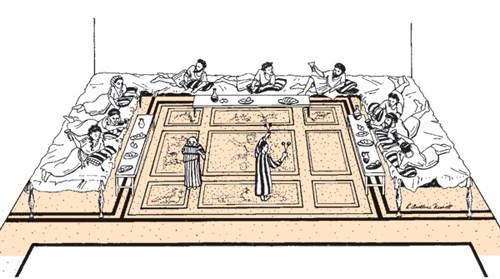
Although there is some debate among scholars whether the Pharisees, scribes and other Jews concerned with ritual purity participated in this type of banquet to any significant degree[4], it has been proposed that these banquets, better known as symposiums, were derived from the Greco-Roman tradition generally conducted in a culturally-accepted and prescribed way throughout the Roman Empire. Many homes had formal dining rooms. Other larger public rooms could be reserved, and even the temples had dining facilities. Invitations were sent. Guests were met at the door and led to the dining area by servants who then removed a guest’s shoes and washed his feet. The social standing of each guest was demonstrated by the distance one’s assigned dining place was relative to the host. Couches or cushions were arranged behind low tables around three sides of the room, leaving a large central opening. Diners reclined on their left side and elbow with their feet away from the center. The guest of honor was given the place of privilege to the host’s immediate right.   In his Gospel, John is careful to include a description of his position at the Passover feast the night Jesus spoke of a looming betrayal. “Leaning back against Jesus, he asked him, “Lord, who is it?” (John 13:25). From this narrative it is clear that, with Jesus as host of the meal, and himself lying on his left side, John was occupying the position of honor to Jesus’ right.[5]

What’s more, in Jesus’ time, the reclining position was itself a posture which connoted honor; slaves and women were not allowed to recline. Servants and even uninvited guests would often stand along the outer wall watching the diners eat and listening to their discussions and entertainment. Others were allowed to sit near the feet of the diners where they might be able to scoop up crumbs or leftovers. It was also customary for the highest-status diners to be served the choicest (and most) food. As we will see, these issues of social standing, honor, and privilege at shared meals would be challenged by Jesus (and later Paul) on a routine basis.

The center area outlined by the reclining couches held the common bowl of wine, typically diluted with water and passed among participants as a shared cup after the meal. The tables were cleared away so that the central area could be used for the symposium itself, a period marked by entertainment, singing and instrumental music, debate, or lecture. The Greek tradition of symposium was generally considered to have evolved into nothing more than a hedonistic descent into drunken promiscuity. As the Romans adopted the custom, the symposium, though still thoroughly embedded with wine and entertainment[6], was ideally meant to function as time for participants to debate a pre-planned controversy or philosophical question, or for out-of-town visitors to give a speech. Today we might put forth a question about clashes in culture, morality, or worldview to be debated around the table after the meal, or we might invite a missionary on home leave to speak to us about her work.

Next time, in post 22, we will look at the Jewish eating and purity traditions of Jesus’ day.

[1] Scot McKnight, Fasting, (Nashville: Thomas Nelson, 2009), pp. xv-xvi.

[2] McKnight, Fasting, p. xx.

[3] The recent works of Dennis E. Smith, From Symposium to Eucharist (Minneapolis: Fortress Press, 2003) and Hal Taussig, In the Beginning was the Meal, (Minneapolis: Fortress Press, 2009) are excellent resources for redefining first century church worship and fellowship activities in the context of shared meals, as well as understanding the place of the banquet in the ministry of Jesus.

[4] Craig L. Blomberg, Contagious Holiness: Jesus’ Meals with Sinners (Downers Grove, Illinois: InterVarsity Press, 2005), p. 22.

[5] The 15th century mural of the Last Supper by Leonardo DaVinci shows the diners seated and standing along one side of a long table, illustrating both the artist’s creative freedom as well as how the social custom of reclining had died out by the 1400’s.

[6] The birthday celebration for Herod, in which Salome danced for the head of John the Baptist was likely such a feast-symposium (Matt .14:6-8).

Photo Credit:  www.biblicalarchaeology.org

20. Two Birds! Repent!

Two Birds for the Lamb

On the fortieth day after Jesus’ birth, and as part of the purification rites according to the Law of Moses, Joseph and Mary take six-week old Jesus to Jerusalem to present him to the Lord (Luke 2:23). It is an interesting paradox that this baby, Jesus, is likewise Joseph and Mary’s and God’s firstborn son, so this is indeed a day of celebration. Still, it also a day both marked by, and foreshadowing sacrifice. Joseph and Mary bring two birds- young doves or pigeons- to sacrifice, one as a burnt offering, the other as a sin offering (as prescribed in Lev. 12:8 ) to dedicate their son Jesus to the Lord God. The birds are acceptable if parents cannot afford a year-old lamb. And so, here we see the Lamb of God of Passover significance, born into such poverty that his parents can only afford birds for the purification rites.

 A Feast and a Mission

The next we hear of Jesus in Luke is when his family travels from Nazareth up to Jerusalem for the Passover feast when Jesus is twelve years old (Luke 2:42). They feast there according to custom. It is probable that Jesus had gone up with his family for Passover feasts in previous years, since the law required Joseph, as an adult male, to attend on a yearly basis. But at the age of twelve (Scripture is very clear here about Jesus’ age being twelve, meaning he was in his thirteenth year), an Israelite boy like Jesus would have been in the midst of preparing to take his expected place among the adult males of the religious community when he turned thirteen. Jesus tells his earthly parents that he just had to be in his Father’s house, a hint that Jesus already recognized and craved intimacy with a father other than Joseph. So, here we see a pre-teen Jesus celebrating Passover in Jerusalem with, perhaps, the dawning knowledge that twenty-one years hence at this same feast of bitter herbs and unleavened bread, and in this very city which he dearly loves, he himself, the firstborn and only son of God, will become the sacrificed lamb whose sprinkled blood will safeguard and deliver the lives and souls of all who believe. In the last week of his life, Jesus sends disciples ahead into the city to prepare the Passover meal at a pre-arranged location (Luke 22:8-12). I have often wondered where, in which house in Jerusalem, Jesus’ family celebrated their Passover meals in those early years. Could it be that their family returned to the same upper room year after year, much like we return to a favorite resort or restaurant when we visit a nearby city? Could this be the same room where Jesus spent his last supper with his beloved disciples?

 Repent and Bear Fruit

In chapter three, Luke turns to the ministry of John the Baptist calling out in the desert for people to produce fruit in keeping with a repentant life. The fruit metaphor is universally used throughout the Bible to signify an edible, life-sustaining seed-bearing plant which is deep-rooted, wisely pruned, and well-watered, thriving in its season and producing an abundant crop from year to year. Jesus also uses the fruit comparison, when he curses a barren fig tree (Matt. 21:19), when he claims that “no good tree bears bad fruit,” (Luke 6:43), and when he entreats people to graft their “branches” onto his “vine” to become and remain fruit-producing believers (John 15).

To think about:  what fruit is your life producing for the kingdom?  Where could your attitudes and behaviors use some watering?  Pruning?  How can your life be sweet, wholesome, nutritious food for others?

19. Jesus, Food, and Meals

Here we begin an in-depth look at meals in the Bible, with a special focus on the meals Jesus shared.

Food and Blessing

The book of Genesis tells us that before the fall, Adam and Eve spent the daytime tending a garden overflowing with abundant plant life, much of which was available to them as food. They walked with God in the cool of the evening, a practice of setting aside time to enjoy God’s presence. A significant component of the curse, after God exiled them from Eden, was that Adam and Eve and all their descendants would henceforth access food only by the sweat of their brows; our need for food didn’t change, but our ability to obtain it was forever made problematic.

Bread, wine, milk, oil, fig, pomegranate, fish, honey, wheat and barley are all foods associated with God’s great spiritual blessings and salvation in Scripture. Moreover, gospel as food for the hungry is a constant metaphoric biblical theme. The prophet Joel, in pleading with Israel to repent and fast after the land is overrun by locusts, reminds the people that after God’s judgment and punishment the harvest will be restored to overflowing for those who call on the name of the Lord. “You will have plenty to eat, until you are full, and you will praise the name of the LORD your God, who has worked wonders for you…” (Joel 2:26)

Isaiah prophesied a feast of rich food prepared by God for all people, “a banquet of aged wine-the best of meats and the finest of wines. On this mountain he will destroy the shroud that enfolds all peoples … he will swallow up death forever.” (Isa 25:6-8). You can’t miss the messianic picture here; by virtue of his own death shroud found neatly folded in an empty tomb, Jesus frees people from death and invites them first to remember him with a memorial meal, and, upon his return, to a lavish wedding feast.

 A Savior for a Hungry World

I have come to the conclusion that Jesus, unlike his hermit cousin John, was a foodie in the most marvelous sense of the word. God’s only son consented to leave his glory behind in heaven and take on a fully human form. That alone is worthy of praise. But, to view the New Testament Jesus through the eyes of food and meals, as one who was just as dependent on the earth’s fruits and people’s hospitality as we are, brings us to a position of wonder. This Jesus, son of God, author of creation, able to partake of heavenly banquets at any turn, master chef of manna and vintner fine wine, arrived poor, needy, hungry, and dependent, and he accepted this lowly position on our behalf. Moreover, Jesus spent a good deal of his time eating in the company of others, even enemies, sharing food and companionship, and using these opportunities to connect, teach, confront and love; in short, he “used simple hospitality and mealtime conversations to share the gospel.”[1]

In his gospel, Luke intentionally presents Jesus from birth to death, resurrection and ascension, as the means of salvation, and it is Luke, more than any other of the gospel writers, who characteristically sets his salvation stories of Jesus in the context of meals, fasts, feasts, and food.[2] Jesus’ cousin John abstains from wine and other fermented drinks in the priestly way of Samson, Samuel and the Nazirites (Luke 1:15). In her song at Jesus’ conception, Mary sings of God’s favor and mercy in filling the hungry with good things (Luke 1:53). For lack of anything better, Mary and Joseph must lay Jesus in a manger in Bethlehem, a crude feeding trough for animals (Luke 2:7). Later, Jesus himself would say, “Consider the ravens: They do not sow or reap, they have no storeroom or barn; yet God feeds them. And how much more valuable you are than birds!” (Luke 12:23-25). The Bread of Life, cradled in a rude manger “begins to symbolize how God will feed his “hungry” people…through Jesus.”[3]

[1] D. Webster, Table Grace: The Role of Hospitality in the Christian Life, p. 14

[2] For an excellent overview of the meal scenes in Luke, see books by Tim Chester, A Meal with Jesus: Discovering Grace, Community, and Mission around the Table (Wheaton, IL: Crossway, 2011) and John Paul Heil, The Meal Scenes in Luke-Acts: An Audience-Oriented Approach (Atlanta: Society of Biblical Literature, 1999).

[3] Heil, The Meal Scenes in Luke Acts: An Audience-Oriented Approach, p. 19.

18. The Day Jesus Needed Tampons

Allow me to share a true story, one that dramatically changed how I think about the shared meal. I was at a conference in Seattle in June, about a year after starting to research the Christian practice of the shared meal. On this particular night a colleague and I headed down to the wharf to get some fish and fries. While getting on line at the outdoor fish stand, we were approached by a homeless woman for money for feminine products. A colleague replied,

“No.”

But, I was intrigued by the woman’s request because it had never once occurred to me how a homeless woman would manage such a monthly (and expensive) need. This woman was relatively young, maybe in her early thirties. One of her front teeth was chipped, and her skin showed obvious signs of vitamin deficiency, likely related to alcohol abuse. Not wanting to give her money for alcohol, I instead said,

“Well, let’s go to the drugstore and I will buy you what you need.”

The woman immediately argued that it was thirteen blocks to the nearest drugstore, and she’d just take the money. So I looked her right in the eyes and said,

“No, I am sorry. I can’t give you any money.”

She swore at me and walked away, and I found myself asking to her back,

“Wait a minute! Are you hungry?”

The woman stopped in her tracks, turned back toward me with a question on her face (my colleague did too), and I said,

“I am getting some fish and fries for supper. Do you want some supper?”

She eyed me with a suspicious hope and I managed to hold her gaze. Wrinkling up her forehead she said,

“Well, can I have a Coke too?”

I replied, “Sure. You can have fish and fries and a Coke, same as I am having.”

She came toward me then, and touched my arm with her filthy, scaly hands, and I all but recoiled from this physical contact that violated my “personal space”.[1] She quizzed me again,

“Can I have the biggest Coke they got?”

“Sure, the biggest Coke you can get”, I said.

By now we were next in line. I told her to go ahead and order, while informing the vendor that her order was on me. With great flourish and glee the woman ordered fish and fries and “the biggest Coke you got,” while ferociously tearing at the napkin dispenser to stuff napkins in her pocket. As I stepped up to make my order and pay, she turned to me, put her reeking arm around my shoulder and said,

“Lady, you made my day. You made my whole month. Thank you.”

And she skipped down the line to fill her Coke cup. Her order came up, and she snatched at the sack of food wondering aloud if she could get some ketchup. I motioned to the tables overlooking the harbor where ketchup bottles stood ready for the diners, but she said,

“No, no, no. I need them little packets of ketchup. Lots of ‘em.”

So the vendor gave her a fistful of ketchup packs while I filled my drink, looking around for my colleague amongst the tables, and, I admit, consciously hoping this woman would be on her way. And that’s what happened- she bounded off with her food and drink and napkins and ketchup. My colleague commented that I was an easy target while I sat down congratulating myself that the situation had turned out so well. I went to bed that night content that God had placed a need in front of me and I had responded with kindness and generosity- I had loved my “neighbor” in an uncomfortable situation.

I was awakened by a voice around 2:00 a.m. I remember sitting up in the bed, frightened that someone had broken into the room. I confirmed that I was awake, not dreaming and then felt a shadow at the end of the bed. There was Someone in my room; Jesus was here, and I had nowhere to hide. But very gently, he repeated the question with which he’d awakened me,

“What was her name?”

“What? Whose name?”

And the Lord distinctly and forthrightly said,

“What was the name of the woman at the fish stand?”

Then he was gone. And my heart welled up with an overwhelming wretchedness. I had bought a hungry woman some food. But, even after more than a year of study on the Christian practice of the shared meal, I had failed to dignify the woman’s existence by asking her name, and inviting her to sit with me for supper. I had not once thought to pray with her or for her, to introduce her to the Jesus I know and love. I had helped a hungry person by sharing some money. But I had not shared a meal or had any serious conversation about God and his love with this distressed woman whose hunger was deep. That night I learned that while hunger comes in all shapes and sizes, and that non-judgmental love for the stranger is itself a hard and strange calling, we are called nonetheless to attend to the needs of those Jesus places in our path, even when it means sharing an evening meal at close quarters around a table with someone who suffers from addiction and needs a bath almost as badly as she needs Christ. I gave her a meal, but I neglected to tell her about the coming Feast.

I tell you this story because we all need to think about why our participation in Christian practices like the shared meal may take much practice. It is precisely through these shared practices Christians can “more fully…understand their shared life of response to God’s active presence in Christ and to embody God’s grace and love to others amid the complexities of contemporary life”[2] and how they can help us think “about how a way of life that is deeply responsive to God’s grace takes actual shape among human beings.”[3] What is even more important, the Seattle story unveils a truth about who is welcome at God’s Table. “Jesus intentionally ate with those at the margins…as an act of compassion but also of empowerment.”[4]

Shared meals afford us all these things: helping us understand our shared lives together, responding to God’s presence, embodying his grace, and recognizing and empowering the marginalized. Thus, the shared meal constitutes a critically important practice we should not ignore, because they provide a regular opportunity for becoming “deeply responsive” to God’s provision, nourishment, and grace. If you have been hungering for a change in the way you live your life, start at the table. Invite. Prepare. Provide. Sit. Eat. Relax. Converse. Listen. Invest in the other lives at the table. Pray together. Read Scripture. Forgive. Reconcile. Be forgiven. Laugh. Cry. Share. Live. And, God himself will be amongst you to confirm its rightness. It is time to clear your table of mail and projects and get started. And, the best place to start is with Jesus himself, and the meals he shared.

[1] I say “personal space” because it is a cultural norm in North America to be physically “distant” from strangers, giving us the “power” to decide who is invited into that space. The Pharisees of Jesus’ day weren’t any different-they kept the “unclean” away and criticized Jesus for doing the opposite. I admit to being a little germ-conscious, so hugs, and touching, and handshaking have always made me uncomfortable. You can ask my friend Joy, the hugger. After five years I can now hug her back with enthusiasm. These things take practice!

[2] Dorothy C. Bass, “Introduction,” in Practicing Theology: Beliefs and Practices in Christian Life, ed. Miroslav Volf and Dorothy C. Bass (Grand Rapids: Wm. B. Eerdmans, 2002), p. 7.

[3] Craig Dykstra and Dorothy C. Bass, “A Theological Understanding of Christian Practices,” in Practicing Theology: Beliefs and Practices in Christian Life, ed. Miroslav Volf and Dorothy C. Bass (Grand Rapids: Wm. B. Eerdmans, 2002), p. 15.

[4]Smith, G.T., A Holy Meal: The Lord’s Supper in the Life of the Church, p. 77.

 

17. Willfully NOT Caring

When our daughter left for college, my husband and I found our table manners slipping. With an empty nest, we both became exceptionally stretched, having taken on more and more responsibilities both at work and at church at the same time the health of our parents began a slow decline. Not surprisingly, our mealtimes suffered. I’d find myself standing in the kitchen too exhausted to be creative and too hungry to care. On more than one occasion we settled on having a bowl of Cheerios for dinner, only to discover the milk had soured because neither of us had had the time (or inclination) to stop for groceries in the past two weeks. Sound familiar? Well, this is not abundant living. Regularly sitting down at night for cereal, ordering a pizza that’s too costly, financially and calorically, or grabbing a sub sandwich, which completely transgresses our daily sodium limits indicates something’s amiss. It is subsistence living. These are not meals. As a little family of two, our garden was choking from weeds of inattention. We had fallen out of practice. So, we’ve recently pared down a few obligations and recommitted ourselves to healthier foods, intentional conversation and prayer at the table, to taking homemade soups and casseroles to our parents, and to inviting others and our parents over more often no matter how messy our home might be.[1] “Whether we are reluctant or eager, we should understand that hospitality was meant to be an opportunity, not an imposition.”[2]

Accordingly, at this stage of my life, when Jesus asks me what I want to nurture at my family table, and during the evening that follows, I find I want to grow six things: simplification, grace, gratitude, empathy, stewardship of the evening hours, and wisdom. I want my husband’s and my life to be less complicated, less filled with noise and calendars and exhaustion, and more centered on God, each other, our aging parents, our church family, and the stranger we usually avoid by pretending s/he doesn’t exist. Our table comfortably seats six people, yet almost always only two places are set. I pray for the room to let God into our packed, busy lives.

My first response has been to simplify our meals. I still make menus and shop ahead (a later post will have ideas), but our evening meal is far simpler than in days gone by, with fewer ingredients, less food (and less meat) overall, and a reliance on quick but healthy main dishes, with vegetables, salads, breads, and fruit to round out the menu. When we host others at our table, the idea is to dwell together in God’s presence rather than play at entertaining our guests. As a result, my new practice is to keep the meal simple enough so that all enjoy and participate at the table-even me.

I want us to invest our time in knowing God, and through experience of his grace, to practice being more gracious in serving family and stranger alike. I want God to know how grateful we are for the ‘Bread of Life’ in Jesus Christ, for this food that satisfies above all others. I want to stop pushing the awareness of the needs of others to a dark, dusty corner of my mind, and bring that certainty to the very forefront of my heart and my family’s awareness. I no longer want to insulate my mind with deliberate ignorance about the plight and sufferings of others, especially where food, and the impact of our own food and economic behavior is concerned. I want to invite the stranger to eat with us.

More than anything, I want to stop: wasting time and food, and willfully not caring. I want our evening meal to signify day’s end, and to mindfully help us transition into a night spent in God’s Word, in prayer, and in his presence as we actively participate together in the start of this new day. All of this will take the sort of wisdom only God can provide, and I want that for my family and the friends and strangers with whom we dine. I hope my “wants” resonate with you at this stage in your life.

There is a box below to leave comments, and a LIKE button to share if you find what you read helpful.  PLEASE!  Take a moment to give me some feedback, and/or start a conversation.  I am a TEACHER.  I welcome you into my “classroom”!

[1] It is critical to get over any pride or guilt about the condition of your home. When perfection is your goal, then you are not being a faithful host. Hospitality is about enfolding guests in love, comfort, and respite, even if they must share in the messiness of your life. Having a “Martha” approach to hosting a meal becomes more about “entertaining” than it does about using table time to invite, nourish, challenge and send your guests out prepared to shoulder the co-mission of Christ. Obviously, you don’t want to convey to guests that you are a slob, and that your home might not pass a cleanliness test from the public health inspector! Still, a little dust, and “things lying around” should never keep you from opening your table to others.

[2] Douglas Webster, Table Grace: The Role of Hospitality in the Christian Life (Fearn, Scotland: Christian Focus Publications, 2011), p. 11.

16. The Family Table: Like a Tended Garden

By rethinking the order of a day, the supper hour has come to symbolize an exceedingly meaningful threshold to me.  Watching darkness advance through the kitchen window, making a simple meal and joining with loved ones, guests, or church family around the table has come to embody the real gift of greeting the new day ahead.  Not only that, but my attitude does a miraculous about-face: preparing or sharing such a meal is anything but a chore.  It is filled with an energizing, urgent expectancy for God’s presence and grace.  In short, it is a delight to anticipate a night of walking together with God in the cool of the evening as we share a simple meal that is both the final act of this day and an unfolding prelude to tomorrow.

It is a subtle shift in thinking and attitude and practice.  Our evening meal continues to nourish us as we lie down to sleep, so that we may arise refreshed and ready because the food and practices of the night before are used by our body and soul, physically and spiritually, to heal, grow, strengthen, and prepare us for the rigors of tomorrow.  So what we practice at night is foundational for how we greet tomorrow.  The evening meal opens a new day, and initiates us into all the promises the evening hours, as new day, hold. 

Think of the possibilities if you turn each night, in your mind and in your practice into a new day.  When you do, the shared meal takes on new significance, as do the hours between 7:00 and 11:00 p.m., so often wasted away in front of a television or computer because of our perceived need to wind down.  I believe that viewing each evening as God-given time for entering a new day can change our perspective on the practices of prayer, fellowship, meals, and study.  Suddenly, being still becomes both a possible and desirable practice-for every member of the family. You may be frustrated at this point at what seems my naïveté- I can’t possibly understand the crazy mixed-up world that your family experiences from the after-school bell until bedtime.  I do understand though, and I am telling you that your life and that of your family need not be that frenzied.  Later posts will address some of the ways our modern culture interferes with any intention to have a shared evening meal with a walk-with-God kind of evening, and how we can actively address how we’ve allowed the world’s intrusions to compromise our peace, rest, fellowship, and restoration.

This Will Take Much Practice

So, coming to the table for both common and sacred meals is more important than we recognize as the way to create space in our lives for God and each other.  In a way, time at the table cultivates a particular way of life.  It is a practice for all ages and for the ages.

Cultivation is a gardening term.  So, in one way, we can think of the table as garden, to be tended much like Adam and Eve were called to do in Eden, with care and devotion and joy.  If shared meals at home and church were a tended garden, what would you want to cultivate there?  What would you plant, nurture, and grow there to nourish and sustain your faith life and that of your family?  Remember, Jesus asks, “What do you want?”


~Julie A.P. Walton, Ph.D.

15. Evening: the New Day Starts Now

The truth is, we find getting together at the table (even just getting the food into the house) a practical challenge in a today’s world. In Eden, God invited Adam and Eve to eat all sorts of plant life.  God fed them well.  There was, of course, that one forbidden food.  Now, forbidden foods have a way of not being good for us.  A diabetic must avoid sweets.  Walnuts or shrimp are life threatening for people with a nut or seafood allergy.  But, Adam and Eve, driven by what Griffiths calls the vice of curiosity, made a fatal mistake for all of Creation.[1]  The intimacy we had with God was broken, and not until Jesus came- eating and drinking, suffering, dying, rising, forgiving our sins, and inviting us to the feast of the Lamb-did we have any hope for restored relationship with God.

The table, then, at home and at church (table and Table) is the place of invitation, nourishment, acceptance, forgiveness, gratitude, learning, growing, and going.  It is as much about relationship building and disciple-making as it is about food.  In both instances, we come hungry for food and companionship with one another and with God.  In both instances, we are invited and fed by something or Someone who had to die for us to live.  God’s Word fills us.  In both instances, we leave with a co-mission to go and do likewise for our neighbor.  And, in both instances, we can stand with Jesus and proclaim “that we live by ‘every word that comes from the mouth of God,’ because that word has everything to do good things, with real nourishment for body and soul.  With the eyes of faith, Christ comes to be known as that word, incarnate, embodied, the Word of God, present then and now.  Christ is then the invitation, the way we have of re-creating that living relationship of intimacy with God that the original humans knew in the garden.”[2]

 Rethinking the Practice of a Shared Evening Meal

I believe we need to be at the table each night, fully present and alive to the invitation, provision, and gratitude a meal together involves, with a keen insight that compels us to keep families knit together and to regularly weave strangers into our midst. In our homes and churches, the time spent at the table, especially in the evening, is never wasted.  It slows time down, it reconnects us with those we love as well as with the guest, it provides a shared training ground for life’s challenges, and it generatively introduces the next generation to the saving ways and nourishment of a life in Christ.  Perhaps most importantly, I suggest that it affords us the time for opening a new day together because the rhythms and predictability and rightness of the Christian practices transform the way we view the world and time.

Dorothy Bass considers how attending to the practices shapes a day in her book Receiving the Day: Christian Practices for Opening the Gift of Time.[3]  This book unlocked for me an entirely new perspective on how a regular “day” could flow.  Our modern notion is that each day starts at sunrise and continues until bedtime. However, a careful study of the creation story in Genesis 1 literally flips a day on its head; God created, there was night, then day.  In practice, then, a new day actually begins in the evening.  Can you believe it?

After Adam and Eve sinned, God was strolling in the garden in the cool of the day looking for them.  Evening was a time for walking with God.   Imagine the implications of making it a regular faith practice to restructure your “day” so that a new day begins as you get home from work or school.  Then you can consider the place of the evening meal as a shared practice from the ancient Jewish custom of beginning the new day in the evening.

Gathering family, friends, and strangers around the table for supper might actually be considered a corporate event for greeting the new day.  In other words, the evening meal is a threshold we cross together, a natural transition from the work and school day that is behind us to the new day ahead, filled with all of God’s creative possibilities.  At the evening meal, we gather together to be nourished, but not just with food.  We prepare to spend the evening walking and resting with God as Adam and Eve did, putting aside a day in which we may have done or said something we should not have, or failed to do or say something we should have.   God intends for the day to be done.  And at the table, together, we transition to a new day in Christ that is immediately ahead of us.

I don’t know about you, but this was a revolutionary idea for me, that nighttime be less a time of recovery and more about active preparation.  For me, getting home from work was always about wrapping myself in the comforting insulation of house and family.  It was a way to hibernate and shield myself from the outside world, to recover from this day, and to literally shed this day’s responsibilities.  In doing so, getting a nightly meal on the table always seemed just one more obligation in a long day’s to-do list that included work, laundry, packing lunches, helping with homework, paying bills, and church committee meetings. Next time we will dig into this idea of new day like hungry teens into a pizza!

Julie A.P. Walton, Ph.D.

LET ME KNOW WHAT YOU THINK ABOUT ALL THIS!  IT HELPS AS I W RITE AND REVISE 🙂

Featured Image credit:  K.Richardson, 2016

[1] Paul J. Griffiths, The Vice of Curiosity: An Essay on Intellectual Appetite (Kitchener, Ontario: Pandora Press, 2006). In this short treatise, Griffiths discusses the darker nature of curiosity as a means to owning and controlling knowledge for power, the same kind of appetite Adam and Eve gave into.

[2] Cathy C. Campbell, Stations of the Banquet (Collegeville, Minnesota: Liturgical Press, 2003), p. 13.

[3] Dorothy C. Bass, Receiving the Day: Christian Practices for Opening the Gift of Time (San Francisco: Jossey-Bass, 2000).