
22. “We vs. ‘Them'”

The Jews had particular rules about who could eat with whom as Jesus’ meal with Levi reveals. The Greco-Roman meals of the day specifically encouraged and were often framed by friendship as a means of social bonding. Thus, “the meal became the primary means for celebrating and enhancing community ties.”[1] But for the Jews in particular, it is important to note that the dietary laws given in Leviticus 11 served in one sense to create a visible separation between the Jews and other people; these laws created religious and ethnic identity in very real and serious ways.

By Jesus’ day, Jewish legal tradition had added multiple layers of behaviors and requirements regarding what defined ritual purity to the dietary laws originally given by God.   Thus, righteous Jews were not only to keep the appointed feasts and ascribe to ritual purity, they were to avoid eating with Gentiles and unclean Jews, as well as anyone known to be wicked, for example those associated with the reputed gluttony, drunkenness, and sexual idolatry of Gentile feasting. So we should not be surprised that, in the case of Jesus’ meal with Levi, the Pharisees and their scribes are dismayed to see a Jewish teacher flaunting their carefully crafted rules for ritual purity. Under Roman occupation, a Jewish tax collector was vilified for being nothing better than a corrupt Roman puppet. Consequently, eating with such publicly renowned sinners made one unclean, so much so that it was unconscionable to be a friend or companion of (com meaning with and pan meaning bread) such persons. It simply was not done. But Jesus intentionally, even provocatively joins these “wicked sinners” so marginalized by the Jewish elite at mealtime, using the meal setting to demonstrate the purpose of his ministry to love the unlovable, to call them to repentance, and to openly show the grace with which God “includes those the world excludes.”

From our perspective, the Pharisees and scribes seem excessively arrogant in their self-righteous exclusivity. But, we must remember that it was God who called his people to be separate, who gave them visible boundary markers like the dietary code to preserve them from the ungodly nations all around them. “Through exclusive practices [a] group differs from its social environment. [A] group uses them to practice boundary maintenance. In contrast, the inclusive practices are also practiced by the social majority and enable their members to integrate themselves into the surrounding culture. That means that every group that wants to be discernable as a group is in need of an at least partially exclusive ethos which functions outwards as ‘boundary marker’ and inwards as ’identity marker.’”[3] So, the Pharisees and scribes, among others, were separatist for what they believed were very good reasons, and any Jew who blurred the lines of separation was, by association, himself impure. “The significance of the fact that Jesus would set the stage for the abolition of these laws in early Christian practice can scarcely be overestimated.”[4] Jesus means to show the Jewish leaders that in their self-righteous comparisons to Levi and his associates, and because of their insistence on exclusivity at the expense of inclusive love, they fail to comprehend the rottenness of the fruit of their own obedience to the letter of the law rather than its spirit.

The Pharisees continue to badger Jesus and his disciples with inflammatory questions. Why didn’t Jesus and his followers fast like John? Why did they just go on eating and drinking? Why did they pick and eat the heads of grain on the Sabbath? (Luke 5:33-6:5). Luke gives us a clear picture of how deeply the religious leaders of the day suffered from spiritual starvation-so much so that they couldn’t begin to fathom the kind of nourishment Jesus offered. The Jewish leaders were so fearful of being contaminated by the unclean that they failed, in their blinding legalism, to recognize the pure, unblemished, sinless Messiah in their midst. It is an important lesson for us when we find ourselves mired in a “we vs. them” mentality. In such instances, we should stop and reflect on our attitude to test if our determination to be exclusive is blindly sinful.

In the next post, we will study the actions and attitudes of Simon the Pharisee during a meal to which he invited Jesus.

[1] Dennis E. Smith and Hal E. Taussing, Many Tables: The Eucharist in the New Testament and Liturgy Today, (Philadelphia: Trinity Press International, 1990), p. 31.

[2] Tim Chester, A Meal with Jesus: Discovering Grace, Community and Mission around the Table, 2011, p. 32.

[3] Michael Wolter, “Primitive Christianity as a Feast,” in Feasts and Festivals ed. Christopher Tuckett (Walpole, Massachusetts: Peeters, 2009), p. 172.

[4] Craig L. Blomberg, Contagious Holiness: Jesus’ Meals with Sinners, p. 39.

Featured Image credit:  Pharisee, Google Images, fireandlife.org
 

21. Jesus Came Eating & Drinking

Bread and Stones

While Jesus’ earthly ministry ends with a Passover supper, it formally begins with an extended forty day fast immediately subsequent to his baptism by John (believers in the early church often fasted as preparation for their baptism- we aren’t told if Jesus did). Fasting in the Old Testament was typically a whole-body companion to prayer, either as a demonstration of one’s yearning for God, or as an avenue for developing compassion for others (see David’s psalms and Isaiah 58).[1]

Scot McKnight defines fasting as “the natural, inevitable response of a person to a… sacred moment in life.”[2] Jesus’ fast in the wilderness surely was accompanied by prayer as way of preparation for the sacred and sacrificial role he was about to undertake. Try to imagine Jesus heading into the desert alone, to pray and fast and prepare for the enormity of what he was about to do. The Bread of Life refused bread. The Vine drank no wine. Coming from heaven, but as a fully-human being, Jesus must have been hit hard by the limitations of his embodiment, experiencing the physical, emotional, and spiritual effects of a forty-day fast in very tangible ways. He hungered after God his Father, and for the strength and peace to carry out his mission. And who shows up on day forty? Satan, of course. Isn’t it just like Satan to hit us in our weakest moments, and appeal to our biggest appetites? After forty days without food, Jesus’ encounter with Satan starts off with a challenge to turn stones to bread. But Jesus, fortified from forty days of fasting and prayer, is armed with the very word and Spirit of God to rebuff Satan’s temptations.

 Jesus Came Eating and Drinking

According to Luke, Jesus initiates his ministry of teaching and healing turning up first in Nazareth, then Capernaum. He heals Simon’s mother of a fever and she responds by getting up and making Jesus a meal. As he goes about Judea preaching, he stops at the Sea of Galilee and talks Simon into letting him use a fishing boat as a lakeside pulpit. In a very short time, Simon is astonished by both Jesus’ teaching and actions, and is convicted he must leave his fishing boat and the nets which catch real food to follow this teacher and learn about an entirely new kind of fishing and wholly different kind of food.  Much later, after Christ’s resurrection he grills fish for breakfast in this same place!

Jesus next comes upon Levi in a tax collection booth. Like Simon, Levi is convinced he must repent and change his life. In short order, we see Levi giving a great celebratory banquet with Jesus as the guest of honor (Luke 5: 27-39). Now this is no ordinary meal, but a lavish banquet, the first of several shared- and truly radical- meals for Jesus in Luke’s account. The typical Greco-Roman banquet in the Hellenistic Mediterranean regions of Jesus’ day included a guest of honor as well as other invited guests, usually those familiar to the host, often those with whom one associated via one’s profession or guild.[3] So, it shouldn’t seem odd to us in any way that Jesus would attend a formal meal given by a very grateful Levi at which the other invited diners were also tax collectors (as a tax collector, it is doubtful Levi would have had many other friends or associates, particularly among the Jewish community).

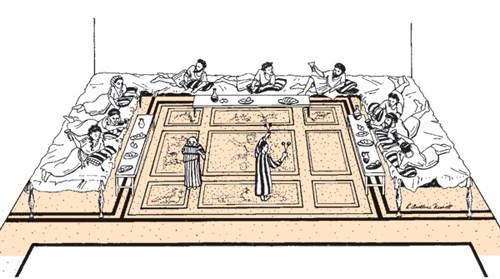
Although there is some debate among scholars whether the Pharisees, scribes and other Jews concerned with ritual purity participated in this type of banquet to any significant degree[4], it has been proposed that these banquets, better known as symposiums, were derived from the Greco-Roman tradition generally conducted in a culturally-accepted and prescribed way throughout the Roman Empire. Many homes had formal dining rooms. Other larger public rooms could be reserved, and even the temples had dining facilities. Invitations were sent. Guests were met at the door and led to the dining area by servants who then removed a guest’s shoes and washed his feet. The social standing of each guest was demonstrated by the distance one’s assigned dining place was relative to the host. Couches or cushions were arranged behind low tables around three sides of the room, leaving a large central opening. Diners reclined on their left side and elbow with their feet away from the center. The guest of honor was given the place of privilege to the host’s immediate right.   In his Gospel, John is careful to include a description of his position at the Passover feast the night Jesus spoke of a looming betrayal. “Leaning back against Jesus, he asked him, “Lord, who is it?” (John 13:25). From this narrative it is clear that, with Jesus as host of the meal, and himself lying on his left side, John was occupying the position of honor to Jesus’ right.[5]

What’s more, in Jesus’ time, the reclining position was itself a posture which connoted honor; slaves and women were not allowed to recline. Servants and even uninvited guests would often stand along the outer wall watching the diners eat and listening to their discussions and entertainment. Others were allowed to sit near the feet of the diners where they might be able to scoop up crumbs or leftovers. It was also customary for the highest-status diners to be served the choicest (and most) food. As we will see, these issues of social standing, honor, and privilege at shared meals would be challenged by Jesus (and later Paul) on a routine basis.

The center area outlined by the reclining couches held the common bowl of wine, typically diluted with water and passed among participants as a shared cup after the meal. The tables were cleared away so that the central area could be used for the symposium itself, a period marked by entertainment, singing and instrumental music, debate, or lecture. The Greek tradition of symposium was generally considered to have evolved into nothing more than a hedonistic descent into drunken promiscuity. As the Romans adopted the custom, the symposium, though still thoroughly embedded with wine and entertainment[6], was ideally meant to function as time for participants to debate a pre-planned controversy or philosophical question, or for out-of-town visitors to give a speech. Today we might put forth a question about clashes in culture, morality, or worldview to be debated around the table after the meal, or we might invite a missionary on home leave to speak to us about her work.

Next time, in post 22, we will look at the Jewish eating and purity traditions of Jesus’ day.

[1] Scot McKnight, Fasting, (Nashville: Thomas Nelson, 2009), pp. xv-xvi.

[2] McKnight, Fasting, p. xx.

[3] The recent works of Dennis E. Smith, From Symposium to Eucharist (Minneapolis: Fortress Press, 2003) and Hal Taussig, In the Beginning was the Meal, (Minneapolis: Fortress Press, 2009) are excellent resources for redefining first century church worship and fellowship activities in the context of shared meals, as well as understanding the place of the banquet in the ministry of Jesus.

[4] Craig L. Blomberg, Contagious Holiness: Jesus’ Meals with Sinners (Downers Grove, Illinois: InterVarsity Press, 2005), p. 22.

[5] The 15th century mural of the Last Supper by Leonardo DaVinci shows the diners seated and standing along one side of a long table, illustrating both the artist’s creative freedom as well as how the social custom of reclining had died out by the 1400’s.

[6] The birthday celebration for Herod, in which Salome danced for the head of John the Baptist was likely such a feast-symposium (Matt .14:6-8).

Photo Credit:  www.biblicalarchaeology.org