19. Jesus, Food, and Meals

Here we begin an in-depth look at meals in the Bible, with a special focus on the meals Jesus shared.

Food and Blessing

The book of Genesis tells us that before the fall, Adam and Eve spent the daytime tending a garden overflowing with abundant plant life, much of which was available to them as food. They walked with God in the cool of the evening, a practice of setting aside time to enjoy God’s presence. A significant component of the curse, after God exiled them from Eden, was that Adam and Eve and all their descendants would henceforth access food only by the sweat of their brows; our need for food didn’t change, but our ability to obtain it was forever made problematic.

Bread, wine, milk, oil, fig, pomegranate, fish, honey, wheat and barley are all foods associated with God’s great spiritual blessings and salvation in Scripture. Moreover, gospel as food for the hungry is a constant metaphoric biblical theme. The prophet Joel, in pleading with Israel to repent and fast after the land is overrun by locusts, reminds the people that after God’s judgment and punishment the harvest will be restored to overflowing for those who call on the name of the Lord. “You will have plenty to eat, until you are full, and you will praise the name of the LORD your God, who has worked wonders for you…” (Joel 2:26)

Isaiah prophesied a feast of rich food prepared by God for all people, “a banquet of aged wine-the best of meats and the finest of wines. On this mountain he will destroy the shroud that enfolds all peoples … he will swallow up death forever.” (Isa 25:6-8). You can’t miss the messianic picture here; by virtue of his own death shroud found neatly folded in an empty tomb, Jesus frees people from death and invites them first to remember him with a memorial meal, and, upon his return, to a lavish wedding feast.

 A Savior for a Hungry World

I have come to the conclusion that Jesus, unlike his hermit cousin John, was a foodie in the most marvelous sense of the word. God’s only son consented to leave his glory behind in heaven and take on a fully human form. That alone is worthy of praise. But, to view the New Testament Jesus through the eyes of food and meals, as one who was just as dependent on the earth’s fruits and people’s hospitality as we are, brings us to a position of wonder. This Jesus, son of God, author of creation, able to partake of heavenly banquets at any turn, master chef of manna and vintner fine wine, arrived poor, needy, hungry, and dependent, and he accepted this lowly position on our behalf. Moreover, Jesus spent a good deal of his time eating in the company of others, even enemies, sharing food and companionship, and using these opportunities to connect, teach, confront and love; in short, he “used simple hospitality and mealtime conversations to share the gospel.”[1]

In his gospel, Luke intentionally presents Jesus from birth to death, resurrection and ascension, as the means of salvation, and it is Luke, more than any other of the gospel writers, who characteristically sets his salvation stories of Jesus in the context of meals, fasts, feasts, and food.[2] Jesus’ cousin John abstains from wine and other fermented drinks in the priestly way of Samson, Samuel and the Nazirites (Luke 1:15). In her song at Jesus’ conception, Mary sings of God’s favor and mercy in filling the hungry with good things (Luke 1:53). For lack of anything better, Mary and Joseph must lay Jesus in a manger in Bethlehem, a crude feeding trough for animals (Luke 2:7). Later, Jesus himself would say, “Consider the ravens: They do not sow or reap, they have no storeroom or barn; yet God feeds them. And how much more valuable you are than birds!” (Luke 12:23-25). The Bread of Life, cradled in a rude manger “begins to symbolize how God will feed his “hungry” people…through Jesus.”[3]

[1] D. Webster, Table Grace: The Role of Hospitality in the Christian Life, p. 14

[2] For an excellent overview of the meal scenes in Luke, see books by Tim Chester, A Meal with Jesus: Discovering Grace, Community, and Mission around the Table (Wheaton, IL: Crossway, 2011) and John Paul Heil, The Meal Scenes in Luke-Acts: An Audience-Oriented Approach (Atlanta: Society of Biblical Literature, 1999).

[3] Heil, The Meal Scenes in Luke Acts: An Audience-Oriented Approach, p. 19.

17. Willfully NOT Caring

When our daughter left for college, my husband and I found our table manners slipping. With an empty nest, we both became exceptionally stretched, having taken on more and more responsibilities both at work and at church at the same time the health of our parents began a slow decline. Not surprisingly, our mealtimes suffered. I’d find myself standing in the kitchen too exhausted to be creative and too hungry to care. On more than one occasion we settled on having a bowl of Cheerios for dinner, only to discover the milk had soured because neither of us had had the time (or inclination) to stop for groceries in the past two weeks. Sound familiar? Well, this is not abundant living. Regularly sitting down at night for cereal, ordering a pizza that’s too costly, financially and calorically, or grabbing a sub sandwich, which completely transgresses our daily sodium limits indicates something’s amiss. It is subsistence living. These are not meals. As a little family of two, our garden was choking from weeds of inattention. We had fallen out of practice. So, we’ve recently pared down a few obligations and recommitted ourselves to healthier foods, intentional conversation and prayer at the table, to taking homemade soups and casseroles to our parents, and to inviting others and our parents over more often no matter how messy our home might be.[1] “Whether we are reluctant or eager, we should understand that hospitality was meant to be an opportunity, not an imposition.”[2]

Accordingly, at this stage of my life, when Jesus asks me what I want to nurture at my family table, and during the evening that follows, I find I want to grow six things: simplification, grace, gratitude, empathy, stewardship of the evening hours, and wisdom. I want my husband’s and my life to be less complicated, less filled with noise and calendars and exhaustion, and more centered on God, each other, our aging parents, our church family, and the stranger we usually avoid by pretending s/he doesn’t exist. Our table comfortably seats six people, yet almost always only two places are set. I pray for the room to let God into our packed, busy lives.

My first response has been to simplify our meals. I still make menus and shop ahead (a later post will have ideas), but our evening meal is far simpler than in days gone by, with fewer ingredients, less food (and less meat) overall, and a reliance on quick but healthy main dishes, with vegetables, salads, breads, and fruit to round out the menu. When we host others at our table, the idea is to dwell together in God’s presence rather than play at entertaining our guests. As a result, my new practice is to keep the meal simple enough so that all enjoy and participate at the table-even me.

I want us to invest our time in knowing God, and through experience of his grace, to practice being more gracious in serving family and stranger alike. I want God to know how grateful we are for the ‘Bread of Life’ in Jesus Christ, for this food that satisfies above all others. I want to stop pushing the awareness of the needs of others to a dark, dusty corner of my mind, and bring that certainty to the very forefront of my heart and my family’s awareness. I no longer want to insulate my mind with deliberate ignorance about the plight and sufferings of others, especially where food, and the impact of our own food and economic behavior is concerned. I want to invite the stranger to eat with us.

More than anything, I want to stop: wasting time and food, and willfully not caring. I want our evening meal to signify day’s end, and to mindfully help us transition into a night spent in God’s Word, in prayer, and in his presence as we actively participate together in the start of this new day. All of this will take the sort of wisdom only God can provide, and I want that for my family and the friends and strangers with whom we dine. I hope my “wants” resonate with you at this stage in your life.

There is a box below to leave comments, and a LIKE button to share if you find what you read helpful.  PLEASE!  Take a moment to give me some feedback, and/or start a conversation.  I am a TEACHER.  I welcome you into my “classroom”!

[1] It is critical to get over any pride or guilt about the condition of your home. When perfection is your goal, then you are not being a faithful host. Hospitality is about enfolding guests in love, comfort, and respite, even if they must share in the messiness of your life. Having a “Martha” approach to hosting a meal becomes more about “entertaining” than it does about using table time to invite, nourish, challenge and send your guests out prepared to shoulder the co-mission of Christ. Obviously, you don’t want to convey to guests that you are a slob, and that your home might not pass a cleanliness test from the public health inspector! Still, a little dust, and “things lying around” should never keep you from opening your table to others.

[2] Douglas Webster, Table Grace: The Role of Hospitality in the Christian Life (Fearn, Scotland: Christian Focus Publications, 2011), p. 11.

15. Evening: the New Day Starts Now

The truth is, we find getting together at the table (even just getting the food into the house) a practical challenge in a today’s world. In Eden, God invited Adam and Eve to eat all sorts of plant life.  God fed them well.  There was, of course, that one forbidden food.  Now, forbidden foods have a way of not being good for us.  A diabetic must avoid sweets.  Walnuts or shrimp are life threatening for people with a nut or seafood allergy.  But, Adam and Eve, driven by what Griffiths calls the vice of curiosity, made a fatal mistake for all of Creation.[1]  The intimacy we had with God was broken, and not until Jesus came- eating and drinking, suffering, dying, rising, forgiving our sins, and inviting us to the feast of the Lamb-did we have any hope for restored relationship with God.

The table, then, at home and at church (table and Table) is the place of invitation, nourishment, acceptance, forgiveness, gratitude, learning, growing, and going.  It is as much about relationship building and disciple-making as it is about food.  In both instances, we come hungry for food and companionship with one another and with God.  In both instances, we are invited and fed by something or Someone who had to die for us to live.  God’s Word fills us.  In both instances, we leave with a co-mission to go and do likewise for our neighbor.  And, in both instances, we can stand with Jesus and proclaim “that we live by ‘every word that comes from the mouth of God,’ because that word has everything to do good things, with real nourishment for body and soul.  With the eyes of faith, Christ comes to be known as that word, incarnate, embodied, the Word of God, present then and now.  Christ is then the invitation, the way we have of re-creating that living relationship of intimacy with God that the original humans knew in the garden.”[2]

 Rethinking the Practice of a Shared Evening Meal

I believe we need to be at the table each night, fully present and alive to the invitation, provision, and gratitude a meal together involves, with a keen insight that compels us to keep families knit together and to regularly weave strangers into our midst. In our homes and churches, the time spent at the table, especially in the evening, is never wasted.  It slows time down, it reconnects us with those we love as well as with the guest, it provides a shared training ground for life’s challenges, and it generatively introduces the next generation to the saving ways and nourishment of a life in Christ.  Perhaps most importantly, I suggest that it affords us the time for opening a new day together because the rhythms and predictability and rightness of the Christian practices transform the way we view the world and time.

Dorothy Bass considers how attending to the practices shapes a day in her book Receiving the Day: Christian Practices for Opening the Gift of Time.[3]  This book unlocked for me an entirely new perspective on how a regular “day” could flow.  Our modern notion is that each day starts at sunrise and continues until bedtime. However, a careful study of the creation story in Genesis 1 literally flips a day on its head; God created, there was night, then day.  In practice, then, a new day actually begins in the evening.  Can you believe it?

After Adam and Eve sinned, God was strolling in the garden in the cool of the day looking for them.  Evening was a time for walking with God.   Imagine the implications of making it a regular faith practice to restructure your “day” so that a new day begins as you get home from work or school.  Then you can consider the place of the evening meal as a shared practice from the ancient Jewish custom of beginning the new day in the evening.

Gathering family, friends, and strangers around the table for supper might actually be considered a corporate event for greeting the new day.  In other words, the evening meal is a threshold we cross together, a natural transition from the work and school day that is behind us to the new day ahead, filled with all of God’s creative possibilities.  At the evening meal, we gather together to be nourished, but not just with food.  We prepare to spend the evening walking and resting with God as Adam and Eve did, putting aside a day in which we may have done or said something we should not have, or failed to do or say something we should have.   God intends for the day to be done.  And at the table, together, we transition to a new day in Christ that is immediately ahead of us.

I don’t know about you, but this was a revolutionary idea for me, that nighttime be less a time of recovery and more about active preparation.  For me, getting home from work was always about wrapping myself in the comforting insulation of house and family.  It was a way to hibernate and shield myself from the outside world, to recover from this day, and to literally shed this day’s responsibilities.  In doing so, getting a nightly meal on the table always seemed just one more obligation in a long day’s to-do list that included work, laundry, packing lunches, helping with homework, paying bills, and church committee meetings. Next time we will dig into this idea of new day like hungry teens into a pizza!

Julie A.P. Walton, Ph.D.

LET ME KNOW WHAT YOU THINK ABOUT ALL THIS!  IT HELPS AS I W RITE AND REVISE 🙂

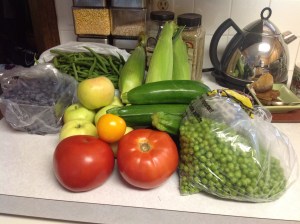
Featured Image credit:  K.Richardson, 2016

[1] Paul J. Griffiths, The Vice of Curiosity: An Essay on Intellectual Appetite (Kitchener, Ontario: Pandora Press, 2006). In this short treatise, Griffiths discusses the darker nature of curiosity as a means to owning and controlling knowledge for power, the same kind of appetite Adam and Eve gave into.

[2] Cathy C. Campbell, Stations of the Banquet (Collegeville, Minnesota: Liturgical Press, 2003), p. 13.

[3] Dorothy C. Bass, Receiving the Day: Christian Practices for Opening the Gift of Time (San Francisco: Jossey-Bass, 2000).

14. A Significant Motif

So, we can see that as a custom, the regular, planned, healthy shared meal at home is difficult to accomplish on a consistent basis without someone being intentional about it; the family supper and the church family supper are less common events in these days of compressed and multi-layered schedules.  But, if we consider the shared meal (especially the evening meal) as a practice, in particular a Christian practice, it then has the potential for both common and sacred relationships in the daily lives of believers.  So even though it may often seem like a lost practice, we should at least consider if it is an important practice in need of attention, intention, and restoration; it is time to explore why eating together matters.

People must eat, and every single thing we eat was once a living entity as plant or animal.  So there is always this built-in truth that for us to eat and live, something else must be sacrificed.  It is interesting that Jesus started his ministry not with fortifying food, but a fast.  In Matthew 4 Jesus fasts forty days in the wilderness.  Now, a forty-day fast will leave most humans at death’s door, famished, literally starving.  How fitting that Satan’s first tempting volley is to entice Jesus to eat bread.  While it feels both farcical and predictable that Satan would dare tempt the Bread of Life with earthly bread, we must remember that Satan knew that Jesus was both man and God, and appealed here to Jesus’ human need to eat. But, Jesus responds, “It is written: ‘Man does not live on bread alone, but on every word that comes from the mouth of God.’” (Matthew 4:4)[1]

There is a significant motif here that must not be missed.  Where do Christians come together, on a regular basis to be nourished, satisfied, and sustained?  It is at the Table.[2]  At this Table, we eat the bread that is Christ’s body, and drink the cup that is his blood.  Someone has died so we might live.  It is a central Christian practice for believers to share this meal, as it confirms and affirms our identity as God’s people living out our faith in a family of believers. In the early Church, Paul puts it this way: “The cup of blessing that we bless, is it not a sharing in the blood of Christ? The bread that we break, is it not a sharing in the body of Christ?” (1 Corinthians 10:16 NRSV).  Paul emphasizes the shared nature of Communion.  In a way, it is the family meal for the people of God.

In our sacred meals at church, we live out, again through shared practice, the saving grace of Jesus Christ.  Side by side around this sacred Table we are invited in our hunger to partake, in our wounded-ness to be healed, and in our loneliness to be a welcome part of the Body.  As one Body we look inward to Christ the Word, remember who he is, the sacrifice he became, and the grace with which he’s invited us, and we eat together. As we leave this Table, still side-by-side, we are forgiven, fed, and fortified to look outward beyond the Table, our eyes opened to see Christ in one another, and to take his gospel to a hungry, wounded, and lonely world.  Our shared meal at the Table “is specifically an act by which we are enabled to discern the world, to see and respond in a manner that is consistent with the reign of God.  Our vision for the world is renewed and we are oriented with the will and purposes of God…[it is this] Supper [that should] foster a capacity to see and act with courage, integrity, love, and justice in the world…”[3]

In a curious way, this suggests what should also happen at home. We meet around the common family table to be fed, a shared meal for our physical body, as well as sustenance for our social and familial needs to connect, and also, because for Christian families, to share God’s Word, that is, Christ the Bread of Life, is to grow together as a family in intimacy with God.  This is the true ‘tie that binds’ and strengthens us two and three times a day to do God’s work in a hurting world.  So, in daily meals at home and common meals at church we practice all that it means to consume both our daily bread and God’s Word in one another’s company.  In return, we benefit from all the shared meal has to offer-a safe place to BE- to belong, be heard, be nourished, be affirmed, be forgiven, and be taught.

In short, the table and the Table both share the common elements of a Christian practice: we are invited to partake of what only God can provide.  In gratitude we are nourished and formed into more godly people for work in God’s kingdom.  It is beautifully simple.  At least, it should be.

Let’s Eat!  Together!

~Julie A.P. Walton, Ph.D.

[1] Jesus is quoting Deuteronomy 8:3, where Moses reminds Israel of the manna God provided to quell their hunger in the desert that they might know that life depends on every word, in particular the Ten Commandments, that comes from God’s mouth.

[2] For the purposes of this book, Table refers to the sacred meal of the Lord’s Supper, while table connotes the place where any common meal is shared.

[3] Smith, G.T., A Holy Meal: The Lord’s Supper in the Life of the Church, p. 74.