12. Is There Food on Your Table?

In Acts 2:42, we are told about the first believers:  “They devoted themselves to the apostles’ teaching and to the fellowship, to the breaking of bread and to prayer… All the believers were together and had everything in common (v. 44)… They broke bread in their homes and ate together with glad and sincere hearts, praising God and enjoying the favor of all people.” (v. 46-47)

A study of the communal meal practice of the first century church reveals a radically different model from our present-day attitudes toward shared meals.[1]  Why did their shared meal practices disappear over time, and why, today, do our foodways and mealways look so different?  A foodway is an accepted term that describes the habits and practices of food consumption and production in a cultural, social, or economic context, and shows us “how societies construct notions of self and community.” [2],[3]

The North American approach to food has shifted most dramatically in the past forty years, and seems absurdly paradoxical even for Christians because our foodways swing between two poles, one of apathy and ignorance, the other of obsessive and compulsive control. We now have 24-7 cooking shows on television, yet very few of us actually cook anymore.  We say we have no time to eat, but most of us are overweight, a symptom of eating too much too often.  Time is scarce, while cheap (and unhealthy) food is overabundant.  We spend millions of dollars each year on dieting (i.e. we spend more in an attempt to eat less).  Some of us overdo, while others do nothing; some of us are indifferent to our health and healthcare, while others’ anxiety about their health creates fanatical control issues.  Most people shun regular exercise while others spend far too many self-absorbed hours in the gym. We either become overly fastidious about the quality of our food sources, or we consume vast amounts of processed foods we know are not good for us.  (As one example, boxed cereal, a highly processed food, once promoted as just one part of a healthy breakfast, has become the default nighttime ‘meal’ when we are short on time, energy, or creativity.)  Our dining and kitchen tables are repositories for mail and school papers rather than places for a shared meal.

Since the dawn of time, people have been hunters, gatherers, farmers and shepherds.  Today we are much more disconnected from understanding how food reaches our tables.  At home and at church, we take pride in our manicured lawns and landscaping, but rarely consider using the church property to grow food for others with no land.  It seems that we are hungry, but not for food, and that Christians in particular need to think and pray about their own selected foodways and mealways.

Thoughtfulness can go a long way to help us find a healthy middle ground where food and meals are concerned.

“To grow food and eat in a way that is mindful of God is to collaborate with God’s own primordial sharing of life in the sharing of food with each other.  It is to participate in forms of life and frameworks of meaning that have their root and orientation in God’s caring ways with creation… Food is about the relationships that join us to the earth, fellow creatures, loved ones and guests, and ultimately God.  How we eat testifies to whether we value the creatures we live with and depend upon… When our eating is mindful, we celebrate the goodness of  [all creation has to offer], and…acknowledge and honor God as the giver of every good and perfect gift.”[4]   In other words, we must relearn what it means to care about, and care for all creation, including ourselves.

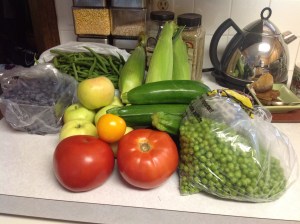
Perhaps even more importantly, our inattention to meals and cooking means we have stopped teaching our children about foodways and meal practices (mealways).[5]  In my experiential nutrition class a few years ago, I handed a bunch of fresh carrots from the farmers’ market to a student to peel.  I can still see him standing at the sink, carrots in hand, exclaiming with confusion that these could not possibly be carrots, because in his world all carrots were the size of one’s pinky finger and had no peel or green leafy tops.

Fortunately, young people are beginning to show a resurgent interest in healthy (and just) ways to grow, prepare, and share food!

[1] A subsequent chapter discusses the meal practices of the early Church in detail.

[2] Angel F. Mendez-Montoya, The Theology of Food: Eating and the Eucharist (Chichester, UK: Wiley-Blackwell, 2012), p.6.

[3] I have coined the term “mealway” to describe the general habits and practices surrounding how a society or culture consumes meals.

[4] Norman Wirzba, Food and Faith: A Theology of Eating (New York, New York: Cambridge University Press, 2011), p. xiii, 4

[5] This is a critically important point, as we will see.  Much is learned in the kitchen and around the table that actually has little to nothing to do with food.
10. The MEAT of a Christian Practice

In the last post, I introduced the idea that our customs are not the same thing as a practice, and promised to sketch out the common elements of a Christian practice.

Let’s start with the idea of customs.  As an example, meal customs are informative.  Why did Jesus recline at meals?  Why did the Jews wash their feet before entering the dining area?  Why did Jesus tell the story of the man who threw a banquet for friends who were no-shows?  As we will see in subsequent posts, the meals that Jesus attended were shaped by the influences of Greece and Rome, as well as Jewish tradition, and, as a result, diners’ behaviors were circumscribed by particular customs.  A fundamental question for us is how did Jesus’ first followers move from those religiously and socially-traditional meals into the practice of the first century church in which shared meals were an integral part of the worship experience?

If a Christian practice is an activity that is regular, shared with other believers, and designed to strengthen our common life together as Christians, then it might be helpful to try and sketch out what I believe are the common elements of a Christian practice on our way to showing how the shared meal qualifies as such a practice.

As noted, there are several distinct Christian practices which we do together in Christian community, including worship, prayer, fasting, Sabbath-keeping, stewardship, the Lord’s Supper, forgiveness, and, as I claim, the shared meal.  The common elements of these Christian practices are invitation, provision, gratitude, nourishment, and formation.

God invites us into a particular practice whether it is worship or prayer or a shared meal.  We are invited to enter the practice by entering into God’s and one another’s presence, entering into rest and restoration, and entering into community and communion with God and one another.  Thus, there is always a kind of prologue to each practice, in which we mindfully enter into the practice by divine invitation to do so.  From the perspective of a shared meal, we accept God’s invitation to take time out to eat and share and rest together at table and in God’s presence.

There is an element of mutually beneficial provision in each of the practices.  We are individually and corporately provided for with charitable care and concern out of God’s grace and abundance, paradoxically finding in each practice an opportunity to serve as a way of providing for others.  We commit to praying for others, we fast together in lament and petition for a particular provision, and, when we worship and share in the sacred meal of Holy Communion, we realize God’ provision for our own life through Jesus’s life, death, resurrection and coming consummation.  Moreover, we learn, with grace and humility, to accept others’ service to us despite our ever-undeserving state.  Most importantly, God provides this time that we may to set it aside for Himself, others, and for our in-common well-being.

Each of the Christian practices contains the attribute of gratitude.  There is nothing we practice together which does not raise up an unquenchable desire to thank God as the source of all things good, and praise him for being our Creator, Savior, Counselor and King.  When we share a meal, we say grace before eating because we are so grateful for God’s ongoing presence in and provision for our lives, and for the food before us that will fuel our service to the kingdom.

The Christian practices nourish us by both feeding and satisfying our physical, emotional, and spiritual hungers to the point that we, in turn, are energized and able to serve God and neighbor.  We often enter into a particular practice with a mindset that there must be “something in it for me.”  The reality, as is often the case in our Christian walk, is that God intends the practice to show his glory, and create in us as the body of Christ the deep love and sacrificial posture we need to love him and serve our neighbor.

Lastly, the Christian practices all share the element of formation.  The profoundly formative nature of the practices is nearly beyond comprehension.  The practices introduce us to the kingdom of God, then reinforce and direct our discipleship.  We begin to grasp that all the Christian practices are inter-related, and that the more we practice them simultaneously in community, the stronger the weave of our life in common together.  To put it another way, the practices of the first Christians give us a firm anchor in how to live out our common lives (Acts 2:44).  Moreover, the practices act as a compass to direct us-in Christian community– along a path of growth and maturity in our faith, what we often call our ongoing development in Christlikeness.  It is the daily practice of our shared prayer, worship, meals, Sabbath-keeping, and forgiveness that leads, over time, to human flourishing- for ourselves and those we serve- to God’s glory.

Finally, then, we can ask if, in the lives of Christians, the shared meal is simply a custom handed down from earlier generations, or if Christians should view it from a faith perspective as a Christian practice.  It has always been a universal custom for people to eat together, no matter what their belief systems entailed.  As far as family and church family are concerned, it seems to me that we treat the shared meal as custom, easily shaped by the culture and the times, when it may actually be meant to be approached as a central communal practice in the Christian home and in the Church.  The shared meal, like other Christian practices, embedded with invitation, provision, gratitude, nourishment, and formation has the deep potential to fortify and direct our individual and common lives in ways that might surprise us.  So, it is to the notion of shared meals as faith practice we wll turn next time.

Thanks for sharing this space!  We are steadily moving into the MEAT of the shared meal as Christian practice!  There is a button below to :LEAVE A COMMENT.  I would appreciate hearing what you think.

~ Julie A.P. Walton, Ph.D.

(Featured image photo credit:  K.Richardson. 2016)

9. Our Common Life Together

So, we see that being a practicing Christian takes a lot of practice-that daily attention to the Word of God, the ways of God, and the will of God.  Practice makes us better.  What have you been practicing with and for other believers in your faith life?

Of course, participating in the shared Christian practices is not simply a matter of making them a priority subject to your will. Practices are not something to control.  On the contrary, Christian practices require active submission.  As an example from my own life, once in a while, when it seems that for weeks I have been home only to sleep and shower, I will wake up on a Sunday morning and contemplate the pleasures of staying home from church, “just this once”, drinking coffee, reading, catching my breath, and having the house to myself, maybe taking a long walk.  Over the years I have come to label this misplaced desire for home and solitude as “red flag Sunday” because rather than being at church, actively practicing with my believing family and sharing the Lord’s meal with them at the Communion table, I am being tempted to stay home alone attending to my own leisure while pretending that worship-and my place within it- is inconsequential.  In these instances, I must recognize Satan’s lie; there is nothing corporate or worshipful about staying home alone on Sunday morning.  If you are like me, you dutifully go on to church anyway because this is how you participate in a practice; worship, as a shared Christian practice, means your presence is important.  As a church member, you have made very public promises to this congregation to be there for and with them.  In my experience, sitting in worship and Sunday school on a “red flag Sunday” is always the most wonderful morning in God’s presence, praising him together with my beloved church family, and with absolutely no regrets.  A life of practice, then, gives us the strength to be submissively yet firmly obedient in times of temptation.

As you may have guessed by now, these shared Christian practices are, by nature, meant to infuse, inform, and support life, minute by minute, day by day, and season by season as we yield to their power through Christ and the Holy Spirit to structure and direct our life.  They are the cure for the arrhythmic, time-starved heart threatening to arrest your soul’s health and growth. They are simple.  Curative.  Restful.  Spacious.  Grace-full.  Is it not, after all, a life worth considering, when you are asked each day by the Lord,

          “Where are you?”

And, in face-to-face confrontation,

          “What do you want?” 

The shared Christian practices, therefore, are meant to strengthen us both individually and in our common life together as believers.  They help us think critically together, and to develop healthy responses to cultural temptations and evils we must resist, especially those that threaten our common life together.  Craig Dykstra puts it this way:  Our Christian practices give us abilities for “criticizing and resisting all those powers and patterns…that destroy human beings, corrode human community, and injure God’s creation.”[1]   Not long before losing her earthly life to cancer, Kara Tippets wrote of the importance of showing up for one another,

“Friends. Community.  It is the only way to know and be known.  It’s where we see our own humanity and frailty, our gifts and our weaknesses.  When we show up for one another, we invade each other in love and become witnesses to the truth that trials and sickness and pain are not the whole story.  There’s more, so much more. We can remind one another that our lives are not a mistake.  And, more importantly, that we are loved with and everlasting love.”[2]

So, it is in our shared Christian practices we show up for one another in good times and bad. There are so many things we do today, individually and as a society that foster misguided patterns of thought and behavior.  In essence, we too easily become thoughtless.  We waste natural resources, abdicate care of the poor, and prize our individualism, civil rights, and retirement portfolios.  Sustained participation in the shared Christian practices instead teaches us to sniff out injustice, to discern social patterns which threaten family, to give up our right to self, to learn to serve others wholeheartedly, and to work to redeem and restore our all-too-common human penchant for destroying rather than stewarding Creation.  And it teaches us that there is strength in doing these things together.

To What Have You Become Accustomed?

Of course, not everything we do is a practice, so we must distinguish between practice and custom.  In the United States, it is customary to sing the national anthem before sporting events, to use a knife and fork when eating, to have cake on a birthday, for a man to give a woman a diamond ring for engagement, to hold parades on major holidays, and to follow an agriculturally-based school calendar.  In the same vein, there are many once-common customs we have lost.  Men no longer wear dress hats or women dress gloves.  Generations no longer live together in sprawling family units.  It is no longer customary for children to walk to school.

What customs have led to habits that might need your discernment?  Staying up too late watching television?  Skipping meals?  Skipping church “just this once”?  Non-stop use of your cell phone while in the presence of others?  Dressing provocatively?  Living together outside of marriage?    Yes.  Your customs are visible in your daily actions and decisions.

In the next post, we will look at the common elements of a Christian practice on our way to studying the shared meal in the life of believers.

Please SHARE this with friends!  Thank you for following along.  Wish we could pull up a chair and share a pot of tea!

~Julie A.P. Walton, Ph.D.


[1] Craig Dykstra, Growing in the Life of Faith: Education and Christian Practices, 2nd ed. (Louisville: Westminster John Knox Press, 2005), p. 43.

[2] Kara Tippetts and Jill L. Buteyn, Just Show Up: The Dance of Walking Through Suffering Together (Colorado Springs, Colorado: David C Cook, 2015), p.11.

7.God is the Author of Time (and He has Given you Enough)

So, even though we have work to do to get our priorities and loves in order,  we must also admit that doing such things can inadvertently create a works mentality that is, for most practical purposes, pharisaical.  Remember, when we come to Christ, we bring nothing but our sin, our sorrow, and our shame.  His atoning work on the cross is what gives us a hope that pours forth in praise, thanksgiving, and adoration.  So, there is nothing we can do or bring.  Christ is all, and our discipleship and growth in Christ-likeness is “built entirely on the supernatural grace of God.”[1] It is true that sometimes we must persevere through the wilderness of boredom, apathy, busy-ness, and fatigue in carrying out the disciplines and practices which frame and bolster our faith– much like an athlete who doesn’t feel like going to practice today goes anyway and pushes through the adverse emotions.

You Don’t Understand!  There Isn’t Enough Time in a Day!

It is precisely for the pressed and dry times in life that we deliberately set our sights on holy living by fixing our eyes on Jesus.  It is an attitude that defies “time” and declares fidelity to looking for and leaning on God in all life circumstances- what is typically called a disposition.  In other words, our disciplines and practices lead us to become disposed to actively seeking and acknowledging God’s presence and sovereignty in every aspect of our lives.  All the same, since the Fall, humans have been mostly disposed to avoiding God.  “Then the man and his wife heard the sound of the LORD God as he was walking in the garden in the cool of the day, and they hid from the LORD God among the trees of the garden.  But the LORD God called to the man, “Where are you?””  (Genesis 3, 8-9).

I think God still calls to us today,

                                                                                 “WHERE ARE YOU?”

And a typical response is,

“I’m here Lord.  But, I’ve been so busy!”

These virtues and habits that develop when we practice our faith help us become inclined, or disposed toward God and the things of God.  But they are not ““natural” in the sense of being inborn capacities or abilities; rather they are “second nature”: acquired… over time by participating in the routines and rituals of a tradition…”[2]  This is why we must be open to the practice of our faith on a daily basis.

Likewise, our second nature is a disposition largely affected by our practices, especially those that we learn through handed-down ritual and attend to with consistency.  Moreover, there is something unique and lasting about a practice.  Alasdair MacIntyre defined a practice as having significant internal goods, meaning that the object and consequence of the practice can only be achieved by regular absorption in the practice itself.[3]   Take the shared meal as an example.  As a Christian practice, the internal goods of a shared meal include fellowship, acknowledgment of God’s provision and presence, generous sharing and hospitality, and acting as a regular place and space for testimony- learning about and sharing the gospel.  If, at meal times, we come to the table only because we physically need to eat, then we fail to seek the truly internal goods of the shared meal; eating in itself is not a practice precisely because we can eat anything, anywhere, at any time in our culture.

So, practicing one’s faith as lived devotion through spiritual disciplines and Christian practices help a person-even a child- become stronger, healthier, and more resilient in the face of life’s unpredictability.  Think of it this way: your heart has an internal pacemaker responsible for what is called normal sinus rhythm which stimulates the heart to beat in a regular, predictable way, both at rest and in response to physical or emotional stress.  Our individual and corporate faith practices strengthen the faith life’s pacemaker if you will; attentively practicing our faith miraculously generates a consistent and healthy life rhythm, and the death grip of too little time in our lives is instantly relaxed.  Instead, our time becomes permeated with God’s presence, and we become more skilled in being still before him.  There will continue to be moments when you feel compelled to hurry or, perhaps, inclined to idle mindlessness, but you won’t ever again need to feel harried or bored.  It sounds simple, and it’s meant to be.  Restlessness fades when you practice making room for God in your life.[4]  It is an important thought with which you must wrestle:

                                                        God has given you enough time.


~J.A.P. Walton, Ph.D.

[1] Oswald Chambers, My Utmost for His Highest (Grand Rapids, Michigan: Discovery House Publishers, 2011 mobile application), October 21.

[2] David I. Smith and James K.A. Smith, Teaching and Christian Practices: Reshaping Faith and Learning (Grand Rapids: Wm. B. Eerdmans, 2011), p.8.

[3] Alasdair MacIntyre, After Virtue, 3rd ed. (Notre Dame: University of Notre Dame Press, 2007), p. 187.

[4] If you are unsure where to start, think about the practice of Sabbath-keeping.  We consistently underestimate the value of the rest of God, and the vanity of our incessant striving after things of the world.  For ideas, see Marva Dawn’s book, “Keeping the Sabbath Wholly” and Dorothy Bass’ book, “Receiving the Day”.  If you are unsure how to start, think about disconnecting from any common-day addictions that may sap your available time, including the television, telephone, internet, fitness center, children’s activities, shopping mall, and, perhaps, work itself.

6.Spiritual Discipline or Christian Practice?

CHAPTER TWO: A FAITH PRACTICE TAKES PRACTICE

The Christian life is a training ground

As a Kinesiology professor at a Christian college, my office was in the athletic complex. Around 3:00 p.m. on a typical weekday, athletes would begin streaming past my door on their way to practice-a two-hour period for which the coaches had made distinct plans for individual and team improvement. Most of us can relate to this notion that sports performance is enhanced by daily practice of the techniques and strategies necessary to be competitive. The same holds true in music; becoming proficient on one’s instrument takes years of daily practice with repetition of scales and scores on one’s own, as well as corporate practice with the band, orchestra, or ensemble.

So we have a natural understanding that these kind of skills-athletic and musical- require much repetitive practice to grow as an athlete or musician. But, this is often where this application breaks down. Once out of school, our busy lives fog our thinking when it comes to purposeful planning and practicing and cultivating maturation in our faith life. The Christian life is a training ground for eternity. We must, then, submit to its daily practice.

There are two important ways Christians can nurture and deepen their faith. One is to participate in any number of spiritual disciplines like the study of Scripture, prayer, fasting, and observing the Sabbath. The other is to engage in multiple Christian practices including worship, prayer, feasting, testimony, and the breaking of bread.

Notice here the similarities and differences between the two approaches. Both the spiritual disciplines and Christian practices take intention, planning, and follow-through. They require submissive and sacrificial practice that is consistent and repetitive, not unlike the way an athlete shows up to practice and follows a coach’s directions and plan. Both take time and personal investment.   Most importantly, both are formative in nature, meaning that when practiced consistently they become embedded in our daily responses, rhythms, and reasoning, and make us more skilled at handling change, challenge, and the needs of others with grace and wisdom. In other words, through time and practice we mature in virtuous living and Christlikeness, training to one day stand on holy ground.

The critical difference between spiritual disciplines and Christian practices is that the spiritual disciplines are practiced individually, much like a musician practices scales, whereas the Christian practices are performed in and through community with other believers-with an ensemble or the entire orchestra if you will. One has to do with “me” and the other “we”. Table 2.1 helps show where these activities overlap and where they are distinct.

Table 2.1. The Spiritual Disciplines and the Christian Practices

Both (Me and We) Spiritual Disciplines (Me) Christian Practices (We)
Prayer Sabbath keeping Worship
Bible study Solitude Hearing Scripture & teaching
Fasting Frugality Fellowship
Confession Honoring the body Feasting
Forgiveness, Reconciliation Testimony
Lament Hospitality
Submission and Obedience Co-mission
Sacrifice Breaking of bread
Stewardship
Discernment

Undertaking these actions in both our individual and corporate Christian life is not easy, especially at first. Life has a way of getting in the way. But, the more we practice the more likely these will become life habits that help condition and train us in ways which fortify our souls and insulate us against life’s trials and vagaries. In every way, they strengthen our ability to respond to God and neighbor. More importantly, the spiritual disciplines and Christian practices work together to form in us the twin habit of looking for God and looking to God in every life situation.  We will continue this discussion of being a practicing Christian next time, and you will begin to understand how and why the shared meal is, truly, a Christian practice in our homes and the Church.

If this blog is helping you, please leave a comment to stimulate further discussion!

5. Come Back to the Table!

God’s Invitation: Come Back to the Table

Be still. Know God. Slow down. Look for God. Listen to Jesus.   Sit in God’s presence and soak up his wisdom, grace, and glory. Ask God to heal the brokenness you see all around you. Learn to take the time to enjoy more moments in the company of other believers. Be still. Know God. Peter puts it well, “His divine power has given us everything we need for life and godliness through our knowledge of him who called us by his own glory and goodness.” (2 Pet 1:3).

As a rule, we are perversely unskilled in being still before God despite being so good at sitting, as our growing incidence of obesity demonstrates. Being sedentary is not the same as being actively still before and present to God. Do you remember the last time you were still but not mindfully absent, silent but not sleepy, fully present to God and alive to his presence? You may be out of practice.

For those of us in a perpetual time crunch, we may need to consider the culture’s aggressive choke-weeds that strangle our schedule and keep us from seeking God’s kingdom first. To recognize the grace of God’s eternal presence, we may need to purge our lives of too much time spent in vain, and to shun the lie and idolatry and vanity of the notion of time ‘management’. It is not that we don’t love God; we just don’t have time to look for him, listen to him, or live for him, and our attempts to manage our time, to ‘schedule’ God into our days are often futile.

Because of our busy lives, we are out of practice in being still before God, and this throws us out of rhythm as well. The practice of being still before God on a regular basis helps us understand that even for those who are alone for extended periods, we are not really alone. There are ways to yield that time to God’s presence, giving ourselves to service, starting perhaps with determined and prolonged periods of prayer. Even from a position of poverty, whether financial, physical, or spiritual, we can minister to others.

 Thus, when we are bored or lonely, we can pray. We can recite God’s Word, buried in our hearts after years of practice. We can sing hymns of praise. We can write or email notes of encouragement to others. We can sit by a window and watch God’s creation and marvel at its rhythms and beauty. If we are able, we can make someone a meal or a plate of cookies. We can recall of all the ways, over our lifetime, that God has directed and protected us, and praise him for his care. So, when time drags (as it must for nearly all of us at some point in our lives), the first question to ask is, “How can I live out this time wisely for God’s purposes?”

In many ways, life is a long training session, and we train now to one day exchange the temporal for the eternal, not because we must, since our salvation is assured apart from our works, but because we can. A musician practices scales. A basketball player practices free throws. An artist practices by making sketches, a cook practices a new recipe, doctors practice medicine. In the same way, our faith calls us to practice a faith-full life, and to teach and encourage others to do the same.

It has taken me years to learn how to respond to this question, “How are you?” My typical introvert-induced answer is a quick and shallow quip meant to fend off further conversation because I tend to freeze up at the thought of becoming involved or being asked to do something. Really, how selfish is that?

But, how we ask and answer the question is important. Asking others how they are should not be a customary social nicety. Rather, its motive should be that you care about the lives of the people in your midst. So, I am learning to belay the automatic response of “fine” or “busy” and instead to give a short but accurate answer of how I really am doing, to thank the person who asked for inquiring of my well-being, and, when warranted, to ask for prayer for myself or a particular situation. The next time someone asks, “How are you?” stop yourself from automatically responding, “Busy,” as if that’s virtuous, or, “Fine,” when you aren’t really fine at all. Tell them you’re a faith practitioner in training to become a saint. It’s a path that starts with yielding your time and attention to what we call faith practices.

Where time is concerned, and no matter our particular circumstances, we must all be willing to risk changing our attitude, and approach and appropriation. Yielding our time to God takes practice. It takes intention. And sacrifice. Not only that, we easily weary of trying so hard to live out our faith in these busy times.

Are you tired of the harried tempo of your life? Are you hungry for a slower pace? Do you wish you had time to share a wholesome meal at home with loved ones on a regular basis?  Is food bland because you frequently eat alone?   Solomon wrote, “I delight to sit in his shade, and his fruit is sweet to my taste. He has taken me to the banquet hall, and his banner over me is love.” (Song of Songs 2:3b-4). Christ, our apple tree, provides shade, a banner of love for IMG_0338shelter, and the fruit of the Spirit. Rest in him. Let Christ be a sanctuary from the world’s insanity; partake of the fruit of his peace, renewal, joy and love, and let each shared meal bring to mind his promise of a glorious wedding feast when he returns. Don’t you think you are ready to turn away from the time famine that starves your life of meaning and nourishment? Come back to the table.

God lives outside of time, but for his good reasons, he gave us the minutes, hours, days and years as important boundary markers for lives. With each passing year, we recognize more fully how short an earthly life really is. God also gave us hunger, thirst, food, and one another. So, in very real ways, sharing meals each day helps us learn more about the gracious and abundant ways God delivers us from our hunger and thirst. Our time on earth is for knowing God and delighting in him, and he gives us ample time to study and put into practice what matters. If you are out of practice, there’s no better time to start than today.

(please SHARE these posts on FaceBook with friends-it helps!)

4. Too Busy to Eat

CHAPTER ONE:     IT’S TIME WE TOOK THE TIME

Arrhythmic Lives……..As an exercise physiologist, nutrition professor, and wellness educator, I have long been intrigued by the notion that God’s gift of time envelopes us in a regular, rhythmical embrace of hours, days, weeks and seasons. From the primal rhythm of each heartbeat to the predictable pull of the moon on tides, from the daily need for sleep and food to the coming of winter after harvest, our bodies and our communities are shaped and framed by time. So, we shouldn’t be surprised when our responses often affect our health.

When it comes to physical, emotional and spiritual health, it is important to pay attention to these God-created rhythms.   Our non-stop activities put us in perpetual fight-or-flight-response mode, causing hormones like cortisol, designed specifically to help us respond to immediate threats, to course through our veins for hours on end, keeping us literally wired for action. Consequently, our blood pressure rises.  Our gut tells our brain to eat more high-energy carbohydrate.  Insulin response to rising blood sugar is blunted, and our sleep patterns become disturbed. As a result, our bodies don’t get the regular, rhythmic rest they need, and we find ourselves self-medicating with sugar, caffeine, “energy” drinks, fast food, TV/internet surfing, and sleeping pills to keep the “on” button lit like a pilot light.

So, we live rather arrhythmic lives, pulled out of step by a culturally subtle but very real centrifugal force that thrives on flinging us helplessly outward into a world where time is compressed, and the great unspoken assumption is that we can control it. Time is no longer gift, but an increasingly frustrating commodity in a warped economy with a currency of minutes and hours; just like money, we never seem to have enough time. On a daily basis we live the dual lie that being busy is virtuous (because we all know that the opposite, idleness, is a vice), and that accomplishing everything on the endless to-do list is necessary. What’s worse, we unthinkingly adopt the idolatrous notion that the calendar is the true center of our lives. Commitment to God is reduced to three-minute “devotions”. We slot prayer into the commute to work, we over-schedule and over-manage our children to ensure their successful launch into this perverted world, we skip meals and eat on the fly, and fall into bed too exhausted for nighttime prayer or the delight of intimate physical union with our spouse. We run not the good race, but the futile one. We don’t flourish, we survive, and our filled time leaves little room for making the Lord the center and focus of our lives.

Of course, we must not forget that for each one who experiences the stress of rationed time, there are others with unwelcome time on their hands. For some, one’s heartbeat seems slowed to a crawl, and the hours drag. Those out of work, the aged and alone, and those suffering illness can find that time slows into long, often boring and lonely stretches of hours and days. This is just as stressful as time famine.

In either case, we become unsettled. Restless. Even as the church calendar weaves its liturgical rhythm through our days, we find ourselves surprised and breathless- it’s Advent already? How did Christmas get here so fast? We don’t have time to ask ourselves, “What’s the hurry, why so rest-less?” I often find myself asking how I am supposed to work, and create a stable home life, and be a faithful presence in my church family and local community, and take care of growing children and aging parents, my spouse and myself without losing my way? How do I spend time with God- really seeking his presence- when each day is already so full? More importantly, how do I ever find enough time to respond lovingly and selflessly to the needs I see all around me, praying for those needs and for the salvation of others? Conversely, how can people with too many painfully empty hours view time as God’s gift? I think we all intuitively know God’s answer: “Be still and know that I am God.”  

After all of this, you won’t be surprised to learn, as we dig into the meat of Shared Meals, that eating together on a regular basis immunizes against slavery to time.

May you find that lingering with others over a good meal brings rest, clarity, peace, and togetherness.  Go ahead!  Plan a meal.  Invite others.  Share.  There’s a simple rightness to it all.

~Julie A.P. Walton, Ph.D.

3. The Shared Meal as Full & Faithful Presence

As we saw in the last post, the shared meal with Jesus was where life, belief, and behavior collided head on with the at-hand kingdom of God.

Likewise, meals bookend the biblical post-resurrection account, starting with the risen Christ’s breaking of bread with two disciples along the road to Emmaus, and culminating with the triumphant wedding feast of the Lamb. Acts 2 tells us that the first believing communities were devoted to the shared breaking of bread as they gathered to hear the apostles’ teaching, to worship, and to pray. Without an institutionalized church, early believers met in homes and dining rooms, and shared what they had, including food, in common.

But, times change. People change. Expectations change. Societies change, and their cultural practices do too. A fundamental question to ask, then, in seeking to understand today’s meal practices in the context of those of Jesus and the early church is whether our relative inattention to the shared meal at home, at work, in our neighborhood, and in our church family is even a problem. Perhaps our evolution toward social networking and digital communication is simply a new and different way for people to create those growth-conducive environments for living out a shared faith. In this light, we must address the apparent conflict between our assumptions that “time-expensive” face-to-face interaction has value, as well as the post-modern notion that we can create flourishing, vibrant community through electronic, virtual, time-saving means in which people are not routinely bodily present to one another. We should also note that this suggests that we need to re-think how much we actually value community over and above self, and whether or not we have confused community with communication.

Yes, as time moves forward, change is to be expected, and not all change is bad. Jesus certainly wrought radical, even deviant change on the Roman-occupied Judean world of his day. Yet, God does not change. Jesus came eating and drinking, ushering in a new covenant with an earthly ministry in which shared meals were a common focal point, leaving us with a memorial in this time of his absence which takes the form of a meal, and promising us a great feast upon his return. The unchangeable I AM still, in our day, desires our time, our hearts, our obedience, and our love, both for him and for our neighbors.

I believe that lack of time spent fully and faithfully and regularly in one another’s real (versus virtual) presence is a detriment to our collective means for growth both in our families and as a community of believers, and that a simple focus on the shared meal, both common and sacred, can help a church family and people at home set an anchor in a cultural sea buffeted by time obsession.[1] As a result, this blog attempts to provide practical ways we can encourage regular, shared meals in homes, neighborhoods, and at church functions. Furthermore, it will explore the role and responsibility of the local church to heed the hunger of its neighbors, and to teach and encourage its members to adopt hospitable, just and sustainable food practices.  May you find sustenance and hope and encouragement here to spend time with others, lingering together over the God-given blessings of daily bread, and so nourished, that you may be called and sent out to challenge and inspire others to do likewise.

[1]For a timely and thought-provoking treatment of the theology of faithful presence, see James D. Hunter’s To Change the World: The Irony, Tragedy, and Possibility of Christianity in the Late Modern World. (Oxford: Oxford University Press, 2010).

2. Why are our tables empty?

A shared meal isn’t always enjoyed by everyone. Many of us can bring to mind times around a table when life was sour or empty, when anger, conflict, abandonment, sickness, sadness or fear made the food bitterly inedible, when dining companions seemed more like tyrants and enemies, when our physical hunger deserted us so that gathering around the table was torment.

And what of the many people who live and eat alone? For those who have no table to speak of? For some, there is little or no companionship. Others have little or no food, and life is lonely, hard and hopeless. An empty table shouts of hunger, need, longing, and abandonment, when people feel alone, forgotten, unwelcome, unloved, unforgiven, unwell and unfed. This table is misery, and we must keep this in mind as we learn to host and accommodate friend and stranger at our table, making room for those whose lives are malnourished in every sense of the word.

No matter the reason, our time at the table in one another’s company has dwindled in our day, one sign of an obvious shift in the way we view time itself. God’s gift of time is degraded to commodity in the post-modern era.   The fifteen-minute meal, the microwaveable dinner, the pre-packaged convenience food, and the fast food culture in general have trained us to submit to hunger as only something to be fueled then forgotten, the more quickly the better. As a result, our eating is utilitarian, and nearly always self-concerned.

The practice of an unhurried nightly family dinner, of the days when wholesome fresh foods found their way to the table, when families and neighbors prayed together even as they ate together is nearly extinct. In one sense, this reflects the instability of the modern family. But, in another sense, we have simply abandoned the common meal, such that our tables have lost their cardinal purpose for uniting people. Many tables hold more mail and school papers than food. For families with children at home, after school lessons and sports push a shared dinner to the sidelines. More and more, cars suffice as the dining rooms many homes no longer have or use. At work, we toil alone at our desks, multitasking job and lunch. Or, we simply skip meals altogether for the sake of saving time as if it were money we could bank, because meals are no longer about setting aside time to meet God and the needs of one another, thankful for this daily provision.

Neither have our church families remained immune to this effect of time famine. The common, shared meal at church, whether picnic, potluck, or banquet has diminished in importance and in practice. Gathering together takes time we can’t spare. Really, we are thankful if we can manage to get ourselves and our families to weekly services, prayer-meetings, Bible studies, and youth group on time. Meeting at church for a meal, not to mention helping prepare or serve it, means yet another commitment a lot of us avoid making.

But there’s hope for positive change, as people begin to rethink the importance of sharing meals.  A look at the meal stories of Jesus, and a study of the centrality of the shared meal in the first century church makes it apparent that meal-making and sharing are regular and critical practices for creating an environment conducive to learning and growth, both for individuals and the faith community at large. Jesus ate with Pharisee and tax collector, at weddings and funerals, in homes, on hillsides, and over beachside campfires. He used meal times to confront people’s assumptions and prejudices, to stand the religious and social practice of his day on its head. Jesus’ full presence at meals model for us those faith practices we can emulate: attentiveness, testimony, witness, thanksgiving, service, forgiveness, encouragement, confession, and hospitality. For Jesus, the shared meal was an epicenter where life, belief, and behavior collided head on with the at-hand kingdom of God.

~Julie A.P. Walton, Ph.D.