28. Your Table MINISTRY

Not surprisingly, this latest meal (see post 27) infuriates the Pharisees and teachers of the law to the point that they begin to organize a hostile opposition to Jesus. Likewise, Jesus escalates his attacks in Luke 12 and 13, publicly warning followers about the hypocrisy and murderous intent of the Jewish leadership. Jesus speaks with urgency of a coming day in which there will be a great feast in the kingdom of God, and exhorts people to humbly repent and be faithful.

Not long after this, Jesus attends a Sabbath meal at the home of a prominent Pharisee. For the Jews, the Sabbath was a feast day, so this is no ordinary meal. “Whereas Jesus was explicitly invited to the earlier meals, now, although an invitation may be implied, none is narrated, as Jesus merely “went into the house”” (Luke 14:1).[1] Can you imagine the scene? These leaders have been plotting to permanently incapacitate Jesus’ growing influence amongst the Jews, and here he is, on a Sabbath no less, showing up uninvited for dinner and playing, supposedly, right into their scheme.

Luke leaves out details of the meal and proceeds straight to the events of the after-meal symposium/discussion. Knowing that the Pharisees and lawyers are watching him carefully, Jesus looks up to find a man with dropsy[2] standing in front of him. It is hard to think otherwise that this is a setup, especially because this unclean man appears in front of Jesus in the center part of the dining room reserved for the activities of the symposium, rather than at his feet where bystanders were tolerated. By way of providing a controversy for the after-dinner symposium, the host may have deliberately encouraged the man with dropsy to go stand in front of Jesus in hopes Jesus would dare to heal on the Sabbath.

In ancient times, dropsy was thought to result from a habitual overindulgence in food and alcohol, in other words, of uncontrolled appetite.  Luke implies a connection here between the physical greed of the sick man and the moral greed of the diners, portraying Jesus as the medium for healing in both cases. First Jesus heals the man with dropsy while arguing that anyone would rescue even an imperiled ox or donkey on the Sabbath. And, if that’s the case, why should saving a man be any different?   Interestingly, after Jesus heals the man and sends him away, the other diners uncharacteristically refrain from comment. Either they are sullen or bewildered by Jesus’ authority or both.

Again, Jesus uses a meal to teach about salvation as he masterfully takes advantage of the others’ silence to introduce his own after-dinner controversy (which implies he usurps the host’s authority). He directly challenges the way these men jockeyed for positions of honor at the table at the start of the meal, confronting the moral greed which compels a person preoccupied with status to manipulate others for the sake of social standing. Moreover, Jesus challenges the host to rethink his typical invitation list, urging him to invite people on the margins of society instead of his elite, status-seeking, self-righteous peers. Jesus teaches them that the great banquet in the kingdom of God will include people in desperate need of healing, those who are poor, crippled, blind and lame (Luke 14:21). What his dining companions fail to understand is that they themselves are “the spiritually poor-with nothing to offer for [their] salvation; the spiritually crippled-made powerless by sin; the spiritually blind-unable to see the truth about Jesus; [and] the spiritually lame-unable to come to God on [their] own.”[3]

These are lessons taught and learned at the table that should make us consider what we believe, and how we lead our own lives as a result of that belief. In a sense, our meals and our behavior at meals reflect what we believe, especially about Christian community and hospitality, as well as our attitude toward people on the fringes of society. The truth is, when we invite others to our table, we usually do so with the mindset of entertaining them rather than sharing the food of the gospel and its power to transform lives. We are hesitant to embrace total strangers at our family table, finding ourselves far more comfortable including only people we know well, and who happen to be a lot like us.

Perhaps it’s time to view our table as an active place for ministry. Do you know people who seem unable to come to God, blinded to his truth, or determined to save themselves all by themselves? Invite them over for a meal and watch God work!

~ Julie A.P. Walton, Ph.D.

[1] John Paul Heil, The Meal Scenes in Luke Acts: An Audience-Oriented Approach, p. 99.

[2] Today, we’d call this edema, or generalized swelling of tissues related to a host of causes, including heart and renal failure, liver disease related to abuse of alcohol, sodium retention, and abnormal blood pressure. For example, women with breast cancer who have lymph nodes removed often suffer from lymphedema, a significant swelling of the arm related to fluid obstruction in the lymphatic pathway.

[3] Tim Chester, A Meal with Jesus: Discovering Grace, Community, and Mission around the Table, p. 79.

22. “We vs. ‘Them'”

The Jews had particular rules about who could eat with whom as Jesus’ meal with Levi reveals. The Greco-Roman meals of the day specifically encouraged and were often framed by friendship as a means of social bonding. Thus, “the meal became the primary means for celebrating and enhancing community ties.”[1] But for the Jews in particular, it is important to note that the dietary laws given in Leviticus 11 served in one sense to create a visible separation between the Jews and other people; these laws created religious and ethnic identity in very real and serious ways.

By Jesus’ day, Jewish legal tradition had added multiple layers of behaviors and requirements regarding what defined ritual purity to the dietary laws originally given by God.   Thus, righteous Jews were not only to keep the appointed feasts and ascribe to ritual purity, they were to avoid eating with Gentiles and unclean Jews, as well as anyone known to be wicked, for example those associated with the reputed gluttony, drunkenness, and sexual idolatry of Gentile feasting. So we should not be surprised that, in the case of Jesus’ meal with Levi, the Pharisees and their scribes are dismayed to see a Jewish teacher flaunting their carefully crafted rules for ritual purity. Under Roman occupation, a Jewish tax collector was vilified for being nothing better than a corrupt Roman puppet. Consequently, eating with such publicly renowned sinners made one unclean, so much so that it was unconscionable to be a friend or companion of (com meaning with and pan meaning bread) such persons. It simply was not done. But Jesus intentionally, even provocatively joins these “wicked sinners” so marginalized by the Jewish elite at mealtime, using the meal setting to demonstrate the purpose of his ministry to love the unlovable, to call them to repentance, and to openly show the grace with which God “includes those the world excludes.”

From our perspective, the Pharisees and scribes seem excessively arrogant in their self-righteous exclusivity. But, we must remember that it was God who called his people to be separate, who gave them visible boundary markers like the dietary code to preserve them from the ungodly nations all around them. “Through exclusive practices [a] group differs from its social environment. [A] group uses them to practice boundary maintenance. In contrast, the inclusive practices are also practiced by the social majority and enable their members to integrate themselves into the surrounding culture. That means that every group that wants to be discernable as a group is in need of an at least partially exclusive ethos which functions outwards as ‘boundary marker’ and inwards as ’identity marker.’”[3] So, the Pharisees and scribes, among others, were separatist for what they believed were very good reasons, and any Jew who blurred the lines of separation was, by association, himself impure. “The significance of the fact that Jesus would set the stage for the abolition of these laws in early Christian practice can scarcely be overestimated.”[4] Jesus means to show the Jewish leaders that in their self-righteous comparisons to Levi and his associates, and because of their insistence on exclusivity at the expense of inclusive love, they fail to comprehend the rottenness of the fruit of their own obedience to the letter of the law rather than its spirit.

The Pharisees continue to badger Jesus and his disciples with inflammatory questions. Why didn’t Jesus and his followers fast like John? Why did they just go on eating and drinking? Why did they pick and eat the heads of grain on the Sabbath? (Luke 5:33-6:5). Luke gives us a clear picture of how deeply the religious leaders of the day suffered from spiritual starvation-so much so that they couldn’t begin to fathom the kind of nourishment Jesus offered. The Jewish leaders were so fearful of being contaminated by the unclean that they failed, in their blinding legalism, to recognize the pure, unblemished, sinless Messiah in their midst. It is an important lesson for us when we find ourselves mired in a “we vs. them” mentality. In such instances, we should stop and reflect on our attitude to test if our determination to be exclusive is blindly sinful.

In the next post, we will study the actions and attitudes of Simon the Pharisee during a meal to which he invited Jesus.

[1] Dennis E. Smith and Hal E. Taussing, Many Tables: The Eucharist in the New Testament and Liturgy Today, (Philadelphia: Trinity Press International, 1990), p. 31.

[2] Tim Chester, A Meal with Jesus: Discovering Grace, Community and Mission around the Table, 2011, p. 32.

[3] Michael Wolter, “Primitive Christianity as a Feast,” in Feasts and Festivals ed. Christopher Tuckett (Walpole, Massachusetts: Peeters, 2009), p. 172.

[4] Craig L. Blomberg, Contagious Holiness: Jesus’ Meals with Sinners, p. 39.

Featured Image credit:  Pharisee, Google Images, fireandlife.org


21. Jesus Came Eating & Drinking

Bread and Stones

While Jesus’ earthly ministry ends with a Passover supper, it formally begins with an extended forty day fast immediately subsequent to his baptism by John (believers in the early church often fasted as preparation for their baptism- we aren’t told if Jesus did). Fasting in the Old Testament was typically a whole-body companion to prayer, either as a demonstration of one’s yearning for God, or as an avenue for developing compassion for others (see David’s psalms and Isaiah 58).[1]

Scot McKnight defines fasting as “the natural, inevitable response of a person to a… sacred moment in life.”[2] Jesus’ fast in the wilderness surely was accompanied by prayer as way of preparation for the sacred and sacrificial role he was about to undertake. Try to imagine Jesus heading into the desert alone, to pray and fast and prepare for the enormity of what he was about to do. The Bread of Life refused bread. The Vine drank no wine. Coming from heaven, but as a fully-human being, Jesus must have been hit hard by the limitations of his embodiment, experiencing the physical, emotional, and spiritual effects of a forty-day fast in very tangible ways. He hungered after God his Father, and for the strength and peace to carry out his mission. And who shows up on day forty? Satan, of course. Isn’t it just like Satan to hit us in our weakest moments, and appeal to our biggest appetites? After forty days without food, Jesus’ encounter with Satan starts off with a challenge to turn stones to bread. But Jesus, fortified from forty days of fasting and prayer, is armed with the very word and Spirit of God to rebuff Satan’s temptations.

 Jesus Came Eating and Drinking

According to Luke, Jesus initiates his ministry of teaching and healing turning up first in Nazareth, then Capernaum. He heals Simon’s mother of a fever and she responds by getting up and making Jesus a meal. As he goes about Judea preaching, he stops at the Sea of Galilee and talks Simon into letting him use a fishing boat as a lakeside pulpit. In a very short time, Simon is astonished by both Jesus’ teaching and actions, and is convicted he must leave his fishing boat and the nets which catch real food to follow this teacher and learn about an entirely new kind of fishing and wholly different kind of food.  Much later, after Christ’s resurrection he grills fish for breakfast in this same place!

Jesus next comes upon Levi in a tax collection booth. Like Simon, Levi is convinced he must repent and change his life. In short order, we see Levi giving a great celebratory banquet with Jesus as the guest of honor (Luke 5: 27-39). Now this is no ordinary meal, but a lavish banquet, the first of several shared- and truly radical- meals for Jesus in Luke’s account. The typical Greco-Roman banquet in the Hellenistic Mediterranean regions of Jesus’ day included a guest of honor as well as other invited guests, usually those familiar to the host, often those with whom one associated via one’s profession or guild.[3] So, it shouldn’t seem odd to us in any way that Jesus would attend a formal meal given by a very grateful Levi at which the other invited diners were also tax collectors (as a tax collector, it is doubtful Levi would have had many other friends or associates, particularly among the Jewish community).

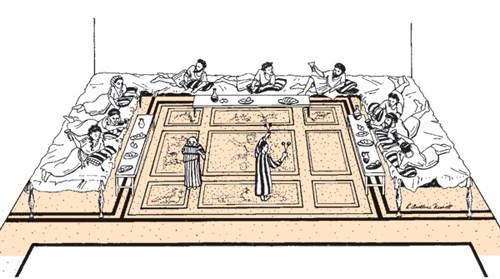
Although there is some debate among scholars whether the Pharisees, scribes and other Jews concerned with ritual purity participated in this type of banquet to any significant degree[4], it has been proposed that these banquets, better known as symposiums, were derived from the Greco-Roman tradition generally conducted in a culturally-accepted and prescribed way throughout the Roman Empire. Many homes had formal dining rooms. Other larger public rooms could be reserved, and even the temples had dining facilities. Invitations were sent. Guests were met at the door and led to the dining area by servants who then removed a guest’s shoes and washed his feet. The social standing of each guest was demonstrated by the distance one’s assigned dining place was relative to the host. Couches or cushions were arranged behind low tables around three sides of the room, leaving a large central opening. Diners reclined on their left side and elbow with their feet away from the center. The guest of honor was given the place of privilege to the host’s immediate right.   In his Gospel, John is careful to include a description of his position at the Passover feast the night Jesus spoke of a looming betrayal. “Leaning back against Jesus, he asked him, “Lord, who is it?” (John 13:25). From this narrative it is clear that, with Jesus as host of the meal, and himself lying on his left side, John was occupying the position of honor to Jesus’ right.[5]

What’s more, in Jesus’ time, the reclining position was itself a posture which connoted honor; slaves and women were not allowed to recline. Servants and even uninvited guests would often stand along the outer wall watching the diners eat and listening to their discussions and entertainment. Others were allowed to sit near the feet of the diners where they might be able to scoop up crumbs or leftovers. It was also customary for the highest-status diners to be served the choicest (and most) food. As we will see, these issues of social standing, honor, and privilege at shared meals would be challenged by Jesus (and later Paul) on a routine basis.

The center area outlined by the reclining couches held the common bowl of wine, typically diluted with water and passed among participants as a shared cup after the meal. The tables were cleared away so that the central area could be used for the symposium itself, a period marked by entertainment, singing and instrumental music, debate, or lecture. The Greek tradition of symposium was generally considered to have evolved into nothing more than a hedonistic descent into drunken promiscuity. As the Romans adopted the custom, the symposium, though still thoroughly embedded with wine and entertainment[6], was ideally meant to function as time for participants to debate a pre-planned controversy or philosophical question, or for out-of-town visitors to give a speech. Today we might put forth a question about clashes in culture, morality, or worldview to be debated around the table after the meal, or we might invite a missionary on home leave to speak to us about her work.

Next time, in post 22, we will look at the Jewish eating and purity traditions of Jesus’ day.

[1] Scot McKnight, Fasting, (Nashville: Thomas Nelson, 2009), pp. xv-xvi.

[2] McKnight, Fasting, p. xx.

[3] The recent works of Dennis E. Smith, From Symposium to Eucharist (Minneapolis: Fortress Press, 2003) and Hal Taussig, In the Beginning was the Meal, (Minneapolis: Fortress Press, 2009) are excellent resources for redefining first century church worship and fellowship activities in the context of shared meals, as well as understanding the place of the banquet in the ministry of Jesus.

[4] Craig L. Blomberg, Contagious Holiness: Jesus’ Meals with Sinners (Downers Grove, Illinois: InterVarsity Press, 2005), p. 22.

[5] The 15th century mural of the Last Supper by Leonardo DaVinci shows the diners seated and standing along one side of a long table, illustrating both the artist’s creative freedom as well as how the social custom of reclining had died out by the 1400’s.

[6] The birthday celebration for Herod, in which Salome danced for the head of John the Baptist was likely such a feast-symposium (Matt .14:6-8).

Photo Credit:  www.biblicalarchaeology.org

20. Two Birds! Repent!

Two Birds for the Lamb

On the fortieth day after Jesus’ birth, and as part of the purification rites according to the Law of Moses, Joseph and Mary take six-week old Jesus to Jerusalem to present him to the Lord (Luke 2:23). It is an interesting paradox that this baby, Jesus, is likewise Joseph and Mary’s and God’s firstborn son, so this is indeed a day of celebration. Still, it also a day both marked by, and foreshadowing sacrifice. Joseph and Mary bring two birds- young doves or pigeons- to sacrifice, one as a burnt offering, the other as a sin offering (as prescribed in Lev. 12:8 ) to dedicate their son Jesus to the Lord God. The birds are acceptable if parents cannot afford a year-old lamb. And so, here we see the Lamb of God of Passover significance, born into such poverty that his parents can only afford birds for the purification rites.

 A Feast and a Mission

The next we hear of Jesus in Luke is when his family travels from Nazareth up to Jerusalem for the Passover feast when Jesus is twelve years old (Luke 2:42). They feast there according to custom. It is probable that Jesus had gone up with his family for Passover feasts in previous years, since the law required Joseph, as an adult male, to attend on a yearly basis. But at the age of twelve (Scripture is very clear here about Jesus’ age being twelve, meaning he was in his thirteenth year), an Israelite boy like Jesus would have been in the midst of preparing to take his expected place among the adult males of the religious community when he turned thirteen. Jesus tells his earthly parents that he just had to be in his Father’s house, a hint that Jesus already recognized and craved intimacy with a father other than Joseph. So, here we see a pre-teen Jesus celebrating Passover in Jerusalem with, perhaps, the dawning knowledge that twenty-one years hence at this same feast of bitter herbs and unleavened bread, and in this very city which he dearly loves, he himself, the firstborn and only son of God, will become the sacrificed lamb whose sprinkled blood will safeguard and deliver the lives and souls of all who believe. In the last week of his life, Jesus sends disciples ahead into the city to prepare the Passover meal at a pre-arranged location (Luke 22:8-12). I have often wondered where, in which house in Jerusalem, Jesus’ family celebrated their Passover meals in those early years. Could it be that their family returned to the same upper room year after year, much like we return to a favorite resort or restaurant when we visit a nearby city? Could this be the same room where Jesus spent his last supper with his beloved disciples?

 Repent and Bear Fruit

In chapter three, Luke turns to the ministry of John the Baptist calling out in the desert for people to produce fruit in keeping with a repentant life. The fruit metaphor is universally used throughout the Bible to signify an edible, life-sustaining seed-bearing plant which is deep-rooted, wisely pruned, and well-watered, thriving in its season and producing an abundant crop from year to year. Jesus also uses the fruit comparison, when he curses a barren fig tree (Matt. 21:19), when he claims that “no good tree bears bad fruit,” (Luke 6:43), and when he entreats people to graft their “branches” onto his “vine” to become and remain fruit-producing believers (John 15).

To think about:  what fruit is your life producing for the kingdom?  Where could your attitudes and behaviors use some watering?  Pruning?  How can your life be sweet, wholesome, nutritious food for others?

19. Jesus, Food, and Meals

Here we begin an in-depth look at meals in the Bible, with a special focus on the meals Jesus shared.

Food and Blessing

The book of Genesis tells us that before the fall, Adam and Eve spent the daytime tending a garden overflowing with abundant plant life, much of which was available to them as food. They walked with God in the cool of the evening, a practice of setting aside time to enjoy God’s presence. A significant component of the curse, after God exiled them from Eden, was that Adam and Eve and all their descendants would henceforth access food only by the sweat of their brows; our need for food didn’t change, but our ability to obtain it was forever made problematic.

Bread, wine, milk, oil, fig, pomegranate, fish, honey, wheat and barley are all foods associated with God’s great spiritual blessings and salvation in Scripture. Moreover, gospel as food for the hungry is a constant metaphoric biblical theme. The prophet Joel, in pleading with Israel to repent and fast after the land is overrun by locusts, reminds the people that after God’s judgment and punishment the harvest will be restored to overflowing for those who call on the name of the Lord. “You will have plenty to eat, until you are full, and you will praise the name of the LORD your God, who has worked wonders for you…” (Joel 2:26)

Isaiah prophesied a feast of rich food prepared by God for all people, “a banquet of aged wine-the best of meats and the finest of wines. On this mountain he will destroy the shroud that enfolds all peoples … he will swallow up death forever.” (Isa 25:6-8). You can’t miss the messianic picture here; by virtue of his own death shroud found neatly folded in an empty tomb, Jesus frees people from death and invites them first to remember him with a memorial meal, and, upon his return, to a lavish wedding feast.

 A Savior for a Hungry World

I have come to the conclusion that Jesus, unlike his hermit cousin John, was a foodie in the most marvelous sense of the word. God’s only son consented to leave his glory behind in heaven and take on a fully human form. That alone is worthy of praise. But, to view the New Testament Jesus through the eyes of food and meals, as one who was just as dependent on the earth’s fruits and people’s hospitality as we are, brings us to a position of wonder. This Jesus, son of God, author of creation, able to partake of heavenly banquets at any turn, master chef of manna and vintner fine wine, arrived poor, needy, hungry, and dependent, and he accepted this lowly position on our behalf. Moreover, Jesus spent a good deal of his time eating in the company of others, even enemies, sharing food and companionship, and using these opportunities to connect, teach, confront and love; in short, he “used simple hospitality and mealtime conversations to share the gospel.”[1]

In his gospel, Luke intentionally presents Jesus from birth to death, resurrection and ascension, as the means of salvation, and it is Luke, more than any other of the gospel writers, who characteristically sets his salvation stories of Jesus in the context of meals, fasts, feasts, and food.[2] Jesus’ cousin John abstains from wine and other fermented drinks in the priestly way of Samson, Samuel and the Nazirites (Luke 1:15). In her song at Jesus’ conception, Mary sings of God’s favor and mercy in filling the hungry with good things (Luke 1:53). For lack of anything better, Mary and Joseph must lay Jesus in a manger in Bethlehem, a crude feeding trough for animals (Luke 2:7). Later, Jesus himself would say, “Consider the ravens: They do not sow or reap, they have no storeroom or barn; yet God feeds them. And how much more valuable you are than birds!” (Luke 12:23-25). The Bread of Life, cradled in a rude manger “begins to symbolize how God will feed his “hungry” people…through Jesus.”[3]

[1] D. Webster, Table Grace: The Role of Hospitality in the Christian Life, p. 14

[2] For an excellent overview of the meal scenes in Luke, see books by Tim Chester, A Meal with Jesus: Discovering Grace, Community, and Mission around the Table (Wheaton, IL: Crossway, 2011) and John Paul Heil, The Meal Scenes in Luke-Acts: An Audience-Oriented Approach (Atlanta: Society of Biblical Literature, 1999).

[3] Heil, The Meal Scenes in Luke Acts: An Audience-Oriented Approach, p. 19.

17. Willfully NOT Caring

When our daughter left for college, my husband and I found our table manners slipping. With an empty nest, we both became exceptionally stretched, having taken on more and more responsibilities both at work and at church at the same time the health of our parents began a slow decline. Not surprisingly, our mealtimes suffered. I’d find myself standing in the kitchen too exhausted to be creative and too hungry to care. On more than one occasion we settled on having a bowl of Cheerios for dinner, only to discover the milk had soured because neither of us had had the time (or inclination) to stop for groceries in the past two weeks. Sound familiar? Well, this is not abundant living. Regularly sitting down at night for cereal, ordering a pizza that’s too costly, financially and calorically, or grabbing a sub sandwich, which completely transgresses our daily sodium limits indicates something’s amiss. It is subsistence living. These are not meals. As a little family of two, our garden was choking from weeds of inattention. We had fallen out of practice. So, we’ve recently pared down a few obligations and recommitted ourselves to healthier foods, intentional conversation and prayer at the table, to taking homemade soups and casseroles to our parents, and to inviting others and our parents over more often no matter how messy our home might be.[1] “Whether we are reluctant or eager, we should understand that hospitality was meant to be an opportunity, not an imposition.”[2]

Accordingly, at this stage of my life, when Jesus asks me what I want to nurture at my family table, and during the evening that follows, I find I want to grow six things: simplification, grace, gratitude, empathy, stewardship of the evening hours, and wisdom. I want my husband’s and my life to be less complicated, less filled with noise and calendars and exhaustion, and more centered on God, each other, our aging parents, our church family, and the stranger we usually avoid by pretending s/he doesn’t exist. Our table comfortably seats six people, yet almost always only two places are set. I pray for the room to let God into our packed, busy lives.

My first response has been to simplify our meals. I still make menus and shop ahead (a later post will have ideas), but our evening meal is far simpler than in days gone by, with fewer ingredients, less food (and less meat) overall, and a reliance on quick but healthy main dishes, with vegetables, salads, breads, and fruit to round out the menu. When we host others at our table, the idea is to dwell together in God’s presence rather than play at entertaining our guests. As a result, my new practice is to keep the meal simple enough so that all enjoy and participate at the table-even me.

I want us to invest our time in knowing God, and through experience of his grace, to practice being more gracious in serving family and stranger alike. I want God to know how grateful we are for the ‘Bread of Life’ in Jesus Christ, for this food that satisfies above all others. I want to stop pushing the awareness of the needs of others to a dark, dusty corner of my mind, and bring that certainty to the very forefront of my heart and my family’s awareness. I no longer want to insulate my mind with deliberate ignorance about the plight and sufferings of others, especially where food, and the impact of our own food and economic behavior is concerned. I want to invite the stranger to eat with us.

More than anything, I want to stop: wasting time and food, and willfully not caring. I want our evening meal to signify day’s end, and to mindfully help us transition into a night spent in God’s Word, in prayer, and in his presence as we actively participate together in the start of this new day. All of this will take the sort of wisdom only God can provide, and I want that for my family and the friends and strangers with whom we dine. I hope my “wants” resonate with you at this stage in your life.

There is a box below to leave comments, and a LIKE button to share if you find what you read helpful.  PLEASE!  Take a moment to give me some feedback, and/or start a conversation.  I am a TEACHER.  I welcome you into my “classroom”!

[1] It is critical to get over any pride or guilt about the condition of your home. When perfection is your goal, then you are not being a faithful host. Hospitality is about enfolding guests in love, comfort, and respite, even if they must share in the messiness of your life. Having a “Martha” approach to hosting a meal becomes more about “entertaining” than it does about using table time to invite, nourish, challenge and send your guests out prepared to shoulder the co-mission of Christ. Obviously, you don’t want to convey to guests that you are a slob, and that your home might not pass a cleanliness test from the public health inspector! Still, a little dust, and “things lying around” should never keep you from opening your table to others.

[2] Douglas Webster, Table Grace: The Role of Hospitality in the Christian Life (Fearn, Scotland: Christian Focus Publications, 2011), p. 11.

16. The Family Table: Like a Tended Garden

By rethinking the order of a day, the supper hour has come to symbolize an exceedingly meaningful threshold to me.  Watching darkness advance through the kitchen window, making a simple meal and joining with loved ones, guests, or church family around the table has come to embody the real gift of greeting the new day ahead.  Not only that, but my attitude does a miraculous about-face: preparing or sharing such a meal is anything but a chore.  It is filled with an energizing, urgent expectancy for God’s presence and grace.  In short, it is a delight to anticipate a night of walking together with God in the cool of the evening as we share a simple meal that is both the final act of this day and an unfolding prelude to tomorrow.

It is a subtle shift in thinking and attitude and practice.  Our evening meal continues to nourish us as we lie down to sleep, so that we may arise refreshed and ready because the food and practices of the night before are used by our body and soul, physically and spiritually, to heal, grow, strengthen, and prepare us for the rigors of tomorrow.  So what we practice at night is foundational for how we greet tomorrow.  The evening meal opens a new day, and initiates us into all the promises the evening hours, as new day, hold. 

Think of the possibilities if you turn each night, in your mind and in your practice into a new day.  When you do, the shared meal takes on new significance, as do the hours between 7:00 and 11:00 p.m., so often wasted away in front of a television or computer because of our perceived need to wind down.  I believe that viewing each evening as God-given time for entering a new day can change our perspective on the practices of prayer, fellowship, meals, and study.  Suddenly, being still becomes both a possible and desirable practice-for every member of the family. You may be frustrated at this point at what seems my naïveté- I can’t possibly understand the crazy mixed-up world that your family experiences from the after-school bell until bedtime.  I do understand though, and I am telling you that your life and that of your family need not be that frenzied.  Later posts will address some of the ways our modern culture interferes with any intention to have a shared evening meal with a walk-with-God kind of evening, and how we can actively address how we’ve allowed the world’s intrusions to compromise our peace, rest, fellowship, and restoration.

This Will Take Much Practice

So, coming to the table for both common and sacred meals is more important than we recognize as the way to create space in our lives for God and each other.  In a way, time at the table cultivates a particular way of life.  It is a practice for all ages and for the ages.

Cultivation is a gardening term.  So, in one way, we can think of the table as garden, to be tended much like Adam and Eve were called to do in Eden, with care and devotion and joy.  If shared meals at home and church were a tended garden, what would you want to cultivate there?  What would you plant, nurture, and grow there to nourish and sustain your faith life and that of your family?  Remember, Jesus asks, “What do you want?”


~Julie A.P. Walton, Ph.D.

15. Evening: the New Day Starts Now

The truth is, we find getting together at the table (even just getting the food into the house) a practical challenge in a today’s world. In Eden, God invited Adam and Eve to eat all sorts of plant life.  God fed them well.  There was, of course, that one forbidden food.  Now, forbidden foods have a way of not being good for us.  A diabetic must avoid sweets.  Walnuts or shrimp are life threatening for people with a nut or seafood allergy.  But, Adam and Eve, driven by what Griffiths calls the vice of curiosity, made a fatal mistake for all of Creation.[1]  The intimacy we had with God was broken, and not until Jesus came- eating and drinking, suffering, dying, rising, forgiving our sins, and inviting us to the feast of the Lamb-did we have any hope for restored relationship with God.

The table, then, at home and at church (table and Table) is the place of invitation, nourishment, acceptance, forgiveness, gratitude, learning, growing, and going.  It is as much about relationship building and disciple-making as it is about food.  In both instances, we come hungry for food and companionship with one another and with God.  In both instances, we are invited and fed by something or Someone who had to die for us to live.  God’s Word fills us.  In both instances, we leave with a co-mission to go and do likewise for our neighbor.  And, in both instances, we can stand with Jesus and proclaim “that we live by ‘every word that comes from the mouth of God,’ because that word has everything to do good things, with real nourishment for body and soul.  With the eyes of faith, Christ comes to be known as that word, incarnate, embodied, the Word of God, present then and now.  Christ is then the invitation, the way we have of re-creating that living relationship of intimacy with God that the original humans knew in the garden.”[2]

 Rethinking the Practice of a Shared Evening Meal

I believe we need to be at the table each night, fully present and alive to the invitation, provision, and gratitude a meal together involves, with a keen insight that compels us to keep families knit together and to regularly weave strangers into our midst. In our homes and churches, the time spent at the table, especially in the evening, is never wasted.  It slows time down, it reconnects us with those we love as well as with the guest, it provides a shared training ground for life’s challenges, and it generatively introduces the next generation to the saving ways and nourishment of a life in Christ.  Perhaps most importantly, I suggest that it affords us the time for opening a new day together because the rhythms and predictability and rightness of the Christian practices transform the way we view the world and time.

Dorothy Bass considers how attending to the practices shapes a day in her book Receiving the Day: Christian Practices for Opening the Gift of Time.[3]  This book unlocked for me an entirely new perspective on how a regular “day” could flow.  Our modern notion is that each day starts at sunrise and continues until bedtime. However, a careful study of the creation story in Genesis 1 literally flips a day on its head; God created, there was night, then day.  In practice, then, a new day actually begins in the evening.  Can you believe it?

After Adam and Eve sinned, God was strolling in the garden in the cool of the day looking for them.  Evening was a time for walking with God.   Imagine the implications of making it a regular faith practice to restructure your “day” so that a new day begins as you get home from work or school.  Then you can consider the place of the evening meal as a shared practice from the ancient Jewish custom of beginning the new day in the evening.

Gathering family, friends, and strangers around the table for supper might actually be considered a corporate event for greeting the new day.  In other words, the evening meal is a threshold we cross together, a natural transition from the work and school day that is behind us to the new day ahead, filled with all of God’s creative possibilities.  At the evening meal, we gather together to be nourished, but not just with food.  We prepare to spend the evening walking and resting with God as Adam and Eve did, putting aside a day in which we may have done or said something we should not have, or failed to do or say something we should have.   God intends for the day to be done.  And at the table, together, we transition to a new day in Christ that is immediately ahead of us.

I don’t know about you, but this was a revolutionary idea for me, that nighttime be less a time of recovery and more about active preparation.  For me, getting home from work was always about wrapping myself in the comforting insulation of house and family.  It was a way to hibernate and shield myself from the outside world, to recover from this day, and to literally shed this day’s responsibilities.  In doing so, getting a nightly meal on the table always seemed just one more obligation in a long day’s to-do list that included work, laundry, packing lunches, helping with homework, paying bills, and church committee meetings. Next time we will dig into this idea of new day like hungry teens into a pizza!

Julie A.P. Walton, Ph.D.

LET ME KNOW WHAT YOU THINK ABOUT ALL THIS!  IT HELPS AS I W RITE AND REVISE 🙂

Featured Image credit:  K.Richardson, 2016

[1] Paul J. Griffiths, The Vice of Curiosity: An Essay on Intellectual Appetite (Kitchener, Ontario: Pandora Press, 2006). In this short treatise, Griffiths discusses the darker nature of curiosity as a means to owning and controlling knowledge for power, the same kind of appetite Adam and Eve gave into.

[2] Cathy C. Campbell, Stations of the Banquet (Collegeville, Minnesota: Liturgical Press, 2003), p. 13.

[3] Dorothy C. Bass, Receiving the Day: Christian Practices for Opening the Gift of Time (San Francisco: Jossey-Bass, 2000).

14. A Significant Motif

So, we can see that as a custom, the regular, planned, healthy shared meal at home is difficult to accomplish on a consistent basis without someone being intentional about it; the family supper and the church family supper are less common events in these days of compressed and multi-layered schedules.  But, if we consider the shared meal (especially the evening meal) as a practice, in particular a Christian practice, it then has the potential for both common and sacred relationships in the daily lives of believers.  So even though it may often seem like a lost practice, we should at least consider if it is an important practice in need of attention, intention, and restoration; it is time to explore why eating together matters.

People must eat, and every single thing we eat was once a living entity as plant or animal.  So there is always this built-in truth that for us to eat and live, something else must be sacrificed.  It is interesting that Jesus started his ministry not with fortifying food, but a fast.  In Matthew 4 Jesus fasts forty days in the wilderness.  Now, a forty-day fast will leave most humans at death’s door, famished, literally starving.  How fitting that Satan’s first tempting volley is to entice Jesus to eat bread.  While it feels both farcical and predictable that Satan would dare tempt the Bread of Life with earthly bread, we must remember that Satan knew that Jesus was both man and God, and appealed here to Jesus’ human need to eat. But, Jesus responds, “It is written: ‘Man does not live on bread alone, but on every word that comes from the mouth of God.’” (Matthew 4:4)[1]

There is a significant motif here that must not be missed.  Where do Christians come together, on a regular basis to be nourished, satisfied, and sustained?  It is at the Table.[2]  At this Table, we eat the bread that is Christ’s body, and drink the cup that is his blood.  Someone has died so we might live.  It is a central Christian practice for believers to share this meal, as it confirms and affirms our identity as God’s people living out our faith in a family of believers. In the early Church, Paul puts it this way: “The cup of blessing that we bless, is it not a sharing in the blood of Christ? The bread that we break, is it not a sharing in the body of Christ?” (1 Corinthians 10:16 NRSV).  Paul emphasizes the shared nature of Communion.  In a way, it is the family meal for the people of God.

In our sacred meals at church, we live out, again through shared practice, the saving grace of Jesus Christ.  Side by side around this sacred Table we are invited in our hunger to partake, in our wounded-ness to be healed, and in our loneliness to be a welcome part of the Body.  As one Body we look inward to Christ the Word, remember who he is, the sacrifice he became, and the grace with which he’s invited us, and we eat together. As we leave this Table, still side-by-side, we are forgiven, fed, and fortified to look outward beyond the Table, our eyes opened to see Christ in one another, and to take his gospel to a hungry, wounded, and lonely world.  Our shared meal at the Table “is specifically an act by which we are enabled to discern the world, to see and respond in a manner that is consistent with the reign of God.  Our vision for the world is renewed and we are oriented with the will and purposes of God…[it is this] Supper [that should] foster a capacity to see and act with courage, integrity, love, and justice in the world…”[3]

In a curious way, this suggests what should also happen at home. We meet around the common family table to be fed, a shared meal for our physical body, as well as sustenance for our social and familial needs to connect, and also, because for Christian families, to share God’s Word, that is, Christ the Bread of Life, is to grow together as a family in intimacy with God.  This is the true ‘tie that binds’ and strengthens us two and three times a day to do God’s work in a hurting world.  So, in daily meals at home and common meals at church we practice all that it means to consume both our daily bread and God’s Word in one another’s company.  In return, we benefit from all the shared meal has to offer-a safe place to BE- to belong, be heard, be nourished, be affirmed, be forgiven, and be taught.

In short, the table and the Table both share the common elements of a Christian practice: we are invited to partake of what only God can provide.  In gratitude we are nourished and formed into more godly people for work in God’s kingdom.  It is beautifully simple.  At least, it should be.

Let’s Eat!  Together!

~Julie A.P. Walton, Ph.D.

[1] Jesus is quoting Deuteronomy 8:3, where Moses reminds Israel of the manna God provided to quell their hunger in the desert that they might know that life depends on every word, in particular the Ten Commandments, that comes from God’s mouth.

[2] For the purposes of this book, Table refers to the sacred meal of the Lord’s Supper, while table connotes the place where any common meal is shared.

[3] Smith, G.T., A Holy Meal: The Lord’s Supper in the Life of the Church, p. 74.

13. Cooking: a Lost Practice

I am old enough to have had a middle school home economics course in which we (girls only that is) learned some cooking basics, long before the arrival of “baby” carrots.I remember learning how to make cooked carrots. Within two years, girls were taking shop class and boys were learning to cook, and I was being encouraged in the high school arena to set my sights high, because women were now truly free of the “bondage” of homemaking to be and do anything they wanted.  Today, life skills classes are rare.   Children are more apt to take technology classes than they are home economics.  Ironically, it’s  much easier today to find a recipe on the Internet than it is to follow its directions.

Despite my schooling, however, I was still in for some truly big surprises when I married because I had learned little at home about food preparation.  With almost no money my husband and I had much to learn about how to plan menus and meals on a budget, how to shop specials and maximize coupon values, how to read labels and stretch meals by making soups or casseroles that also served as work lunches later in the week.  Neither of us knew how to use a slow cooker, or make a healthy sack lunch, or can or freeze foods, or how to make traditional foods in healthier ways.  We didn’t even know how much milk to buy for two people, or what kind of milk to get, and had to phone home for directions when making our first pot roast (we promptly received a Better Homes and Gardens Cookbook the next Christmas which is still in use to this day).  We only knew how to make macaroni and cheese from a box, and had no clue how to grow our own garden or process its abundance for year-round consumption.

However, just out of graduate school, starting my first job, and embracing all it meant for a woman to be highly educated and employed, my biggest adjustment came with the realization that I had no sense of what it meant to serve with any shred of self-sacrifice.  After six years of university food service, I had never once considered that getting food on the table for my own family might take time, planning, sacrifice, and a less me-centered attitude. It took me by surprise (shock might be a better term) to discover that having a somewhat food-averse spouse meant that, unless I was willing to live on Cocoa Puffs and frozen pepperoni pizza, the responsibility for getting food from store to pantry, and from pantry to table was going to lie squarely and solely on my shoulders for the next fifty years or more.[1]  I was overwhelmed and far, far under-prepared for this role.  What’s more, income from our entry-level jobs in Washington, D.C. did not bring in enough money for entertaining others at our table once our tithe and living expenses were covered.[2]  Not that it mattered; I did not know how to cook for a crowd anyway.

Not long after, as a new mother, I had no idea what to feed this little girl after she was weaned, nor how much.  Is it true she shouldn’t have cow’s milk until after her first birthday?  What should we do when she refuses a food?  Is there a way to prevent her father’s food aversions from rubbing off on her? How should we teach her acceptable behavior at the dinner table?  What foods are dangerous for toddlers? How in heaven’s name is this supposed to work?  There we were with a baby, living far from our own families.  I thank God for my dietitian friend Eileen at church, whom I kept on speed dial.  She helped set me on a path of understanding about food, foodways, service to my family, and the importance of the shared meal.[3]

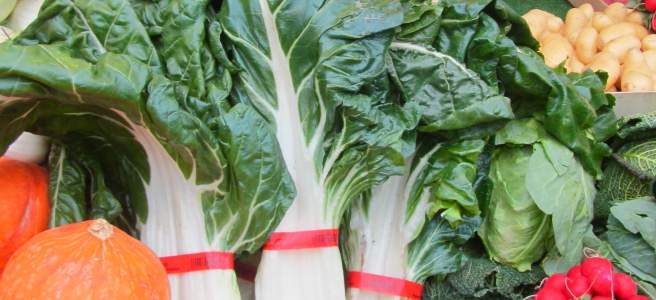
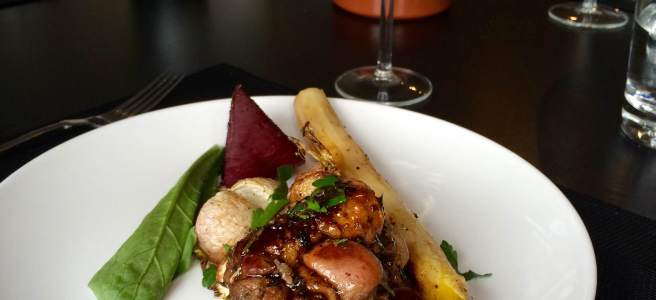
Today, our daughter lives in Paris. As a matter of fact, I am writing this piece from Paris. Just last weekend, the two of us took a Market Cooking class from Chef Lise at La Cuisine Paris.   lacuisine-paris    We toured the local market, selecting duck legs, 3 fine cheeses, beet root, white asparagus, blood oranges, strawberries, turnip, and several fresh herbs to take back to the kitchen-classroom and learn how to make a French feast, including duck a l’orange (see the featured image). It was a wonderful day of sharing the kitchen and table with each other and 6 strangers.

I encourage you to start cooking more often.  Be on the lookout for easy and affordable recipes that you can use when you invite someone to a simple meal.  If you have children at home, involve them in the planning, shopping, and preparation of the meal- it is an important way of teaching them about hospitality and sharing.

In the next post, we will consider how the shared meal (especially the evening meal) as a practice, in particular a Christian practice, has the potential for both common and sacred relationships in the daily lives of believers.

Until then, bon appetit!

~Julie A.P. Walton, Ph.D.

[1] Lest you think poorly of my husband, let me defend him here.  Although he cannot cook and his tastes and texture issues create significant limits, he is the world’s best dishwasher.  We have always shared kitchen responsibilities with unspoken devotion; we share shopping, I prep and cook, he cleans.  It is a beautiful arrangement.  Chapter six will explore these duties in the context of family and food.

[2] I should note here that our apartment in Silver Spring, Maryland was directly across the street from my husband’s office.  As I was not yet working full time, my husband would frequently call around 11:45 a.m. to say he was bringing a coworker home for lunch.  I quickly learned to put out a simple meal that didn’t break the bank, and have always been grateful to him for helping me learn (to unbend really) to trust God to make the “bread and fish” multiply so that there was always more than enough to go around.

[3] As an example, Eileen invited me to drive out to a farm to pick broccoli one day.  I had never known that the “U-Pick” concept extended beyond apples, strawberries, and Christmas trees.  When I got home with about eight pounds of broccoli I had to undertake a crash course in prepping it all for the freezer.  We were graced with months of fresh farm-to-table and highly nutritious broccoli that winter.  It is still a family favorite to this day.