29. Meals for Prodigals

Luke records several parables in chapter 15 about the lost condition of sinners and the redemption available following repentance. These culminate in the parable of the prodigal son, where Jesus describes a famously wayward son who returns home hungry after squandering his inheritance. By rights, his father need not take him back. But, this father has been watching for his son’s return, and sets in motion a grand feast to celebrate the son’s reinstatement in the family.

Here is a feast to note. When a lost loved one returns home with a changed heart, when s/he seeks forgiveness, our natural response should be one of joyful celebration through feasting. It’s a recurring theme throughout the meal stories in the Gospel of Luke; repentance, reconciliation, and redemption are available to all. Our place at God’s table is waiting for our change of heart, which is the catalyst leading to a reformed and responsive life, reenergized by eating the spiritual food Jesus provides.

Not long after preaching the “lost” parables, and getting closer to his last days in Jerusalem, Jesus finds himself in Jericho, peering up into a sycamore tree at Zacchaeus, the town’s chief tax collector. Looking him in the eyes, Jesus doesn’t bother asking Zacchaeus what he wants. Instead, Jesus tells Zacchaeus that he plans on staying at his house. One minute Zacchaeus is “lost” among the tree’s leaves, and the next he is jumping down with rejoicing. Immediately, another meal with “sinners” is in the works. It must have been a very happy meal indeed, marked by a festive welcome unlike any Jesus had experienced in the homes of the Pharisees.

Just imagine:  Jesus coming up to you and asking you to set a place at your dining room table for him!  What’s the menu?  Who else would you invite?  What would the table conversation be like?  Believe it or not, the day is coming when you WILL be seated at the wedding feast table with Jesus the bridegroom. Jesus the lamb of God.  The bread of life.  The Lord of your life.  Wow!  Jesus welcomes you, the prodigal, you, the sinner, with open arms, and the first order of business is a shared meal!

28. Your Table MINISTRY

Not surprisingly, this latest meal (see post 27) infuriates the Pharisees and teachers of the law to the point that they begin to organize a hostile opposition to Jesus. Likewise, Jesus escalates his attacks in Luke 12 and 13, publicly warning followers about the hypocrisy and murderous intent of the Jewish leadership. Jesus speaks with urgency of a coming day in which there will be a great feast in the kingdom of God, and exhorts people to humbly repent and be faithful.

Not long after this, Jesus attends a Sabbath meal at the home of a prominent Pharisee. For the Jews, the Sabbath was a feast day, so this is no ordinary meal. “Whereas Jesus was explicitly invited to the earlier meals, now, although an invitation may be implied, none is narrated, as Jesus merely “went into the house”” (Luke 14:1).[1] Can you imagine the scene? These leaders have been plotting to permanently incapacitate Jesus’ growing influence amongst the Jews, and here he is, on a Sabbath no less, showing up uninvited for dinner and playing, supposedly, right into their scheme.

Luke leaves out details of the meal and proceeds straight to the events of the after-meal symposium/discussion. Knowing that the Pharisees and lawyers are watching him carefully, Jesus looks up to find a man with dropsy[2] standing in front of him. It is hard to think otherwise that this is a setup, especially because this unclean man appears in front of Jesus in the center part of the dining room reserved for the activities of the symposium, rather than at his feet where bystanders were tolerated. By way of providing a controversy for the after-dinner symposium, the host may have deliberately encouraged the man with dropsy to go stand in front of Jesus in hopes Jesus would dare to heal on the Sabbath.

In ancient times, dropsy was thought to result from a habitual overindulgence in food and alcohol, in other words, of uncontrolled appetite.  Luke implies a connection here between the physical greed of the sick man and the moral greed of the diners, portraying Jesus as the medium for healing in both cases. First Jesus heals the man with dropsy while arguing that anyone would rescue even an imperiled ox or donkey on the Sabbath. And, if that’s the case, why should saving a man be any different?   Interestingly, after Jesus heals the man and sends him away, the other diners uncharacteristically refrain from comment. Either they are sullen or bewildered by Jesus’ authority or both.

Again, Jesus uses a meal to teach about salvation as he masterfully takes advantage of the others’ silence to introduce his own after-dinner controversy (which implies he usurps the host’s authority). He directly challenges the way these men jockeyed for positions of honor at the table at the start of the meal, confronting the moral greed which compels a person preoccupied with status to manipulate others for the sake of social standing. Moreover, Jesus challenges the host to rethink his typical invitation list, urging him to invite people on the margins of society instead of his elite, status-seeking, self-righteous peers. Jesus teaches them that the great banquet in the kingdom of God will include people in desperate need of healing, those who are poor, crippled, blind and lame (Luke 14:21). What his dining companions fail to understand is that they themselves are “the spiritually poor-with nothing to offer for [their] salvation; the spiritually crippled-made powerless by sin; the spiritually blind-unable to see the truth about Jesus; [and] the spiritually lame-unable to come to God on [their] own.”[3]

These are lessons taught and learned at the table that should make us consider what we believe, and how we lead our own lives as a result of that belief. In a sense, our meals and our behavior at meals reflect what we believe, especially about Christian community and hospitality, as well as our attitude toward people on the fringes of society. The truth is, when we invite others to our table, we usually do so with the mindset of entertaining them rather than sharing the food of the gospel and its power to transform lives. We are hesitant to embrace total strangers at our family table, finding ourselves far more comfortable including only people we know well, and who happen to be a lot like us.

Perhaps it’s time to view our table as an active place for ministry. Do you know people who seem unable to come to God, blinded to his truth, or determined to save themselves all by themselves? Invite them over for a meal and watch God work!

~ Julie A.P. Walton, Ph.D.

[1] John Paul Heil, The Meal Scenes in Luke Acts: An Audience-Oriented Approach, p. 99.

[2] Today, we’d call this edema, or generalized swelling of tissues related to a host of causes, including heart and renal failure, liver disease related to abuse of alcohol, sodium retention, and abnormal blood pressure. For example, women with breast cancer who have lymph nodes removed often suffer from lymphedema, a significant swelling of the arm related to fluid obstruction in the lymphatic pathway.

[3] Tim Chester, A Meal with Jesus: Discovering Grace, Community, and Mission around the Table, p. 79.

27. A Woeful Dinner with Jesus

Once again, Jesus is invited by a Pharisee for a formal meal (Luke 11: 37-54). From the start, and to the surprise of his host, Jesus is immediately confrontational by purposefully neglecting to wash before the meal (washing was not demanded in the law, but was an expected ceremonial act of cleansing in Pharisaic tradition). “[H]is surprising disregard of the ritual washing before a meal functions as the fait divers that sparks the dispute of this banquet symposium.”[1]

Jesus uses the opportunity of the table’s intimacy to launch into a diatribe against the vainglory of his host and dining companions. Can you imagine a more uncomfortable scene? Jesus pronounces woe on them all, calling them dirty, greedy, wicked, unjust, self-inflated, foolish, irresponsible, and bloodthirsty. The Jewish religious leaders and experts in the law find themselves in an indefensible situation, and their self-righteous anger mounts with each new invective from this itinerant (and unclean) teacher.

Luke does not make us privy to how this meal concludes. But, the message here is important. It is at these shared meals that Jesus calls sinners to repentance; the meals anticipate both the Last Supper and Lord’s Supper and are always concerned with the redemption of the lost. Furthermore, we should realize that not every meal we share with others will be a love fest. Sometimes, sin must be confronted, even with the knowledge that people will be hurt, insulted, and become angry. Not only that, but there’s every possibility that we will be the ones being shown our mistaken ways by others who love us.

We would do well to honestly consider how we live our inner life on a regular basis, and address those places in which our self-congratulation may very well be a woeful thing to our Lord.

In post 28, we will look at yet another of Jesus’ meals with Pharisees-this time when a man with dropsy just “happens to show up” while Jesus is eating.

~Julie A.P. Walton, Ph.D.

[1] John Paul Heil, The Meal Scenes in Luke Acts: An Audience-Oriented Approach, p. 83.

21. Jesus Came Eating & Drinking

Bread and Stones

While Jesus’ earthly ministry ends with a Passover supper, it formally begins with an extended forty day fast immediately subsequent to his baptism by John (believers in the early church often fasted as preparation for their baptism- we aren’t told if Jesus did). Fasting in the Old Testament was typically a whole-body companion to prayer, either as a demonstration of one’s yearning for God, or as an avenue for developing compassion for others (see David’s psalms and Isaiah 58).[1]

Scot McKnight defines fasting as “the natural, inevitable response of a person to a… sacred moment in life.”[2] Jesus’ fast in the wilderness surely was accompanied by prayer as way of preparation for the sacred and sacrificial role he was about to undertake. Try to imagine Jesus heading into the desert alone, to pray and fast and prepare for the enormity of what he was about to do. The Bread of Life refused bread. The Vine drank no wine. Coming from heaven, but as a fully-human being, Jesus must have been hit hard by the limitations of his embodiment, experiencing the physical, emotional, and spiritual effects of a forty-day fast in very tangible ways. He hungered after God his Father, and for the strength and peace to carry out his mission. And who shows up on day forty? Satan, of course. Isn’t it just like Satan to hit us in our weakest moments, and appeal to our biggest appetites? After forty days without food, Jesus’ encounter with Satan starts off with a challenge to turn stones to bread. But Jesus, fortified from forty days of fasting and prayer, is armed with the very word and Spirit of God to rebuff Satan’s temptations.

 Jesus Came Eating and Drinking

According to Luke, Jesus initiates his ministry of teaching and healing turning up first in Nazareth, then Capernaum. He heals Simon’s mother of a fever and she responds by getting up and making Jesus a meal. As he goes about Judea preaching, he stops at the Sea of Galilee and talks Simon into letting him use a fishing boat as a lakeside pulpit. In a very short time, Simon is astonished by both Jesus’ teaching and actions, and is convicted he must leave his fishing boat and the nets which catch real food to follow this teacher and learn about an entirely new kind of fishing and wholly different kind of food.  Much later, after Christ’s resurrection he grills fish for breakfast in this same place!

Jesus next comes upon Levi in a tax collection booth. Like Simon, Levi is convinced he must repent and change his life. In short order, we see Levi giving a great celebratory banquet with Jesus as the guest of honor (Luke 5: 27-39). Now this is no ordinary meal, but a lavish banquet, the first of several shared- and truly radical- meals for Jesus in Luke’s account. The typical Greco-Roman banquet in the Hellenistic Mediterranean regions of Jesus’ day included a guest of honor as well as other invited guests, usually those familiar to the host, often those with whom one associated via one’s profession or guild.[3] So, it shouldn’t seem odd to us in any way that Jesus would attend a formal meal given by a very grateful Levi at which the other invited diners were also tax collectors (as a tax collector, it is doubtful Levi would have had many other friends or associates, particularly among the Jewish community).

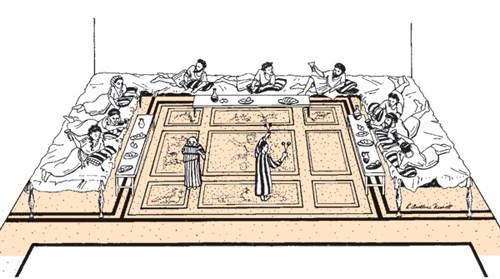
Although there is some debate among scholars whether the Pharisees, scribes and other Jews concerned with ritual purity participated in this type of banquet to any significant degree[4], it has been proposed that these banquets, better known as symposiums, were derived from the Greco-Roman tradition generally conducted in a culturally-accepted and prescribed way throughout the Roman Empire. Many homes had formal dining rooms. Other larger public rooms could be reserved, and even the temples had dining facilities. Invitations were sent. Guests were met at the door and led to the dining area by servants who then removed a guest’s shoes and washed his feet. The social standing of each guest was demonstrated by the distance one’s assigned dining place was relative to the host. Couches or cushions were arranged behind low tables around three sides of the room, leaving a large central opening. Diners reclined on their left side and elbow with their feet away from the center. The guest of honor was given the place of privilege to the host’s immediate right.   In his Gospel, John is careful to include a description of his position at the Passover feast the night Jesus spoke of a looming betrayal. “Leaning back against Jesus, he asked him, “Lord, who is it?” (John 13:25). From this narrative it is clear that, with Jesus as host of the meal, and himself lying on his left side, John was occupying the position of honor to Jesus’ right.[5]

What’s more, in Jesus’ time, the reclining position was itself a posture which connoted honor; slaves and women were not allowed to recline. Servants and even uninvited guests would often stand along the outer wall watching the diners eat and listening to their discussions and entertainment. Others were allowed to sit near the feet of the diners where they might be able to scoop up crumbs or leftovers. It was also customary for the highest-status diners to be served the choicest (and most) food. As we will see, these issues of social standing, honor, and privilege at shared meals would be challenged by Jesus (and later Paul) on a routine basis.

The center area outlined by the reclining couches held the common bowl of wine, typically diluted with water and passed among participants as a shared cup after the meal. The tables were cleared away so that the central area could be used for the symposium itself, a period marked by entertainment, singing and instrumental music, debate, or lecture. The Greek tradition of symposium was generally considered to have evolved into nothing more than a hedonistic descent into drunken promiscuity. As the Romans adopted the custom, the symposium, though still thoroughly embedded with wine and entertainment[6], was ideally meant to function as time for participants to debate a pre-planned controversy or philosophical question, or for out-of-town visitors to give a speech. Today we might put forth a question about clashes in culture, morality, or worldview to be debated around the table after the meal, or we might invite a missionary on home leave to speak to us about her work.

Next time, in post 22, we will look at the Jewish eating and purity traditions of Jesus’ day.

[1] Scot McKnight, Fasting, (Nashville: Thomas Nelson, 2009), pp. xv-xvi.

[2] McKnight, Fasting, p. xx.

[3] The recent works of Dennis E. Smith, From Symposium to Eucharist (Minneapolis: Fortress Press, 2003) and Hal Taussig, In the Beginning was the Meal, (Minneapolis: Fortress Press, 2009) are excellent resources for redefining first century church worship and fellowship activities in the context of shared meals, as well as understanding the place of the banquet in the ministry of Jesus.

[4] Craig L. Blomberg, Contagious Holiness: Jesus’ Meals with Sinners (Downers Grove, Illinois: InterVarsity Press, 2005), p. 22.

[5] The 15th century mural of the Last Supper by Leonardo DaVinci shows the diners seated and standing along one side of a long table, illustrating both the artist’s creative freedom as well as how the social custom of reclining had died out by the 1400’s.

[6] The birthday celebration for Herod, in which Salome danced for the head of John the Baptist was likely such a feast-symposium (Matt .14:6-8).

Photo Credit:  www.biblicalarchaeology.org

20. Two Birds! Repent!

Two Birds for the Lamb

On the fortieth day after Jesus’ birth, and as part of the purification rites according to the Law of Moses, Joseph and Mary take six-week old Jesus to Jerusalem to present him to the Lord (Luke 2:23). It is an interesting paradox that this baby, Jesus, is likewise Joseph and Mary’s and God’s firstborn son, so this is indeed a day of celebration. Still, it also a day both marked by, and foreshadowing sacrifice. Joseph and Mary bring two birds- young doves or pigeons- to sacrifice, one as a burnt offering, the other as a sin offering (as prescribed in Lev. 12:8 ) to dedicate their son Jesus to the Lord God. The birds are acceptable if parents cannot afford a year-old lamb. And so, here we see the Lamb of God of Passover significance, born into such poverty that his parents can only afford birds for the purification rites.

 A Feast and a Mission

The next we hear of Jesus in Luke is when his family travels from Nazareth up to Jerusalem for the Passover feast when Jesus is twelve years old (Luke 2:42). They feast there according to custom. It is probable that Jesus had gone up with his family for Passover feasts in previous years, since the law required Joseph, as an adult male, to attend on a yearly basis. But at the age of twelve (Scripture is very clear here about Jesus’ age being twelve, meaning he was in his thirteenth year), an Israelite boy like Jesus would have been in the midst of preparing to take his expected place among the adult males of the religious community when he turned thirteen. Jesus tells his earthly parents that he just had to be in his Father’s house, a hint that Jesus already recognized and craved intimacy with a father other than Joseph. So, here we see a pre-teen Jesus celebrating Passover in Jerusalem with, perhaps, the dawning knowledge that twenty-one years hence at this same feast of bitter herbs and unleavened bread, and in this very city which he dearly loves, he himself, the firstborn and only son of God, will become the sacrificed lamb whose sprinkled blood will safeguard and deliver the lives and souls of all who believe. In the last week of his life, Jesus sends disciples ahead into the city to prepare the Passover meal at a pre-arranged location (Luke 22:8-12). I have often wondered where, in which house in Jerusalem, Jesus’ family celebrated their Passover meals in those early years. Could it be that their family returned to the same upper room year after year, much like we return to a favorite resort or restaurant when we visit a nearby city? Could this be the same room where Jesus spent his last supper with his beloved disciples?

 Repent and Bear Fruit

In chapter three, Luke turns to the ministry of John the Baptist calling out in the desert for people to produce fruit in keeping with a repentant life. The fruit metaphor is universally used throughout the Bible to signify an edible, life-sustaining seed-bearing plant which is deep-rooted, wisely pruned, and well-watered, thriving in its season and producing an abundant crop from year to year. Jesus also uses the fruit comparison, when he curses a barren fig tree (Matt. 21:19), when he claims that “no good tree bears bad fruit,” (Luke 6:43), and when he entreats people to graft their “branches” onto his “vine” to become and remain fruit-producing believers (John 15).

To think about:  what fruit is your life producing for the kingdom?  Where could your attitudes and behaviors use some watering?  Pruning?  How can your life be sweet, wholesome, nutritious food for others?

17. Willfully NOT Caring

When our daughter left for college, my husband and I found our table manners slipping. With an empty nest, we both became exceptionally stretched, having taken on more and more responsibilities both at work and at church at the same time the health of our parents began a slow decline. Not surprisingly, our mealtimes suffered. I’d find myself standing in the kitchen too exhausted to be creative and too hungry to care. On more than one occasion we settled on having a bowl of Cheerios for dinner, only to discover the milk had soured because neither of us had had the time (or inclination) to stop for groceries in the past two weeks. Sound familiar? Well, this is not abundant living. Regularly sitting down at night for cereal, ordering a pizza that’s too costly, financially and calorically, or grabbing a sub sandwich, which completely transgresses our daily sodium limits indicates something’s amiss. It is subsistence living. These are not meals. As a little family of two, our garden was choking from weeds of inattention. We had fallen out of practice. So, we’ve recently pared down a few obligations and recommitted ourselves to healthier foods, intentional conversation and prayer at the table, to taking homemade soups and casseroles to our parents, and to inviting others and our parents over more often no matter how messy our home might be.[1] “Whether we are reluctant or eager, we should understand that hospitality was meant to be an opportunity, not an imposition.”[2]

Accordingly, at this stage of my life, when Jesus asks me what I want to nurture at my family table, and during the evening that follows, I find I want to grow six things: simplification, grace, gratitude, empathy, stewardship of the evening hours, and wisdom. I want my husband’s and my life to be less complicated, less filled with noise and calendars and exhaustion, and more centered on God, each other, our aging parents, our church family, and the stranger we usually avoid by pretending s/he doesn’t exist. Our table comfortably seats six people, yet almost always only two places are set. I pray for the room to let God into our packed, busy lives.

My first response has been to simplify our meals. I still make menus and shop ahead (a later post will have ideas), but our evening meal is far simpler than in days gone by, with fewer ingredients, less food (and less meat) overall, and a reliance on quick but healthy main dishes, with vegetables, salads, breads, and fruit to round out the menu. When we host others at our table, the idea is to dwell together in God’s presence rather than play at entertaining our guests. As a result, my new practice is to keep the meal simple enough so that all enjoy and participate at the table-even me.

I want us to invest our time in knowing God, and through experience of his grace, to practice being more gracious in serving family and stranger alike. I want God to know how grateful we are for the ‘Bread of Life’ in Jesus Christ, for this food that satisfies above all others. I want to stop pushing the awareness of the needs of others to a dark, dusty corner of my mind, and bring that certainty to the very forefront of my heart and my family’s awareness. I no longer want to insulate my mind with deliberate ignorance about the plight and sufferings of others, especially where food, and the impact of our own food and economic behavior is concerned. I want to invite the stranger to eat with us.

More than anything, I want to stop: wasting time and food, and willfully not caring. I want our evening meal to signify day’s end, and to mindfully help us transition into a night spent in God’s Word, in prayer, and in his presence as we actively participate together in the start of this new day. All of this will take the sort of wisdom only God can provide, and I want that for my family and the friends and strangers with whom we dine. I hope my “wants” resonate with you at this stage in your life.

There is a box below to leave comments, and a LIKE button to share if you find what you read helpful.  PLEASE!  Take a moment to give me some feedback, and/or start a conversation.  I am a TEACHER.  I welcome you into my “classroom”!

[1] It is critical to get over any pride or guilt about the condition of your home. When perfection is your goal, then you are not being a faithful host. Hospitality is about enfolding guests in love, comfort, and respite, even if they must share in the messiness of your life. Having a “Martha” approach to hosting a meal becomes more about “entertaining” than it does about using table time to invite, nourish, challenge and send your guests out prepared to shoulder the co-mission of Christ. Obviously, you don’t want to convey to guests that you are a slob, and that your home might not pass a cleanliness test from the public health inspector! Still, a little dust, and “things lying around” should never keep you from opening your table to others.

[2] Douglas Webster, Table Grace: The Role of Hospitality in the Christian Life (Fearn, Scotland: Christian Focus Publications, 2011), p. 11.

16. The Family Table: Like a Tended Garden

By rethinking the order of a day, the supper hour has come to symbolize an exceedingly meaningful threshold to me.  Watching darkness advance through the kitchen window, making a simple meal and joining with loved ones, guests, or church family around the table has come to embody the real gift of greeting the new day ahead.  Not only that, but my attitude does a miraculous about-face: preparing or sharing such a meal is anything but a chore.  It is filled with an energizing, urgent expectancy for God’s presence and grace.  In short, it is a delight to anticipate a night of walking together with God in the cool of the evening as we share a simple meal that is both the final act of this day and an unfolding prelude to tomorrow.

It is a subtle shift in thinking and attitude and practice.  Our evening meal continues to nourish us as we lie down to sleep, so that we may arise refreshed and ready because the food and practices of the night before are used by our body and soul, physically and spiritually, to heal, grow, strengthen, and prepare us for the rigors of tomorrow.  So what we practice at night is foundational for how we greet tomorrow.  The evening meal opens a new day, and initiates us into all the promises the evening hours, as new day, hold. 

Think of the possibilities if you turn each night, in your mind and in your practice into a new day.  When you do, the shared meal takes on new significance, as do the hours between 7:00 and 11:00 p.m., so often wasted away in front of a television or computer because of our perceived need to wind down.  I believe that viewing each evening as God-given time for entering a new day can change our perspective on the practices of prayer, fellowship, meals, and study.  Suddenly, being still becomes both a possible and desirable practice-for every member of the family. You may be frustrated at this point at what seems my naïveté- I can’t possibly understand the crazy mixed-up world that your family experiences from the after-school bell until bedtime.  I do understand though, and I am telling you that your life and that of your family need not be that frenzied.  Later posts will address some of the ways our modern culture interferes with any intention to have a shared evening meal with a walk-with-God kind of evening, and how we can actively address how we’ve allowed the world’s intrusions to compromise our peace, rest, fellowship, and restoration.

This Will Take Much Practice

So, coming to the table for both common and sacred meals is more important than we recognize as the way to create space in our lives for God and each other.  In a way, time at the table cultivates a particular way of life.  It is a practice for all ages and for the ages.

Cultivation is a gardening term.  So, in one way, we can think of the table as garden, to be tended much like Adam and Eve were called to do in Eden, with care and devotion and joy.  If shared meals at home and church were a tended garden, what would you want to cultivate there?  What would you plant, nurture, and grow there to nourish and sustain your faith life and that of your family?  Remember, Jesus asks, “What do you want?”


~Julie A.P. Walton, Ph.D.