
47. Screen-Free Meals. Or How to Build Real Face2Face Relationships at Home.

Posts 47 and 48 will consider some rules you can create and adhere to for a flourishing family meal time.  Because the table is an important training ground, children and adults both need to understand that certain table behaviors and attitudes are expected at every meal. The shared food is really only a small part of the power of the table. It is more important than you might realize that your family table be a place of nurturing, acceptance, and predictability.

At a family meeting, make a list of table rules. Your rules should stipulate that family, as a unit, always comes first. Perhaps some useful rules might include: (you will need to determine the consequences should a rule be violated)

  • All meals take place around a shared table set aside specifically for that purpose on set days at set times. While flexibility is a hallmark of good hospitality, the more consistent you can be in this area, the happier your family meals will be.
  • No one eats until all are served and thanks to God has been prayed.
  • Determine how grace is said, either corporately or by an individual; memorized grace said in unison is an important means for training children in the rhythm of gratefulness and family concord, while a free-flowing prayer by one individual allows for the influence of the Holy Spirit and for practicing the skill of “public” prayer.
  • Everyone eats the same foods. After teaching college nutrition for fifteen years, I cannot stress strongly enough the importance of not giving in to the power struggles food can cause between parents and children. I have shared meals with a host of adult students who still remove the crust from a piece of bread, who won’t touch a vegetable, and think cereal is an adequate substitute for a meal. A child’s taste buds do take time to mature, and some foods which are delicious to you are bitter, or have a ‘yucky’ texture to your child. You must learn to acknowledge that although they won’t like some foods, they still need to try each food presented. As taste buds mature, more and more foods become acceptable, and multiple attempts to “try it, you’ll like it” have been proven to create palatability over time. It is unrealistic, counterproductive, and servile to prepare separate food items for a family meal based on what each individual member likes and will eat. This is exhausting, and does not adequately prepare a child to view God’s great variety of foods with joyful expectation, respect, or thankfulness. Food aversion is natural, but yielding on a consistent basis to a picky eater can hamstring a child for a lifetime. Obviously, a child with a food allergy or food intolerance is a far different matter. If you have one family member with, say, a peanut allergy, it is important that peanut products are kept out of the home altogether, an adaptation each family member willingly makes out of love and concern for the affected individual.
  • Everyone must try at least one normal-sized bite of each food at the meal without theatrics or whining. If you serve something you know will meet with disapproval, a “one and done” rule can save a mountain of unpleasant confrontation.
  • Everyone is expected to help before and after the meal in age-appropriate ways. This can be an assigned service (don’t call it a chore) or a rotating one. ‘Everyone’ means all adults and children in the home.
  • No one leaves the table until everyone is finished- this is family time. Allowing children, especially, to leave the table early fractures the family dynamic, and means that an untended child is off doing his/her own thing with no adult supervision. Young children do have trouble sitting still over long, protracted meals. But, they should learn to sit through and participate in a normal family meal. They must also understand that once they do leave the table, they are officially done eating. A child who wanders away after a few bites, then returns to the table only to leave again is disruptive. You will have a hungry child on your hands by 8:00 p.m., but you need to stand firm. The table is where we eat, and meal time is when we eat. Period.
  • No electronics during dinner. This rule applies to all family members. Do not allow cell phones or other personal communication devices, computers, or headphones at the table. Do not answer a ringing phone. Do not eat on trays in front of the television.[1]

We will continue looking at some more rules in post 48.

~Julie A.P. Walton, Ph.D.

[1] My husband and I were seated recently next to a large, three-generation family at a nice restaurant. To our amazement, the father pulled out a laptop device and started a loud, intrusive (to us) movie for the children at one end of the table so the parents and grandparents could ‘enjoy’ conversation at the other. This is no way to build intergenerational relationships or significant family ties, and it is rude to other diners in a restaurant.

46. Pitching In, Licking Clean: Meals Take a Team

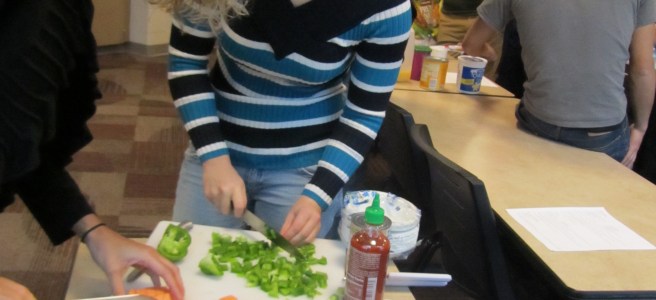
For a regular shared dinner, teamwork is essential, because meal-making cannot simply all fall on one person’s shoulders. Our daughter was nine when I went back to work full time. She was already setting the table each night before dinner, and my husband was helping with kitchen clean-up after dinner, so it was only natural to build on that involvement. When I got home from work and readied dinner, our daughter set the table as before. As she got older, she often undertook age-appropriate preparation tasks with me in the kitchen. After the meal, I was formally excused from any further work. I like to think of it as the 5-D plan: dad, daughter, and dog doing dishes. Dad rinsed the dishes, our daughter put them in the dishwasher, and our black lab joyfully licked them each for good measure. Over the years, this time of shared father-daughter kitchen duty helped them build a vibrant, laughter-filled (most times at my expense), and wonderfully joy-filled relationship. They shared music, jokes, and news of the day. They teased. They snuck extra dessert. It provided this father-daughter duo the opportunity to work together and create a sense of collusion in “mom’s” kitchen that gave them glee. It also helped our daughter begin to learn the value of saving leftovers by having to sort them into containers, prep them for lunches the following day, and creatively think about other ways the food could be combined and prepared for additional meals. It was good practice, and today she is a marvelously creative young cook who entertains on a shoestring budget, having learned early that sharing food- its preparation, consumption, and clean-up- is a rich and happy exercise in what it means to be fully human.

This post is intentionally short.  At this point, I encourage you to really think and pray about ways to MAKE a nightly family meal happen…without stress.  This usually involves INTENTION.  PLANNING.  MENU-MAKING.  It is a WHOLE-FAMILY RESPONSIBILITY.  This week, write down some ways you and your family can come together around a nutritious and comforting meal most nights of the week.

Post 47 will begin to lay out some ground rules!

~Julie A.P. Walton, Ph.D.


45. Disrupted Family Time, Or, Just How Many Subs Can You Eat in a Week?

Well, you have to start somewhere, and taking a long, honest look at the disruptive schedule is a good and necessary first step. I wrote earlier of my belief that our children today are overscheduled and their lives over-managed by parents. While it may sound harsh, the more we schedule our children into adult-led structured activities outside the home, the less time they have for creative free play, learning the joy and discipline of solitary studiousness,[1] and developing the ability to resolve their own differences. When they get home too late in the day, they are often over-tired and over-stimulated, and low blood glucose makes them cranky. What’s more, today’s children live in an increasingly unstable world, including unstable families, and family instability is unhealthy at any age.[2] A shared family meal on a near-daily basis can go a long way in providing children with what they most need from their family: safety, face-time, encouragement, down-time, comfort, discipline, mentoring, and yes, even the predictability of structure, including set times for meals, homework, prayer, and lights out. Research clearly shows that children of families who frequently share meals at home actually perform better academically.[3] [4]. This is because children thrive on the dependability a structured family time affords, and truly benefit from the regular chance for practicing conversation, story-telling, shared prayer, and listening skills. Furthermore, as communication technology becomes increasingly ubiquitous, face time has become imperiled. Meals create opportunities for face-to-face exchange of ideas when the life of the family takes precedence, and the texting and phone calls are temporarily banned.

So, we probably can all agree that shared family time is critically important in a child’s development, and that because we all have to eat, a family meal is an ideal place to come together. But, our shared dinner hours are difficult to make happen. I believe that sports participation is the second most common cause of fractured family time at the dinner hour, the first being when all adults in the family work full time outside the home, or one or both parents’ work requires frequent travel or shift work.[5]   At some point, you may have to admit that it is not necessary or healthy, for your younger children especially, to participate in sports on a year-round basis. When we get caught up in travel teams, twice-weekly lessons with a pro, and hiring a special sports trainer for out-of-season conditioning for our 10 year-olds, we have stepped over a line in most cases, and we have done so at the real peril of regular, intentional family time. It is important for parent and child alike to learn that no one family member’s activities should consistently dictate the entire family’s schedule and routine.

Try to find several days each week when every family member is expected to be home for dinner at a reasonable predetermined time. Teenagers with work and school obligations will need to negotiate nights off from the family meal commitment, but should not be allowed to assume that their presence at the table isn’t important on a regular basis; while it is critical at this age for teens to begin to learn about the privilege of independence, they must not forsake their place in, and obligations to the family either.

In post #46 we will continue to look at ways to get a family meal on the table in these hectic times.  PLEASE!  If you like what you are reading, share this blog with friends at church.  Leave your suggestions and comments in the LEAVE a REPLY box below.

~Julie A.P. Walton, Ph.D.

[1]a very under-developed characteristic in my college students

[2] Susan Fiske, “The Spiritual Costs of the Missing Family,” By Faith Magazine 34 (Winter 2011): p.29.

[3] Catherine E. Snow, Unfulfilled Expectations: Home and School Influences on Literacy (Cambridge, MA: Harvard University Press, 2000).

[4] Sharon M Fruh et al, “The Surprising Benefits of the Family Meal,” The Journal for Nurse Practitioners 7, no. 1 (2011): 18-22.

[5] As a child-athlete myself, and the spouse and parent of child-athletes, I do not pick on sports with random disdain. The ramped-up nature of the sporting world has made indelible marks on Christian families that we ignore to our peril, and we need to start and continue serious ongoing theological reflection and discussion in Christian circles of the true and rightful place of sports in a child’s and family’s life. The same can be said for any other extra-curricular activity.

Featured Image Credit: http://edacious1.blogspot.com/2008/06/good-eating-at-ball-park.html


44. Tricky Balance:Food Idolatry vs Quick, We Need to Eat!

Actually, food preparation is an important concept to think about. We are currently experiencing a rash of new writings about food- what constitutes real food, why fast food threatens our health and way of life, why we should consider eating only locally grown foods, and why the planet cannot sustain food production for the anticipated population of nearly nine billion people worldwide by 2050. The latter chapters of this book attempt to address our individual connection and ease of access to food in the United States with issues of food and water scarcity in much of the rest of the world. For now, suffice it to say that our present national attention to food is, perhaps, overindulgent, and a fascinating study in human nature. On the one hand, we idolize food and nearly make food practice a religion. Food critics, cable cooking shows, and internet bloggers remind us that the world of food has its own language and rules, where food takes on godlike characteristics. On the other hand, such obsession-compulsion and misplaced fidelity is contradicted by a post-modern and relatively mainstream insistence that food be characterized, above all else, by convenience. We don’t have time to fuss over food, and we just want something to mollify our hunger. Somewhere in this dilemma, most of us find ourselves having to work very hard to find middle ground. We want to provide healthy food for ourselves and our families, and wish we could enjoy it together more often.

Unless you have hired help, procuring, storing, and preparing food is a necessity that someone in the home must meet on a consistent basis. Because nutritional needs across the age span can only be met by regular consumption of a variety of healthy foods, we need to understand the importance of the roles of planning menus, buying food, keeping ingredients on hand, and making time and space for preparing food in ways that are appetizing, wholesome, and, yes, even convenient. What’s more, most of us need to do this on a tight budget.

More often than not, this obligation falls to the adult women of a household, but more and more, men are taking an active role in a family’s food needs. One of my colleagues is a single father with two elementary school-aged daughters. The three of them have a routine for the four nightly meals they share each week. On Mondays after school, they go together to the grocery store. Each girl plans the menu for one meal and dad plans two. They walk and talk themselves through the store, picking out the ingredients they need for their planned meals. Once home, they work together in the kitchen to put foods away and begin the evening meal prep. It is not unusual for some of the girls’ friends to stay for a meal with this little family. Each meal begins with prayer, and dad intentionally guides the conversation around biblical stories and themes while having the girls replay the day’s events. My colleague says that this activity of planning, shopping for, making and sharing meals has bonded the three of them together like nothing else they do. In the process, the girls are learning to shop and compare prices, consider substitutes, store and prepare food, and entertain friends in their home over a shared meal.

No matter who sees to the food provision in your home, that person must be well-versed in the age-appropriate nutritional needs, within budgetary limits, of all of the family members being fed. And, if time is tight, it is a job that requires planning, discipline and creative thinking. In Post #45 we will begin to address where to start.

~Julie A.P. Walton, Ph.D.

Photo credit:  K. Luymes